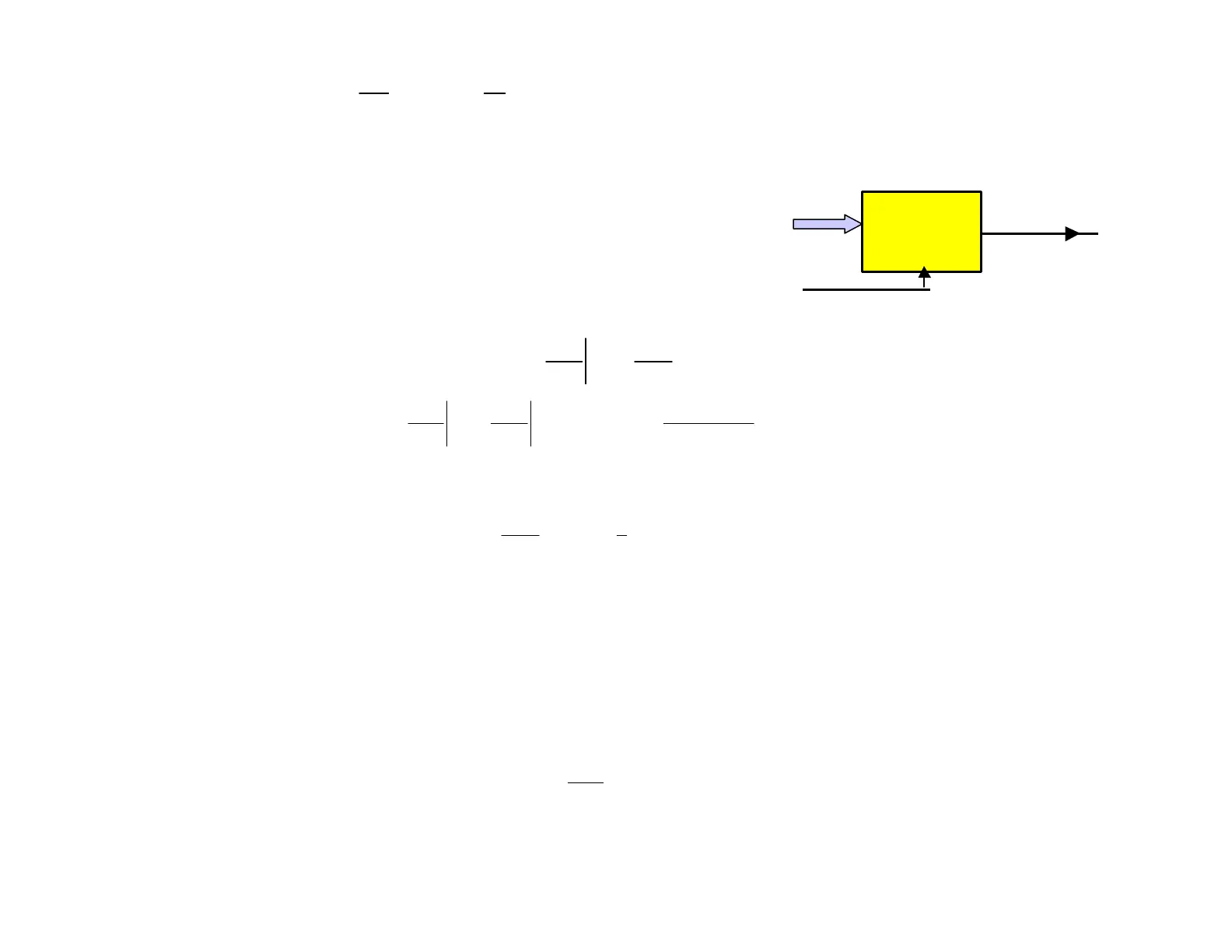
Consider a 3-bit D/A converter in which V
ref
= 4 V, with the following measured voltage values:
{ 0.011 : 0.507 : 1.002 : 1.501 : 1.996 : 2.495 : 2.996 : 3.491 }
1. Find the offset and gain errors in units of LSBs.
2. Find the INL (endpoint) and DNL errors (in units of LSBs).
3. Find the effective number of bits of absolute accuracy.
4. Find the effective number of bits of relative accuracy.
We first note that 1 LSB corresponds to V
ref
/2
3
= 0.5 V.
1. Since that offset voltage is 11 mV, and since 0.5 V corresponds to 1 LSB, we see that the offset error is given by
For the gain error, from (11.25) we have
2. For INL and DNL errors, we first need to remove both offset and gain errors in the measured D/A values. The offset error is removed by
subtracting 0.022 LSB off each value, whereas the gain error is eliminated by subtracting off scaled values of the gain error. For example,
the new value for 1.002 (scaled to 1 LSB) is given by
Thus, the offset-free, gain-free, scaled values are given by
{ 0.0 : 0.998 : 1.993 : 2.997 : 3.993 : 4.997 : 6.004 : 7.0 }
Since these results are in units of LSBs, we calculate the INL errors as the difference between these values and the ideal values, giving us
INL errors : { 0 : -0.002 : -0.007 : -0.003 : -0.007 : -0.003 : 0.004 : 0 }
For DNL errors, we find the difference between adjacent offset-free, gain-free, scaled values to give
DNL errors: { -0.002 : -0.005 : 0.004 : -0.004 : 0.004 : 0.007 : -0.004 }
3. For absolute accuracy, we find the largest deviation between the measured values and the ideal values, which, in this case, occurs at 0 V
and is 11 mV. To relate this 11-mV value to effective bits, 11 mV should correspond to 1 LSB when V
ref
= 4 V. In other words, we have
the relationship
which results in an absolute accuracy of N
abs
= 8.5 bits.
4. For relative accuracy, we use the INL errors found in part 2, whose maximum magnitude is 0.007 LSB, or equivalently, 3.5 mV. We relate
this 3.5-mV value to effective bits in the same manner as in part 3, resulting in a relative accuracy of N
rel
= 10.2 nits.
Solution
LSB022.0
5.0
011.0
0...0V
V
E
LSB
out
)A/D(off
===
LSB04.0)12(
5.0
011.0491.3
)12(
0...0V
V
1...1V
V
E
3N
LSB
out
LSB
out
)A/D(gain
−=−−
−
=−−
−=
993.1)04.0(
7
2
022.0
5.0
002.1
=
+−
mV11
V4
eff
N
=
Example 2.
NN
ref
LSB
1
LSB1,
V
V ==
D/A
V
in
V
ref
V
out


 To Next Page