3/24/97 3-6 XA Memory Organization
3.4.3 Use and Read/Write Access
Data memory is defined as read-write, and is intended to contain read/write data. It is logically
impossible to execute instructions from XA Data Memory. It is possible, and a common practice,
to add logic to overlap external code and data memory spaces. In this case it is important to
understand that the memory spaces are logically separate. In such a modified Harvard
architecture, implemented with external logic, it is possible –but not recommended– to write
self-modifying XA code. No such overlap is possible for internal data memory.
3.4.4 Data Memory Addressing
XA data memory addressing is optimized for the needs of embedded processing. Data memory
in the XA is divided into 64K byte segments. This provides an intrinsic protection mechanism
for multitasking applications and improves performance by requiring fewer address bits for
localized accesses.
Addressing through Segment Registers
Segment registers provide the upper 8 address bits needed to obtain a complete 24-bit address in
applications that require full use of the XA 16 Mbyte address space. Two segment registers are
defined in the XA architecture for use in accessing data memory, the Data Segment Register
(DS), and the Extra Segment Register (ES). As user stacks are located in the segment specified
by DS, it is probably most convenient to address user data structures through ES. Each pointer
register, namely R0 through R6, is associated with one of the segment registers via the Segment
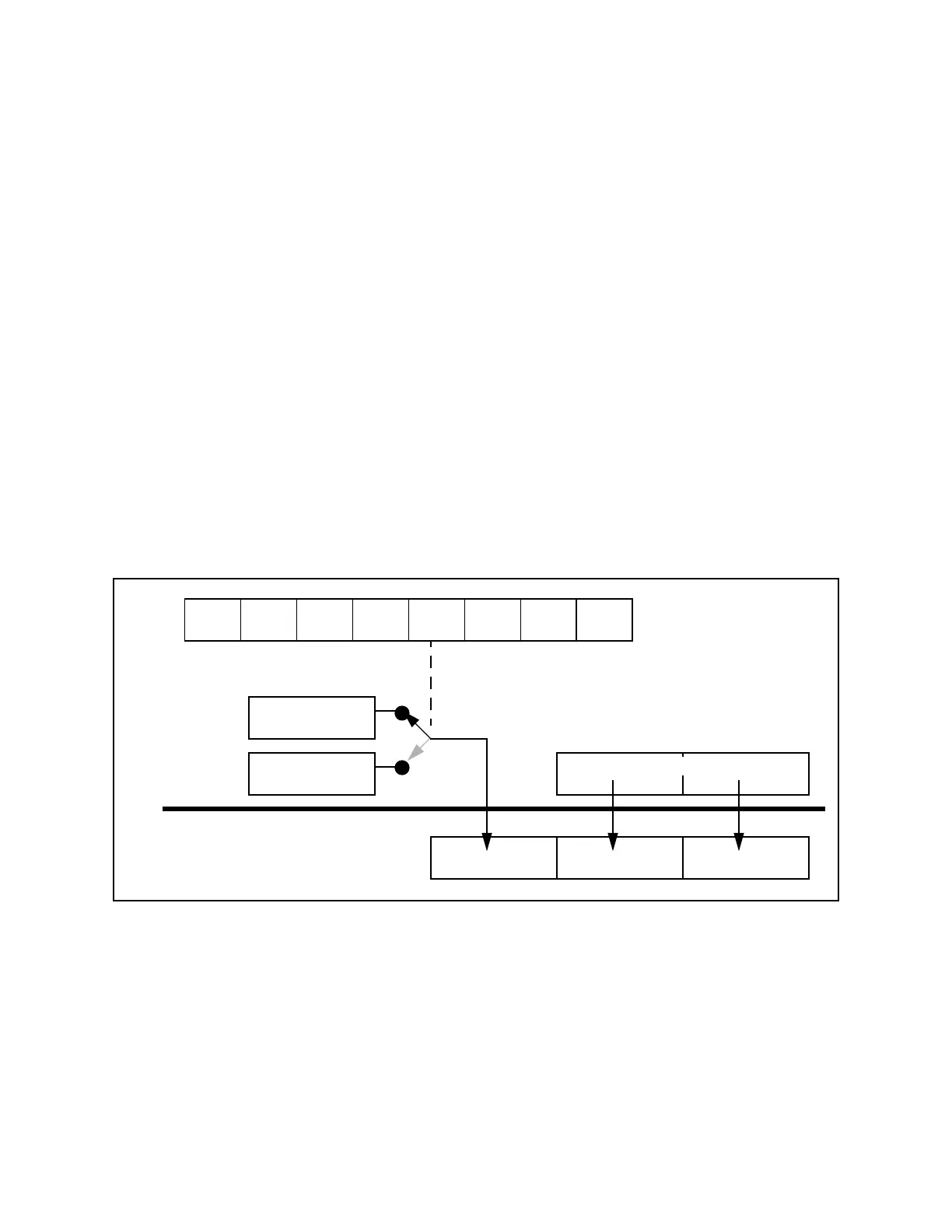
Select (SSEL) register as illustrated in Figure 3.5.
A 0 in the SSEL bit corresponding to the pointer register selects DS (default on RESET) and 1
selects the ES. For example, when R3 contains a pointer value, the full 24 bit address is formed
by concatenating DS or ES, as determined by the state of SSEL bit 3, as the most significant
8 bits. As a consequence of segmented addressing, the XA data memory space may be viewed as
256 segments of 64K bytes each (Figure 3.6).
Figure 3.5 Address generation
SSEL
ESWEN
R6SEG R5SEG R4SEG R3SEG R2SEG R1SEG
DS
ES R3
complete
24-bit memory
address
segment
registers
8-bit segment
identifier
16-bit segment offset
0
1
R0SEG


 To Next Page