3/24/97 3-8 XA Memory Organization
Bit-level. Bit-level addresses are absolute references to specific bits.
Data move instructions and some special purpose instructions also have additional data
addressing modes as described in Chapter 6.
Indirect Addressing
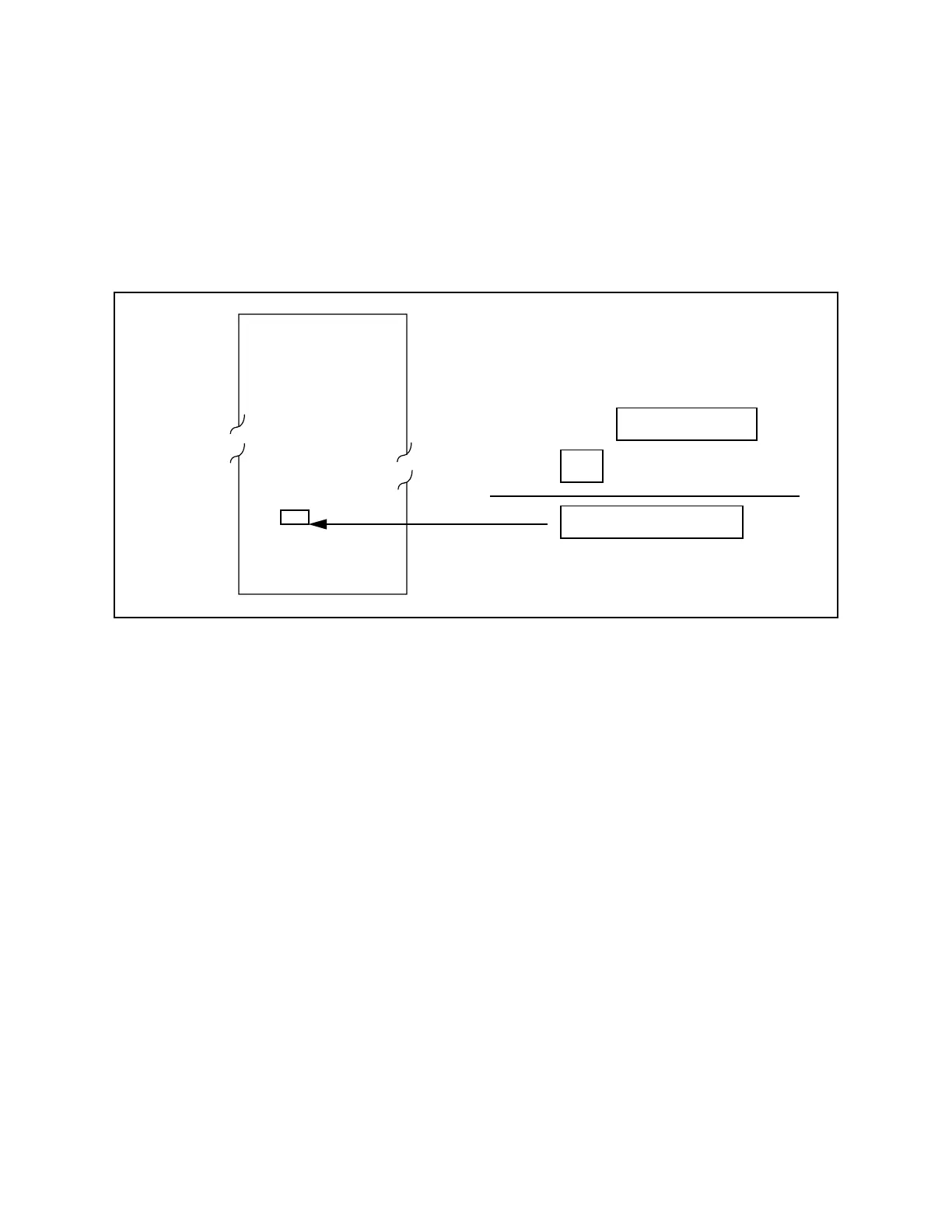
The entire 16 MByte address space is accessible via register-indirect addressing with a segment
register, as illustrated by Figure 3.7 (Note that for simplicity, this figure omits showing how the
Extra Segment or Data Segment Register is chosen using SSEL.).
Indirect addressing with an offset is a variant of general indirect addressing in which an 8-bit or
16-bit signed offset contained within the instruction is added to the contents of a pointer register,
then concatenated with an 8-bit segment register to produce a complete address. This mode gives
access to data structures when a pointer register contains the starting address of the structure. It
also supports stack-based parameter passing.
Indirect addressing with autoincrement is another variant of indirect addressing in which the
pointer register contents are automatically incremented following the operation. When the
operand is a byte, the increment is one; when the operand is a word, the increment is 2. Using
indirect addressing with auto-increment provides a convenient method of traversing data
structures smaller than 64K bytes. For data structures exceeding 64K bytes in length, the
program code must explicitly adjust the segment register at page boundaries.
Address generation in these two modes of indirect addressing is illustrated inFigures 3.8 and 3.9.
When using indirect addressing care is necessary to avoid accessing a word quantity at an odd
address. This will result in an access using the next-lower even address, which is generally not
desirable. Note that the indirect addressing with an offset will be successful in this case as long
as the final, effective address is even. That is, both the base address and the offset may be odd.
Figure 3.7 Indirect Access to 24 Bit Address Space
0
FFFFFFh
Rn
16 bits
Seg
Reg
+
8 bits
24 bit address


 To Next Page