80C187
Numeric Operands
A typical NPX instruction accepts one or two oper-
ands and produces one (or sometimes two) results.
In two-operand instructions, one operand is the con-
tents of an NPX register, while the other may be a
memory location. The operands of some instructions
are predefined; for example, FSQRT always takes
the square root of the number in the top stack ele-
ment (refer to the section on Data Registers).
Register Set
Figure 2 shows the 80C187 register set. When an
80C187 is present in a system, programmers may
use these registers in addition to the registers nor-
mally available on the CPU.
DATA REGISTERS
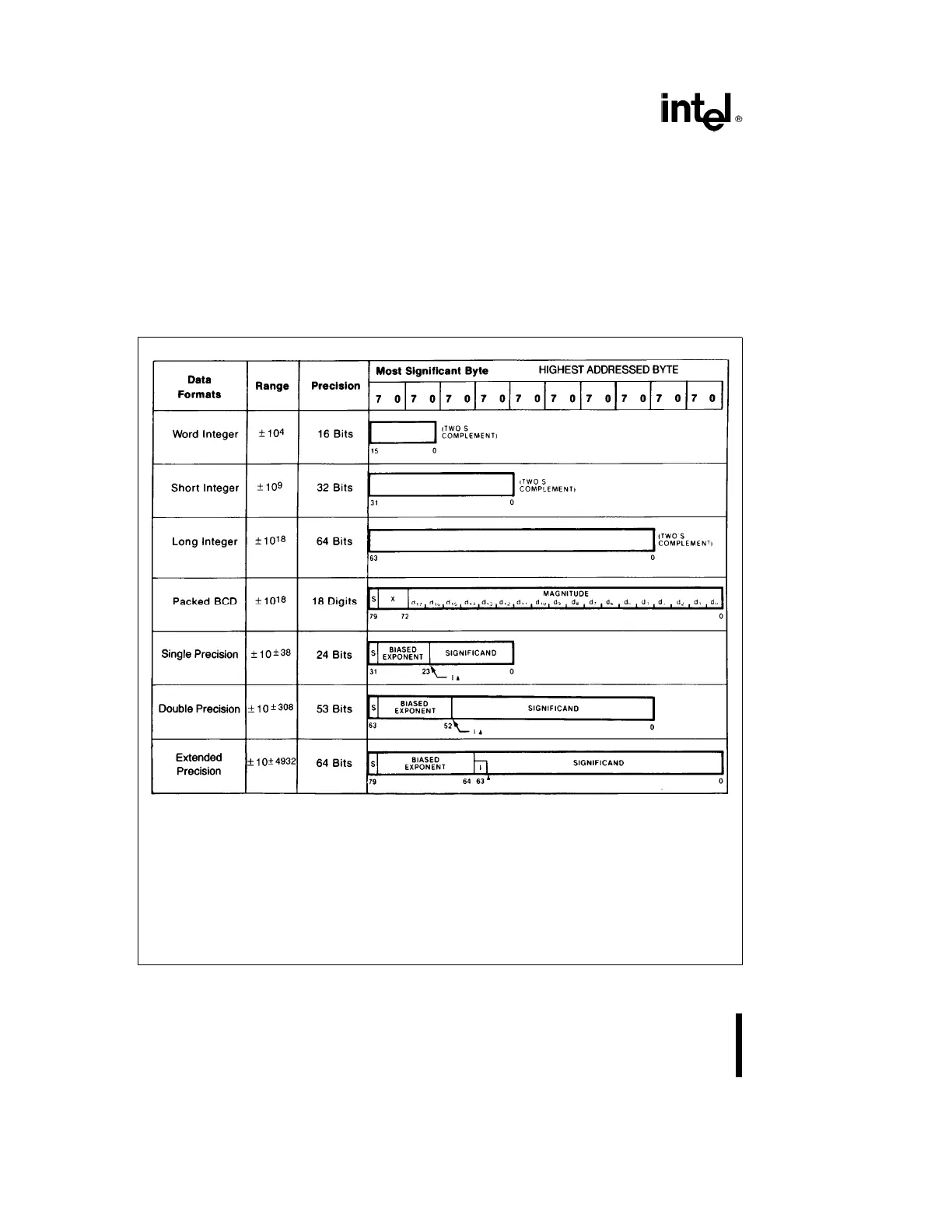
80C187 computations use the extended-precision
real data type.
Table 1. Data Type Representation in Memory
270640–2
NOTES:
1. S
e
Sign bit (0
e
Positive, 1
e
Negative)
2. d
n
e
Decimal digit (two per byte)
3. X
e
Bits have no significance; 80C187 ignores when loading, zeros when storing
4.
U
e
Position of implicit binary point
5. I
e
Integer bit of significand; stored in temporary real, implicit in single and double precision
6. Exponent Bias (normalized values):
Single: 127 (7FH)
Double: 1023 (3FFH)
Extended Real: 16383 (3FFFH)
7. Packed BCD: (
b
1)
S
(D
17
...D
0
)
8. Real: (
b
1)
S
(2
E-BIAS
)(F
0
,F
1
...)
4


 To Next Page