AP-578
2/21/97 12:57 PM 24329102.DOC
INTEL CONFIDENTIAL
(until publication date)
2. Alternatively, a software exception handler can
be invoked to handle the exception. When a
numeric exception is unmasked and the
exception occurs, the FPU stops further
execution of the numeric instruction and
causes a branch to a software exception
handler. The exception handler can then
implement any sort of recovery procedures
desired for any numeric exception detectable
by the FPU.
3.1.2 AUTOMATIC EXCEPTION HANDLING:
USING MASKED EXCEPTIONS
Each of the six exception conditions described
above has a corresponding flag bit in the FPU
status word and a mask bit in the FPU control word.
If an exception is masked (the corresponding mask
bit in the control word = 1), the processor takes an
appropriate default action and continues with the
computation. The processor has a default fix-up
activity for every possible exception condition it
may encounter. These masked-exception
responses are designed to be safe and are
generally acceptable for most numeric applications.
For example, if the Inexact result (Precision)
exception is masked, the system can specify
whether the FPU should handle a result that cannot
be represented exactly by one of four modes of
rounding: rounding it normally, chopping it toward
zero, always rounding it up, or always down. If the
Underflow exception is masked, the FPU will store
a number that is too small to be represented in
normalized form as a denormal (or zero if it’s
smaller than the smallest denormal). Note that
when exceptions are masked, the FPU may detect
multiple exceptions in a single instruction, because
it continues executing the instruction after
performing its masked response. For example, the
FPU could detect a denormalized operand, perform
its masked response to this exception, and then
detect an underflow.
As an example of how even severe exceptions can
be handled safely and automatically using the
default exception responses, consider a calculation
of the parallel resistance of several values using
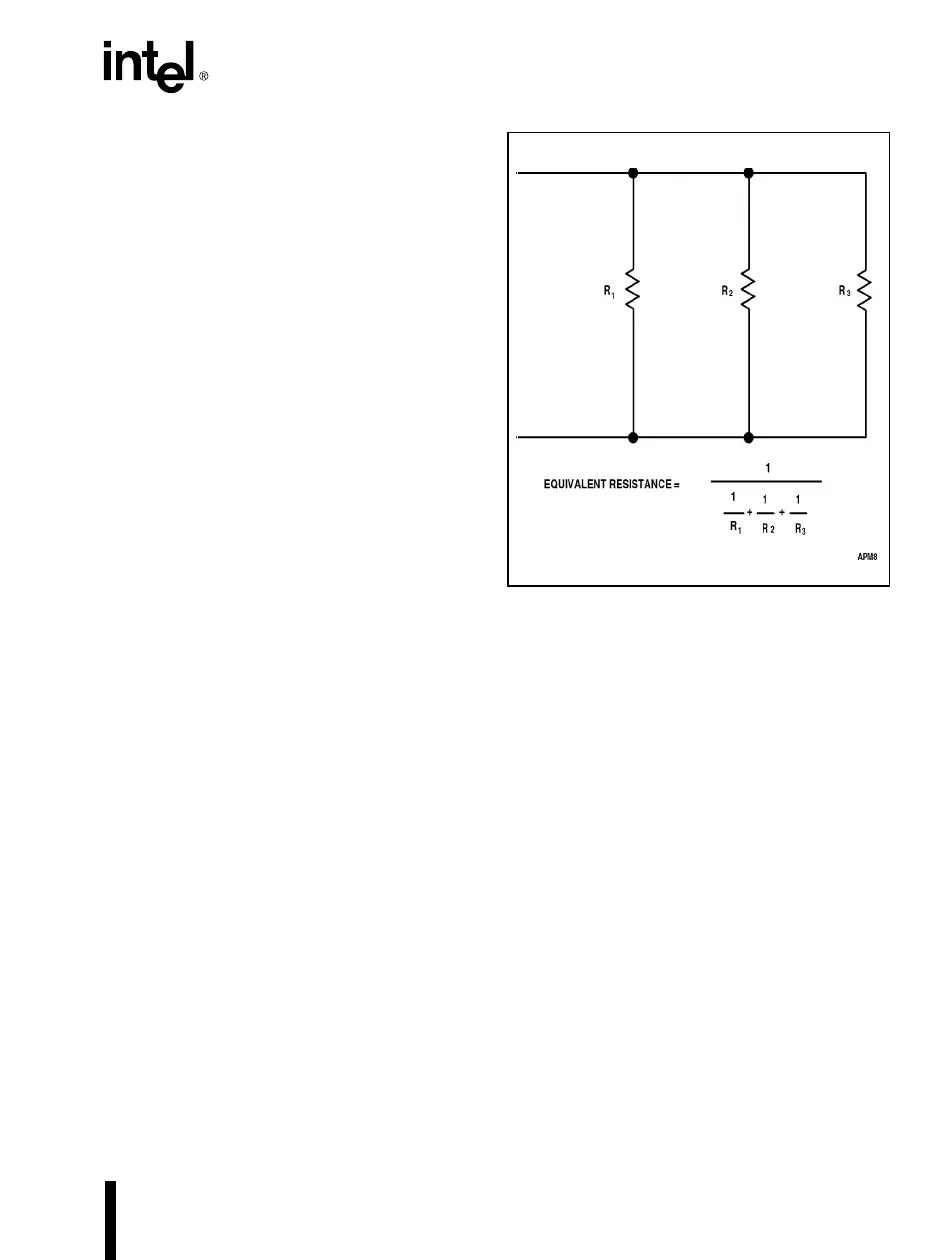
only the standard formula (Figure 4). If R1 becomes
zero, the circuit resistance becomes zero. With the
divide-by-zero and precision exceptions masked,
the processor will produce the correct result. FDIV
of R1 into 1 gives infinity, and then FDIV of (infinity
+R2 +R3) into 1 gives zero.
Figure 4. Arithmetic Example Using Infinity
By masking or unmasking specific numeric
exceptions in the FPU control word, programmers
can delegate responsibility for most exceptions to
the processor, reserving the most severe
exceptions for programmed exception handlers.
Exception-handling software is often difficult to
write, and the masked responses have been
tailored to deliver the most reasonable result for
each condition. For the majority of applications,
masking all exceptions yields satisfactory results
with the least programming effort. Certain
exceptions can usefully be left unmasked during the
debugging phase of software development, and
then masked when the clean software is actually
run. An invalid-operation exception for example,
typically indicates a program error that must be
corrected.
The exception flags in the FPU status word provide
a cumulative record of exceptions that have
occurred since these flags were last cleared. Once
set, these flags can be cleared only by executing
the FCLEX/FNCLEX (clear exceptions) instruction,
by reinitializing the FPU with FINIT/FNINIT or
FSAVE/FNSAVE, or by overwriting the flags with an
FRSTOR or FLDENV instruction. This allows a
programmer to mask all exceptions, run a
calculation, and then inspect the status word to see


 To Next Page