AP-578
2/21/97 12:57 PM 24329102.DOC
INTEL CONFIDENTIAL
(until publication date)
Intel486
,
Pentium
®
, or
Pentium Pro
processor
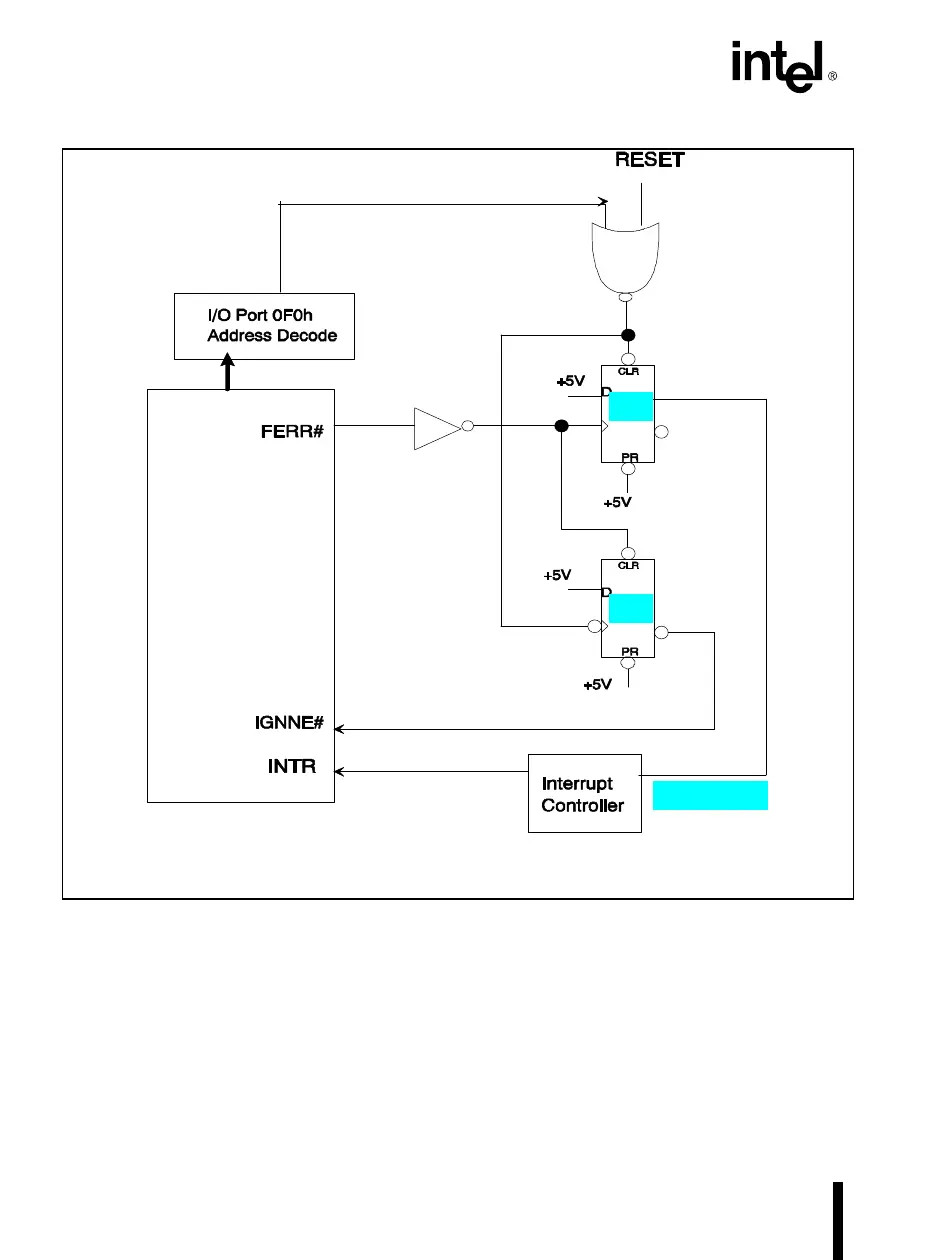
FF #1
FF #2
FP_IRQ
LEGEND
FF #n: Flip Flop #n
CLR: Clear or reset
Figure 1. Recommended Circuit for MS-DOS* Compatible FPU Exception Handling
the FPU exception condition (which de-asserts
FERR#). However, the circuit does not depend on
the order of actions by the FPU exception handler
to guarantee the correct hardware state upon exit
from the handler. The flip flop which drives IGNNE#
to the processor has its CLEAR input attached to
the inverted FERR#. This ensures that IGNNE# can
never be active when FERR# is inactive. So if the
handler clears the FPU exception condition before
the 0F0H access, IGNNE# does not get activated
and left on after exit from the handler.
2.3.3 “NO-WAIT” FPU INSTRUCTIONS CAN
GET FPU INTERRUPT IN WINDOW
The Pentium and the Intel486 processors
implement the “No-Wait” Floating-Point instructions
(FNINIT, FNCLEX, FNSTENV, FNSAVE, FNSTSW,
FNSTCW, FNENI, FNDISI or FNSETPM - See
Section 6.3.7 in the Pentium
®
Processor Family
Developer's Manual, Volume 3) in the MS-DOS
Compatibility mode (CR0.NE = 0) in the following
manner:


 To Next Page