AP-578
2/21/97 12:57 PM 24329102.DOC
INTEL CONFIDENTIAL
(until publication date)
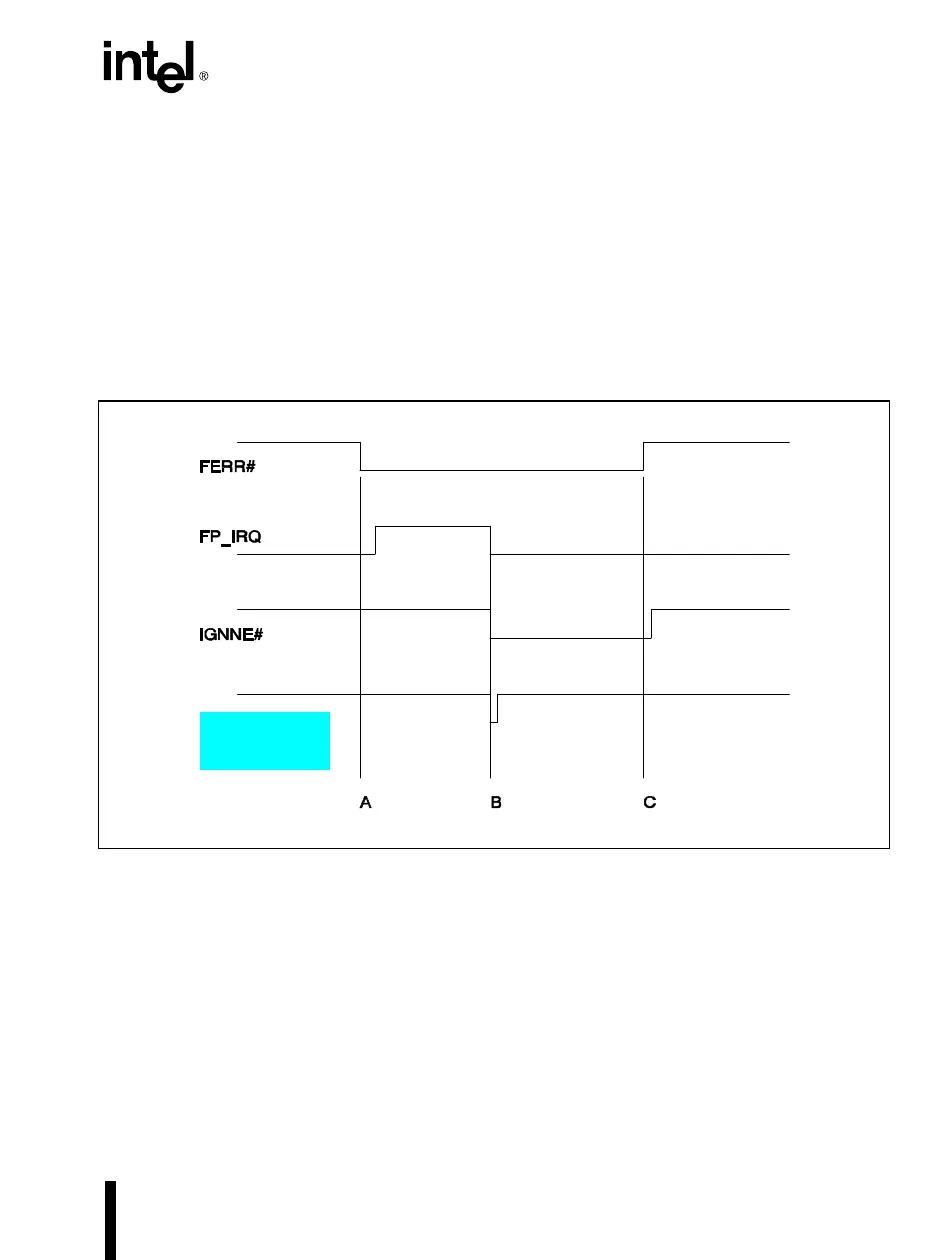
If an unmasked numeric exception is pending from
a preceding FPU instruction, a member of the “No-
Wait” class of instructions will, at the beginning of
its execution, assert the FERR# pin in response to
that exception just like other FPU instructions, but
then, unlike the other FPU instructions, FERR# will
be de-asserted. This de-assertion was implemented
to allow the “No-Wait” class of instructions to
proceed without an interrupt due to any pending
numeric exception. However, the brief assertion of
FERR# is sufficient to latch the FPU exception
request into most hardware interface
implementations (including Intel’s recommended
circuit).
All the FPU instructions are implemented such that
during their execution, there is a window in which
the processor will sample and accept external
interrupts. If there is a pending interrupt, the
processor services the interrupt first before
resuming the execution of the instruction.
Consequently, it is possible that the “No-Wait”
Floating-Point instruction may accept the external
interrupt caused by it’s own assertion of the FERR#
pin in the event of a pending unmasked numeric
exception, which is not an explicitly documented
behavior of a “No-Wait” instruction. This process is
illustrated by Figure 3, which is followed by a
detailed description of the several cases possible.
0F0H Address
Decode
Figure 2. Behavior of Signals During FPU Exception Handling


 To Next Page