82C54
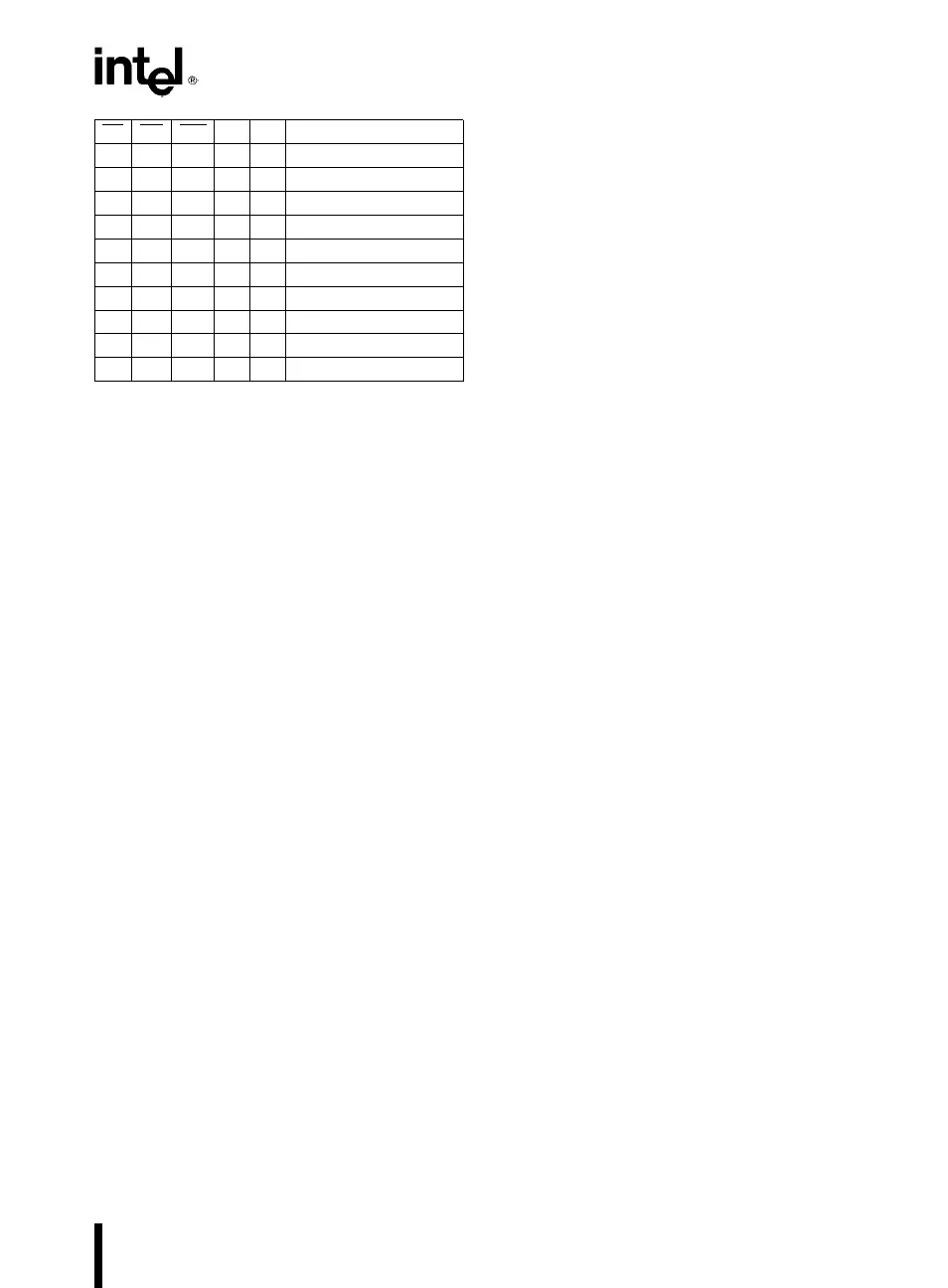
CS RD WR A
1
A
0
0 1 0 0 0 Write into Counter 0
0 1 0 0 1 Write into Counter 1
0 1 0 1 0 Write into Counter 2
0 1 0 1 1 Write Control Word
0 0 1 0 0 Read from Counter 0
0 0 1 0 1 Read from Counter 1
0 0 1 1 0 Read from Counter 2
0 0 1 1 1 No-Operation (3-State)
1 X X X X No-Operation (3-State)
0 1 1 X X No-Operation (3-State)
Figure 14. Read/Write Operations Summary
Mode Definitions
The following are defined for use in describing the
operation of the 82C54.
CLK PULSE: a rising edge, then a falling edge, in
that order, of a Counter’s CLK input.
TRIGGER: a rising edge of a Counter’s GATE in-
put.
COUNTER LOADING: the transfer of a count from
the CR to the CE (refer to
the ‘‘Functional Descrip-
tion’’)
MODE 0: INTERRUPT ON TERMINAL COUNT
Mode 0 is typically used for event counting. After the
Control Word is written, OUT is initially low, and will
remain low until the Counter reaches zero. OUT then
goes high and remains high until a new count or a
new Mode 0 Control Word is written into the Coun-
ter.
GATE
e
1 enables counting; GATE
e
0 disables
counting. GATE has no effect on OUT.
After the Control Word and initial count are written to
a Counter, the initial count will be loaded on the next
CLK pulse. This CLK pulse does not decrement the
count, so for an initial count of N, OUT does not go
high until N
a
1 CLK pulses after the initial count is
written.
If a new count is written to the Counter, it will be
loaded on the next CLK pulse and counting will con-
tinue from the new count. If a two-byte count is writ-
ten, the following happens:
1) Writing the first byte does not disable counting.
OUT is set low immediately (no clock pulse re-
quired).
2) Writing the second byte allows the new count to
be loaded on the next CLK pulse.
3) When there is a count in progress, writing a new
LSB before the counter has counted down to 0
and rolled over to FFFFh, WILL stop the counter.
However, if the LSB is loaded AFTER the counter
has rolled over to FFFFh, so that an MSB now
exists in the counter, then the counter WILL NOT
stop.
This allows the counting sequence to be synchroniz-
ed by software. Again, OUT does not go high until N
a
1 CLK pulses after the new count of N is written.
9


 To Next Page