Functional Description (Continued)
2.5 Errors and Reference Voltage Adjustments
2.5.1 Zero Error
The zero of the A/D does not require adjustment. If the mini-
mum analog input voltage value, V
IN(MIN)
, is not ground, a
zero offset can be done. The converter can be made to out-
put 0000 0000 digital code for this minimum input voltage by
biasing the A/D V
IN
(−) input at this V
IN(MIN)
value (see Appli-
cations section). This utilizes the differential mode operation
of the A/D.
The zero error of the A/D converter relates to the location of
the first riser of the transfer function and can be measured by
grounding the V
IN
(−) input and applying a small magnitude
positive voltage to the V
IN
(+) input. Zero error is the differ-
ence between the actual DC input voltage that is necessary
to just cause an output digital code transition from 0000 0000
to 0000 0001 and the ideal
1
⁄
2
LSB value (
1
⁄
2
LSB
=
9.8 mV
for V
REF
/2
=
2.500 V
DC
).
2.5.2 Full-Scale
The full-scale adjustment can be made by applying a differ-
ential input voltage that is 1
1
⁄
2
LSB less than the desired ana-
log full-scale voltage range and then adjusting the magni-
tude of the V
REF
/2 input (pin 9 or the V
CC
supply if pin 9 is
not used) for a digital output code that is just changing from
1111 1110 to 1111 1111.
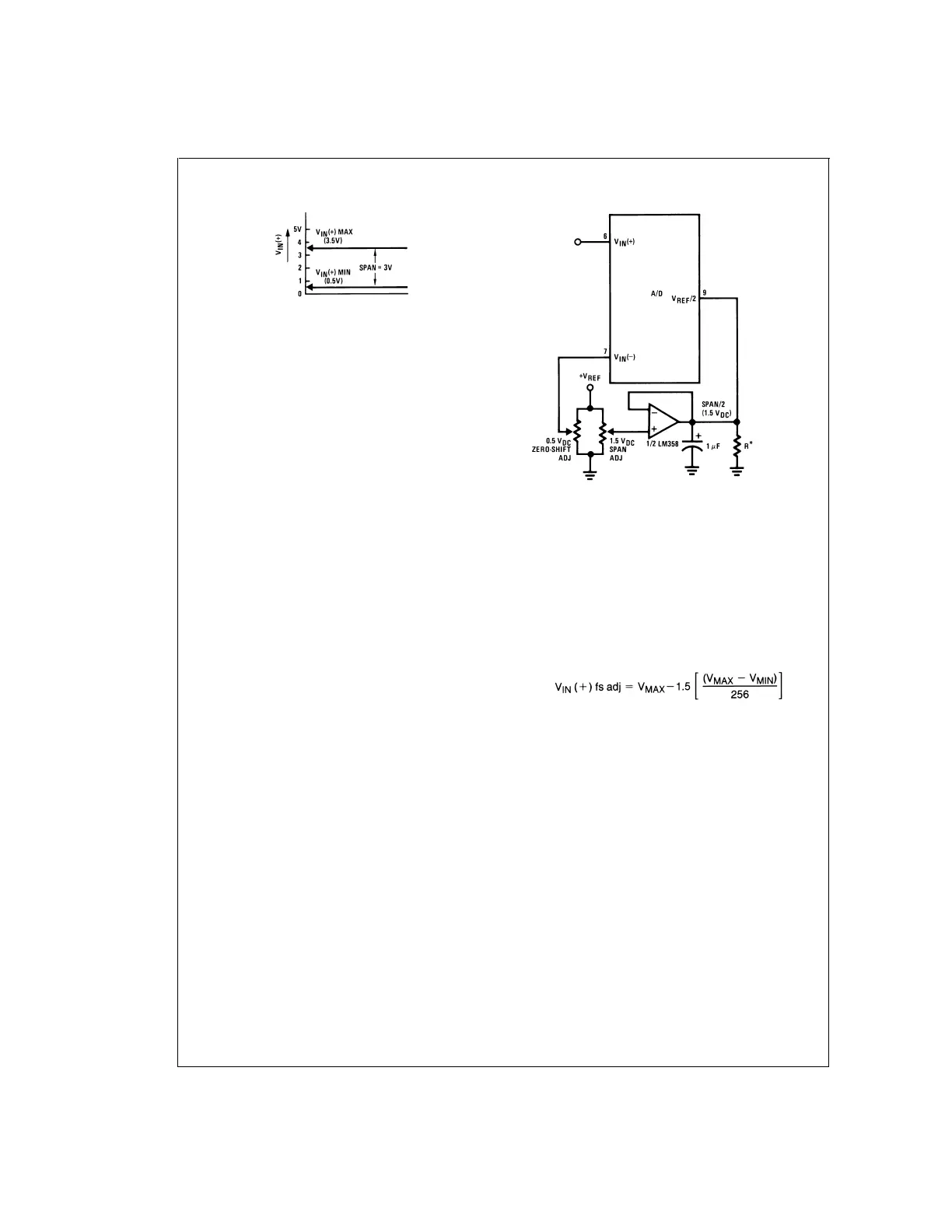
2.5.3 Adjusting for an Arbitrary Analog Input Voltage
Range
If the analog zero voltage of the A/D is shifted away from
ground (for example, to accommodate an analog input signal
that does not go to ground) this new zero reference should
be properly adjusted first. A V
IN
(+) voltage that equals this
desired zero reference plus
1
⁄
2
LSB (where the LSB is calcu-
lated for the desired analog span, 1 LSB
=
analog span/256)
is applied to pin 6 and the zero reference voltage at pin 7
should then be adjusted to just obtain the 00
HEX
to 01
HEX
code transition.
The full-scale adjustment should then be made (with the
proper V
IN
(−) voltage applied) by forcing a voltage to the
V
IN
(+) input which is given by:
where:
V
MAX
=
The high end of the analog input range
and
V
MIN
=
the low end (the offset zero) of the analog range.
(Both are ground referenced.)
The V
REF
/2 (or V
CC
) voltage is then adjusted to provide a
code change from FE
HEX
to FF
HEX
. This completes the ad-
justment procedure.
2.6 Clocking Option
The clock for the A/D can be derived from the CPU clock or
an external RC can be added to provide self-clocking. The
CLK IN (pin 4) makes use of a Schmitt trigger as shown in
Figure 8
.
DS005671-87
a) Analog Input Signal Example
DS005671-88
*
Add if V
REF
/2 ≤ 1V
DC
with LM358 to draw 3 mA to ground.
b) Accommodating an Analog Input from
0.5V (Digital Out
=
00
HEX
) to 3.5V
(Digital Out
=
FF
HEX
)
FIGURE 7. Adapting the A/D Analog Input Voltages to Match an Arbitrary Input Signal Range
ADC0801/ADC0802/ADC0803/ADC0804/ADC0805
www.national.com 22


 To Next Page