XA User Guide 6-4 4/17/98
6.2.3 Indirect-Offset Addressing
This addressing mode is just like the Register-Indirect addressing mode above except that an
additional displacement value is added to obtain the final effective address. Instructions using
this addressing mode contain a 16-bit address field and an 8 or 16-bit signed displacement field.
This field addresses 1 out of 8 pointer registers in the Register File that contains the 16-bit
address of the operand in any 64K data segment. The contents of the pointer register are added to
the signed displacement to obtain the effective address
3
(which must be even) of the operand.
For data the segment is identified by the 8-bit contents of DS or the ES and for code, by the 8-bit
contents of PC23-16 or CS as selected by the appropriate bit (SSEL.bit n = 0 selects DS and 1
selects ES for data and SSEL.bitn = 0 selects PC and 1 selects CS for code) in the segment select
register SSEL.
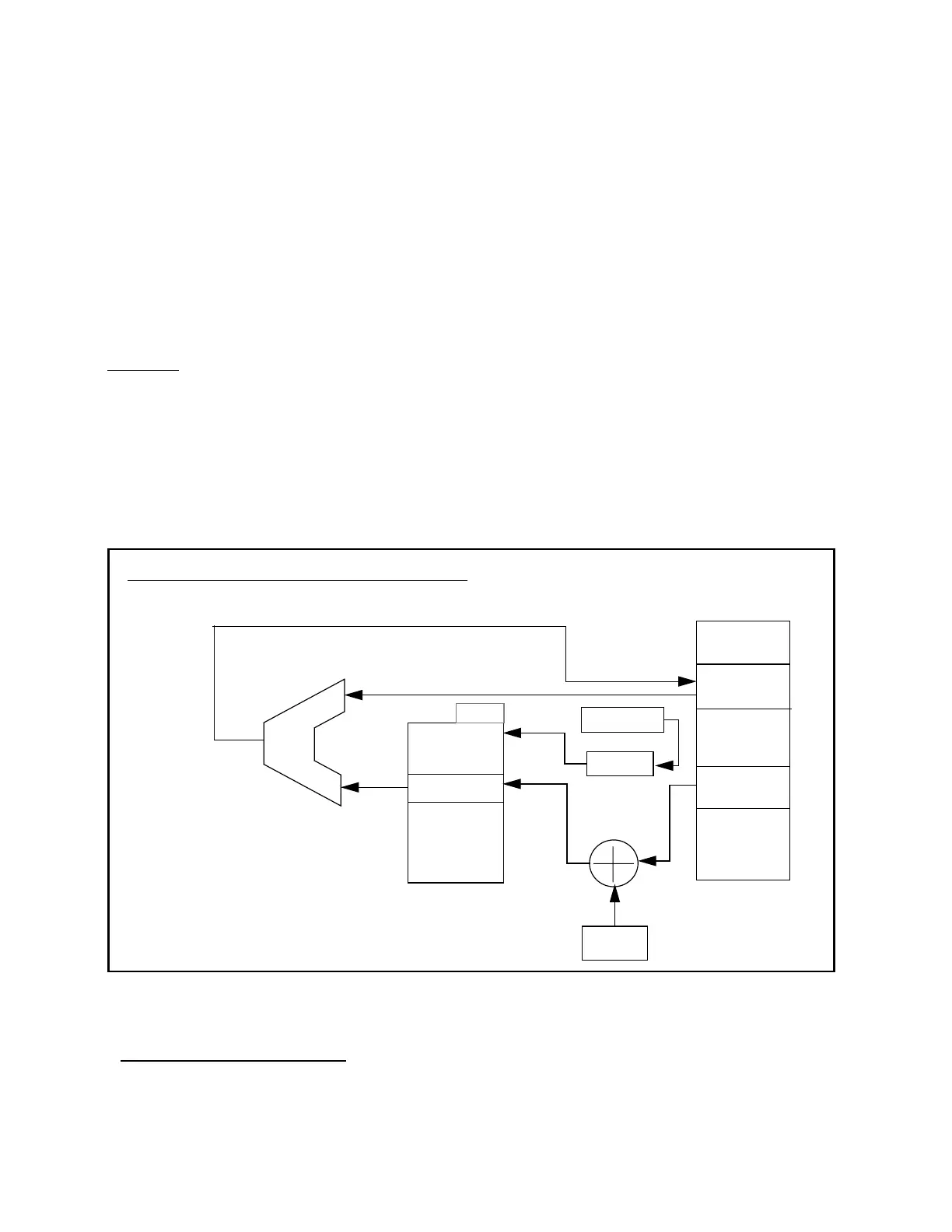
Example: ADD R5, [R3 +30h] Before: R3 contains C000h
SSEL.3 = 1 R5 contains 0065h
i.e., the operand is in Word at C030h = A540h
segment determined
by the contents of ES After: R3 contains C000h
So, if ES = 04, the R5 contains A5A5h
operand is in segment Word at C030h = A540h
4 of data memory.
Figure 6.3
3. In case of an odd address, the XA forces the operand fetch from the next lower even boundary
(address.bit0 = 0)
ALU
ADD R5, [R3+30]
0h
DATA MEMORY
REGISTER - INDIRECT WITH OFFSET
REGISTER FILE
C000h
DESTINATION
FFFFh
R5
POINTER
SSEL.3 = 1
ES = 4
Seg4
R3
0065h A5A5h
0030h
C030h
A540h


 To Next Page