4/17/98 6-7 Addressing Modes and Data Types
6.2.7 Bit Addressing
Instructions using the bit addressing mode contain a 10-bit field containing the address of the bit
operand. The XA supports three bit address spaces, which are encoded into the same format. The
spaces are: 256 bits in the register file (the entire active register file); 256 bits in the data memory
(byte addresses 20 through 3F hex on the current data segment); and 512 bits in the SFR space (byte
addresses 400 through 43F hex).
Bit addresses 0 to FF hex map to the register file, bit addresses 100 to 1FF hex map to data memory,
and bit addresses 200 to 3FF map to the SFR space.
A separate bit-addressable space (20-3F hex) in the direct-address data memory, exists for each
segment. The current working segment for the direct-address space being always identified by the
DS register.
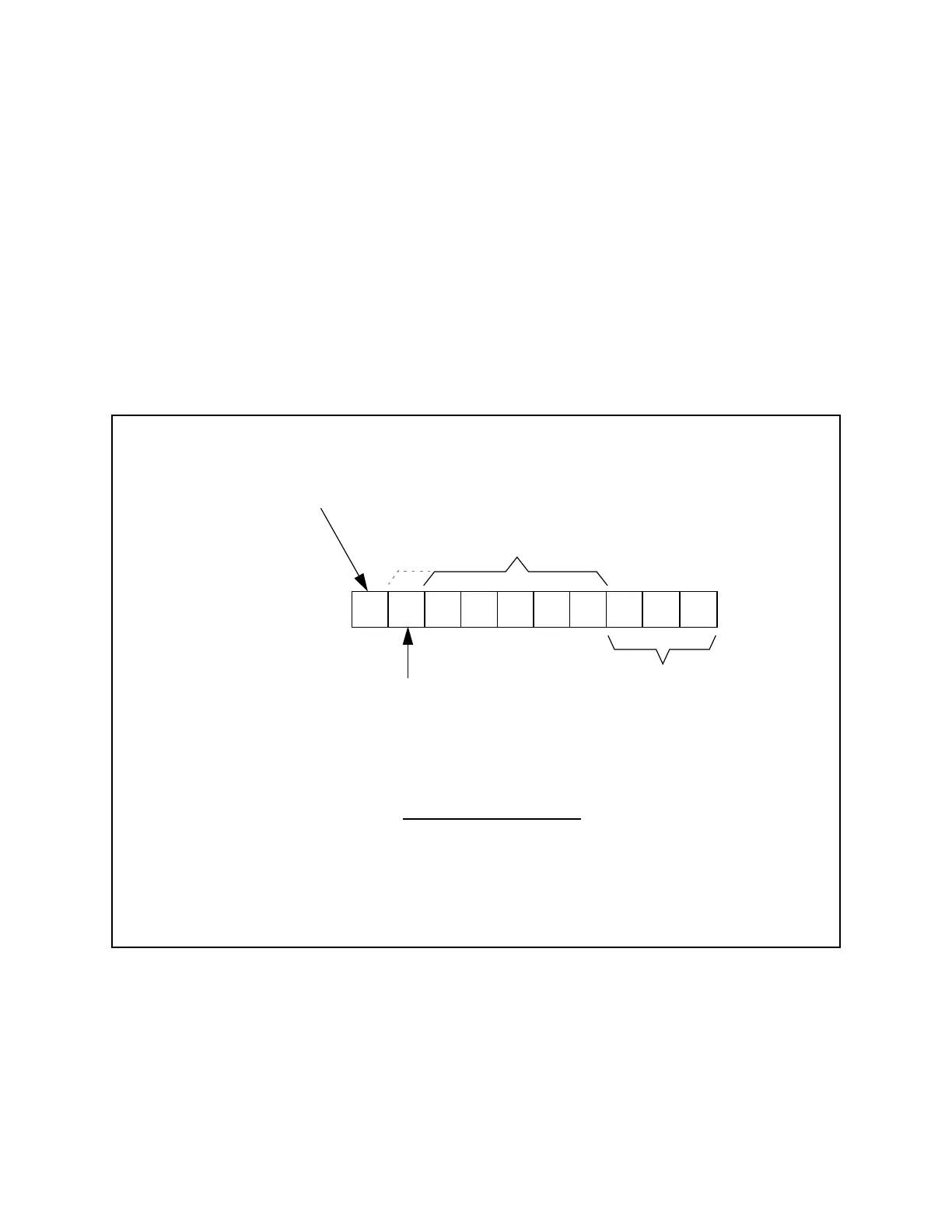
The encoding of the 10-bit field for bit addresses is as follows:
Figure 6.6
3-bit field identifies 1 of
8 bits in a byte.
This bit determines whether
the bit address is an SFR or
not (1 = SFR).
If not an SFR bit address, this bit
determines whether the bit address
is in the Register File or the data
memory (0 = Register file, 1 =
data memory).
5 or 6 bit field (6 bits
for an SFR) identifies
the byte that the
addressed bit resides
in.
Bit Address Encoding
9 8 7 6 5 4 3 2 1 0
Examples:
For a given data segment,
1 001100 010 = Bit 2 of an SFR at address 0Ch (i.e., 40Ch in the map)
0 001100 010 = Bit 2 of Register file at address 0Ch, i.e., R6L
0 101100 010 = Bit 2 of Data memory address 0Ch


 To Next Page