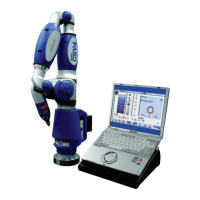
FARO Edge
September 2012
45
Chapter 3: Operation
computer. In a WLAN, a radio communications device called an access point, or
wireless router, connects network computers and provides network access. The
access point, or wireless router, and the wireless network card in the computer
communicate by broadcasting data from their antennas over the air waves.
The Edge WLAN is normally configured as a DHCP Client. Due to the nature of
an open air system, network security is very important. Before discussing Edge
WLAN setup, a brief WLAN Primer is presented.
WLAN Primer
An Edge node or station can connect to a WLAN that complies with the
IEEE 802.11g standard. The Wi-Fi Alliance (an industry group promoting
802.11 networks) has popularized the term Wi-Fi
®
for 802.11 compliant
networks. The term WLAN, refers to the slightly more generalized concept
of the wireless extension of a local area network (LAN), though in practice
most implementations use Wi-Fi technology.
The IEEE 802.11 standard specifies a Medium Access Control (MAC) and
physical layers (PHY) for wireless connectivity between stations (STAs). A
set of stations that have joined the same network have access to the same
network services. These services are called a Basic Service Set (BSS). Every
BSS has a unique 48-bit identifier called the Basic Service Set Identifier
(BSSID). The standard specifies two types of BSS; an Independent BSS
(IBSS), and an Infrastructure BSS (BSS).
There are several different PHY layers specified in IEEE 802.11. The Edge
uses 802.11g.
IEEE 802.11 further breaks up the 2.4 GHz frequency band into 14
overlapping channels. Each country in the world has its own rules and
regulations regarding radio usage. Many countries join together to
coordinate these regulations, forming “Regulatory Domains”. Most
European, Middle Eastern, North and South American, and African
countries, and Australia and Japan use the same regulations. However, there
are differences with regard to which channels and power levels are
permitted. The Edge can support all 14 channels - factory programming is
performed for the specific country where the Edge is to be used (this is not a
user option).
Independent BSS (IBSS)
An IBSS is used to form an Ad Hoc network between peer STAs. STAs
share responsibility for maintaining the IBSS and distributing data to each
other. IBSS is NOT supported for the Edge WLAN.
08M52E00_FaroArm_Edge.book Page 45 Thursday, October 4, 2012 9:31 AM



 To Next Page