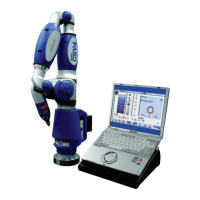
FARO Edge
September 2012
46
Chapter 3: Operation
Infrastructure BSS (BSS)
In an Infrastructure BSS there is one special STA called the Access Point
(AP). The AP is solely responsible for starting and maintaining the BSS and
admitting (or excluding) other STAs. The AP receives all traffic either bound
for or originating from every STA that it admits into its BSS. (Exception is
contained in IEEE 802.11e amendment for Quality of Service - a special
QoS BSS).
The STAs are known as Clients, the AP is known as a Server.
A Distribution System (DS) interconnects a set of APs to create an Extended
Service Set (ESS). The ESS is a super set of all member STAs. The DS
distributes data between ESS STAs. An ESS may include LANs (via a
gateway).
The simplest and most common configuration is to have an ESS that
includes exactly one AP. It is known as a Small Or Home Office (SOHO).
This is the intended configuration for the Edge Stations.
In an Infrastructure BSS, the AP broadcasts Beacon frames that announce
the identity and capabilities of its BSS.
Joining a WLAN
An STA joins a WLAN using a three-step process:
1 Scanning
2 Association
3 Authentication
Scanning
The STA generates a list of all BSSs (APs in the network) it can detect.
Association
In an Infrastructure BSS the Association process requires a frame exchange
between the joining STA and the selected AP. This frame includes the STA’s
capabilities. The AP will accept or deny the request (Association Response
Frame). The STA (Client) learns the BSSID (SSID - Service Set Identifier or
WLAN name) and AP MAC address. If the STA is accepted the AP will issue
an Association Identifier (AID - logical port) at this time.
Authentication
Apply Security - establish a secure wireless network. WPA2-Personal is
recommended for the FARO WLAN security (based on IEEE 802.11i and
Advanced Encryption Standard -AES). The password is the real key to
security!
08M52E00_FaroArm_Edge.book Page 46 Thursday, October 4, 2012 9:31 AM



 To Next Page