122 b EDN S
EPTEMBER 24, 1998
The 386 has disappeared from the desktop-PC market but has
developed a strong presence in embedded-PC applications.
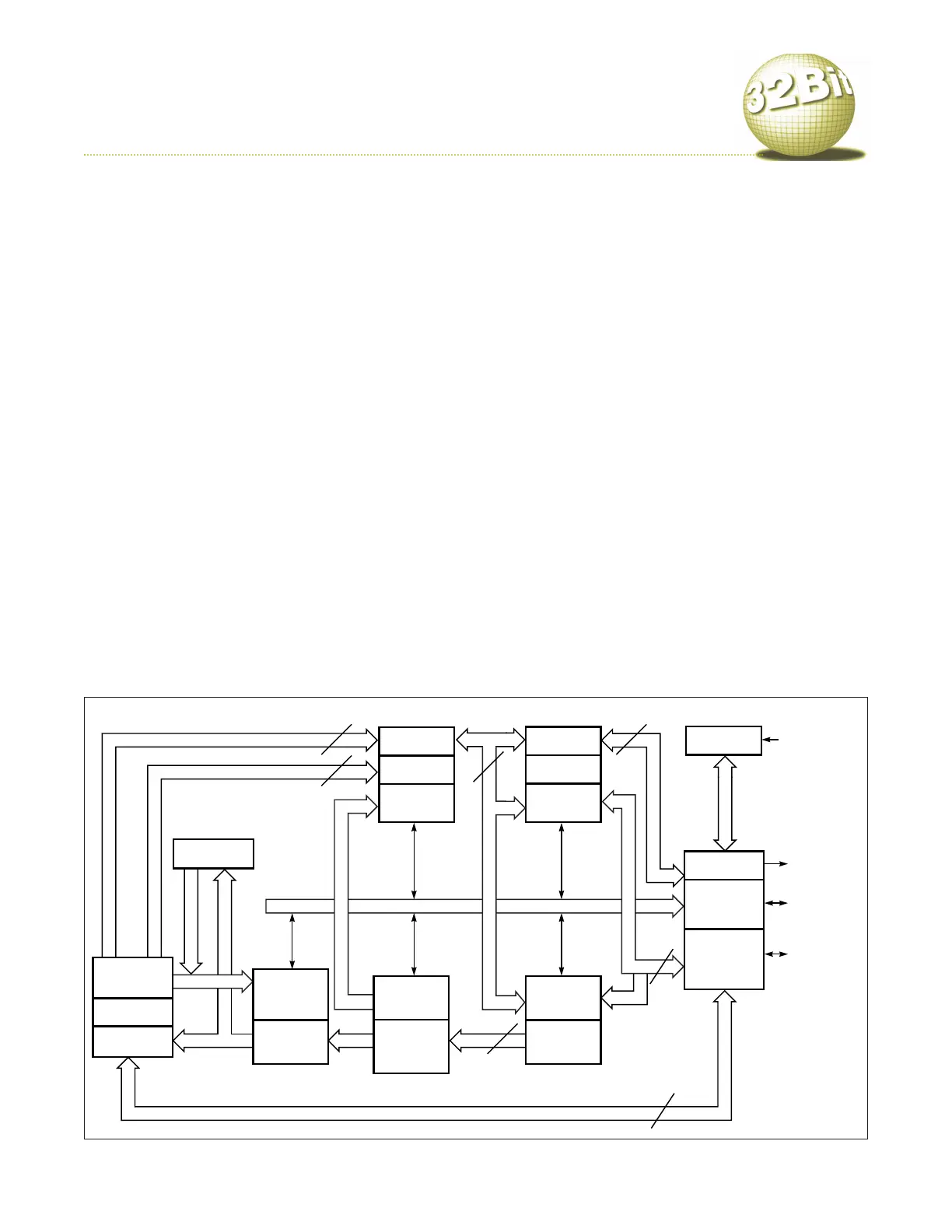
Register-based, the 80386 architecture has four general-pur-
pose registers, four index/pointer registers, six 16-bit segment
registers, and two 32-bit status and control registers. Intel’s
8086 designers used 64-kbyte segments to extend addressing
to 1 Mbyte. The 80386 also uses segmentation; however,
because the general-purpose and index/pointer registers are
now 32 bits, the segment limits extend to the full 4-Gbyte
addressing range, and a segment register references a segment
descriptor with a 32-bit base address. These descriptors also
carry addressing-range and protection limits to prevent data
accesses into code, data that executes as code, and access to
inner privilege levels by outer levels.
Hardware-descriptor registers hold segment-access rights
and segment-base address and size limits. In protected-mode
addressing, a 16-bit selector points to a segment descriptor
and furnishes a base address. The base address adds to the 32-
bit effective address, producing a 32-bit linear address, which
the 80386 then uses as a physical or linear-page address.
The 386 has four code/data breakpoint registers and two
control registers for debugging. You can set the breakpoint
registers with addresses for halting execution on a program
or data access.
Power management: System-management mode (SMM), a
power-management mechanism, enables code to control
CPU power without rewriting or revamping operating soft-
ware. The CPU enters SMM via a hardware interrupt, the sys-
tem-management interrupt (SMI); the SMI code can set
SMMs to reduce chip power dissipation. Integrated versions
of the 386, including Intel’s 386EX, have idle and power-
down modes: Idle discontinues CPU processing but keeps
peripherals active, and power-down shuts down the entire
chip. AMD’s 386SC300 chip has low-speed mode, during
which the CPU goes to 0.5 MHz; doze, which stops the CPU,
system, and DMA clocks; sleep, which stops additional clocks
and peripherals; and suspend, which stops everything except
the real-time clock and memory.
Special instructions: The 386 instruction set is a superset of
the 8086/186. To support SMM, the 386 has seven addition-
al instructions, such as RSM (resume), which causes the
processor to resume from SMM.
Special on-chip peripherals: Intel’s 386EX peripherals
include a serial-I/O unit, a chip select, a clock generator, a
DMA- and bus-arbitrator unit, a DRAM-refresh-control unit,
an interrupt-control unit, a memory-management unit, and
a parallel-I/O unit. AMD’s ElanSC300 combines an Am386
CPU with a PC/A
T chip set and essential embedded-PC
peripherals. The ElanSC300 also includes mobile-computing
peripherals, such as PLL clock generators, PCMCIA-card sup-
port, LCD-graphics control, a memory controller, DMA and
interrupt controllers, a real-time clock, a serial port, and a par-
allel port.
Development tools: Numerous third-party vendors support
the 386 architecture. They provide tools that include assem-
blers, compilers, linkers/locators, remote software debuggers,
software simulators, and integrated design environments for
software development. In addition, several vendors provide
utilities, such as flash-programming, device-driver, and flash-
translation-layer implementations. Hardware tools include
in-circuit emulators, logic analyzers, evaluation platforms,
and single-board computers. Operating-system support
includes DOS and windowed OSs and a variety of real-time
OSs from small, royalty-free microkernels to feature-rich
graphical-user-interface RTOSs.
80386


 To Next Page