82C54
MODE 2: RATE GENERATOR
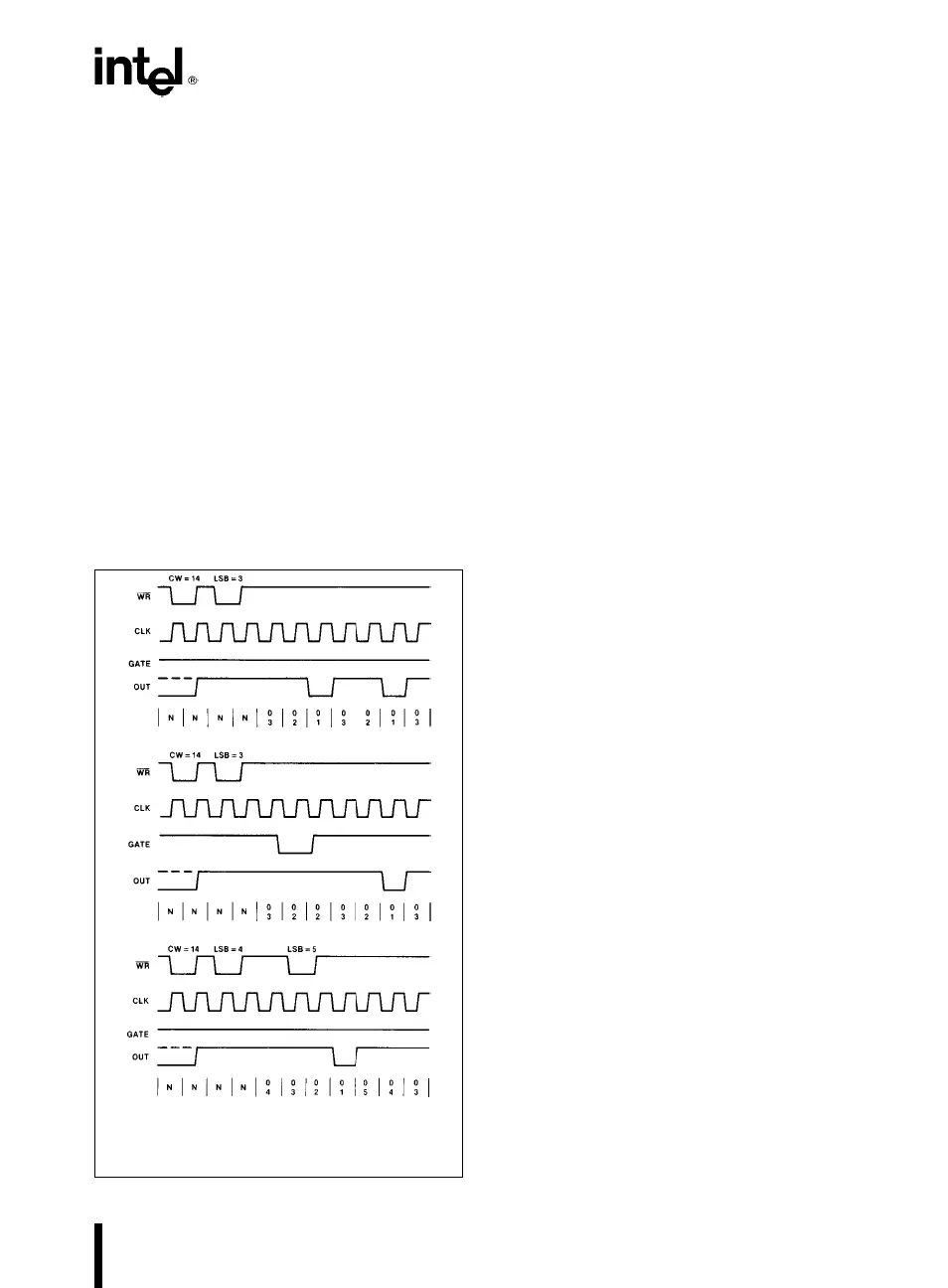
This Mode functions like a divide-by-N counter. It is
typicially used to generate a Real Time Clock inter-
rupt. OUT will initially be high. When the initial count
has decremented to 1, OUT goes low for one CLK
pulse. OUT then goes high again, the Counter re-
loads the initial count and the process is repeated.
Mode 2 is periodic; the same sequence is repeated
indefinitely. For an initial count of N, the sequence
repeats every N CLK cycles.
GATE
e
1 enables counting; GATE
e
0 disables
counting. If GATE goes low during an output pulse,
OUT is set high immediately. A trigger reloads the
Counter with the initial count on the next CLK pulse;
OUT goes low N CLK pulses after the trigger. Thus
the GATE input can be used to synchronize the
Counter.
After writing a Control Word and initial count, the
Counter will be loaded on the next CLK pulse. OUT
goes low N CLK Pulses after the initial count is writ-
ten. This allows the Counter to be synchronized by
software also.
231244–10
NOTE:
A GATE transition should not occur one clock prior to
terminal count.
Figure 17. Mode 2
Writing a new count while counting does not affect
the current counting sequence. If a trigger is re-
ceived after writing a new count but before the end
of the current period, the Counter will be loaded with
the new count on the next CLK pulse and counting
will continue from the new count. Otherwise, the
new count will be loaded at the end of the current
counting cycle. In mode 2, a COUNT of 1 is illegal.
MODE 3: SQUARE WAVE MODE
Mode 3 is typically used for Baud rate generation.
Mode 3 is similar to Mode 2 except for the duty cycle
of OUT. OUT will initially be high. When half the ini-
tial count has expired, OUT goes low for the remain-
der of the count. Mode 3 is periodic; the sequence
above is repeated indefinitely. An initial count of N
results in a square wave with a period of N CLK
cycles.
GATE
e
1 enables counting; GATE
e
0 disables
counting. If GATE goes low while OUT is low, OUT is
set high immediately; no CLK pulse is required. A
trigger reloads the Counter with the initial count on
the next CLK pulse. Thus the GATE input can be
used to synchronize the Counter.
After writing a Control Word and initial count, the
Counter will be loaded on the next CLK pulse. This
allows the Counter to be synchronized by software
also.
Writing a new count while counting does not affect
the current counting sequence. If a trigger is re-
ceived after writing a new count but before the end
of the current half-cycle of the square wave, the
Counter will be loaded with the new count on the
next CLK pulse and counting will continue from the
new count. Otherwise, the new count will be loaded
at the end of the current half-cycle.
Mode 3 is implemented as follows:
Even counts: OUT is initially high. The initial count is
loaded on one CLK pulse and then is decremented
by two on succeeding CLK pulses. When the count
expires OUT changes value and the Counter is re-
loaded with the initial count. The above process is
repeated indefinitely.
Odd counts: OUT is initially high. The initial count
minus one (an even number) is loaded on one CLK
pulse and then is decremented by two on succeed-
ing CLK pulses. One CLK pulse
after
the count ex-
pires, OUT goes low and the Counter is reloaded
with the initial count minus one. Succeeding CLK
pulses decrement the count by two. When the count
expires, OUT goes high again and the Counter is
reloaded with the initial count minus one. The above
process is repeated indefinitely. So for odd counts,
11


 To Next Page