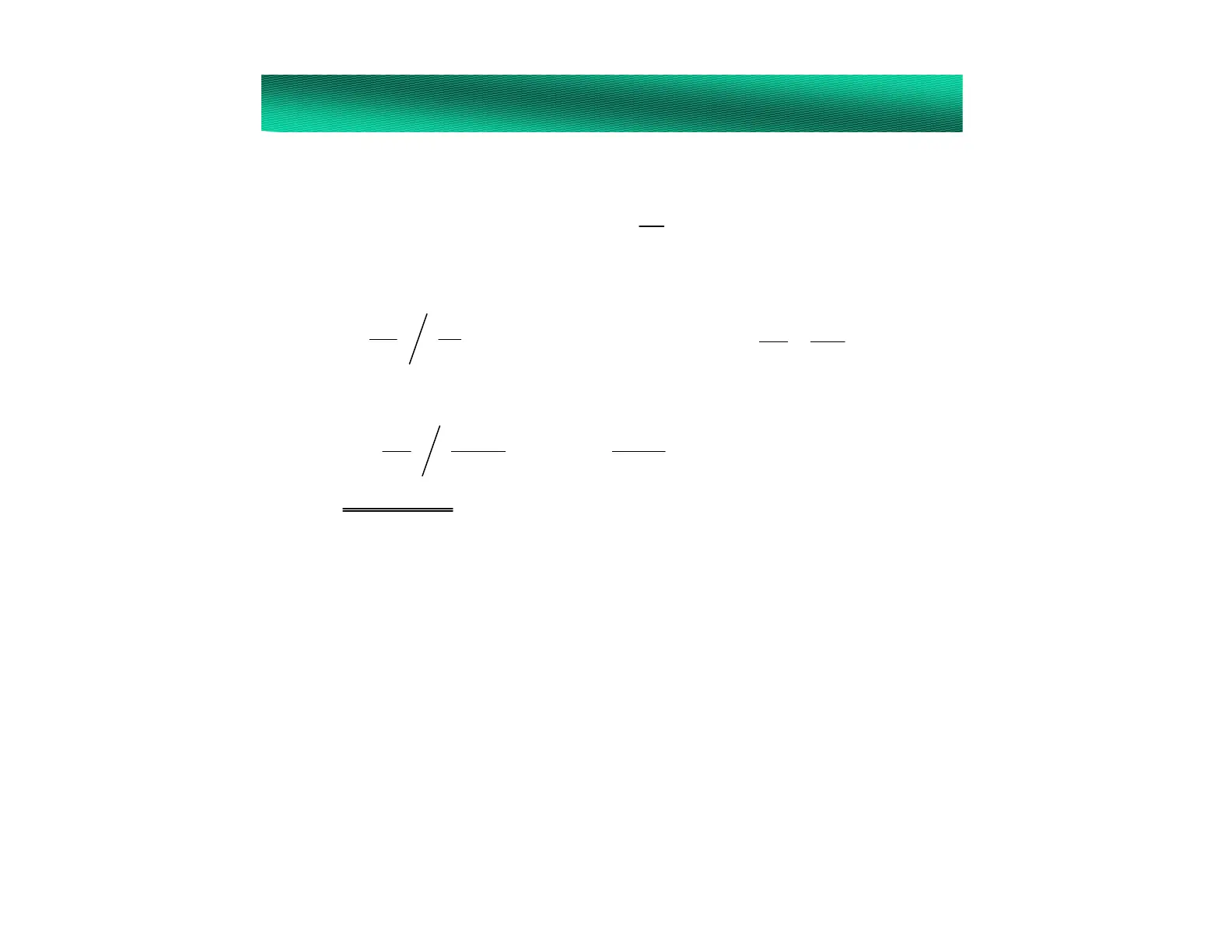
Considering a sine wave input F(t) of amplitude A so that
which has a mean square value of F
2
(t), where
tsinAtF
w
=
( ) ( )
∫
=
p
w
p
2
0
222
dttsinA
2
1
tF
which is the signal power. Therefore the signal to noise ratio SNR is given by
=
12
q
2
A
10LogSNR(dB)
22
but
1nn
A
2A
LSB 1q
−
===
Substituting for q gives
=
=
2
2*3
Log 10
2* 3
A
2
A
Log 10SNR(dB)
2n
2n
22
1.76dB6.02n +⇒
This gives the ideal value for an n bit converter and shows that each extra 1 bit of resolution provide
approximately 6 dB improvement in the SNR.
In practice, integral and differential non-linearity (discussed later in this presentation) introduce errors that
lead to a reduction of this value. The limit of a 1/2 LSB differential linearity error is a missing code condition
which is equivalent to a reduction of 1 bit of resolution and hence a reduction of 6 dB in the SNR. This then
gives a worst case value of SNR for an n-bit converter with 1/2 LSB linearity error
Thus, we can established the boundary conditions for the choice of the resolution of the converter based upon
a desired level of SNR.
4.24dB6.02n61.766.02ncase)(worst SNR −=−+=
Analog and Mixed-Signal Center (ESS)
QUANTIZATION EFFECTS


 To Next Page