XA User Guide 3-11 3/24/97
3.5.2 External and Internal Overlap
If External Code Memory is placed by external logic at locations that overlap Internal Code
Memory, the Internal Code Memory takes precedence, and the overlapped portion of the
External memory will in not be accessed. However, on XA implementations that provide an
External Address (
EA) hardware input, setting EA low will cause external program memory to
be used.
3.5.3 Access
Code memory is intended to contain executable XA instructions. The XA architecture supports
storing constant data in Code Memory and provides special access modes for retrieving this
information. Constant data is implicitly stored within the instruction of many data manipulation
instructions when immediate operands are specified.
It is possible, and a common practice, to overlap external code and data memory spaces. In this
case it is important to understand that the memory spaces are logically separate. In such an
architecture, implemented with external logic, code memory is logically read-only memory that
is writable when accessed as external data memory. No such overlap is possible for internal code
memory.
MOVC addressing in Code Memory
A special instruction, MOVC, is defined in the XA for accessing constant data (e.g lookup
tables, string constants etc.) stored in code memory. There is a standard form of MOVC that
reflects the native XA architecture, and there are two variations that reflect 80C51 compatibility;
see Chapter 9 for details of 80C51 compatibility. The standard form of MOVC uses a 16-bit
register value as a pointer, appended to either the top 8 bits of the Program Counter (PC) or the
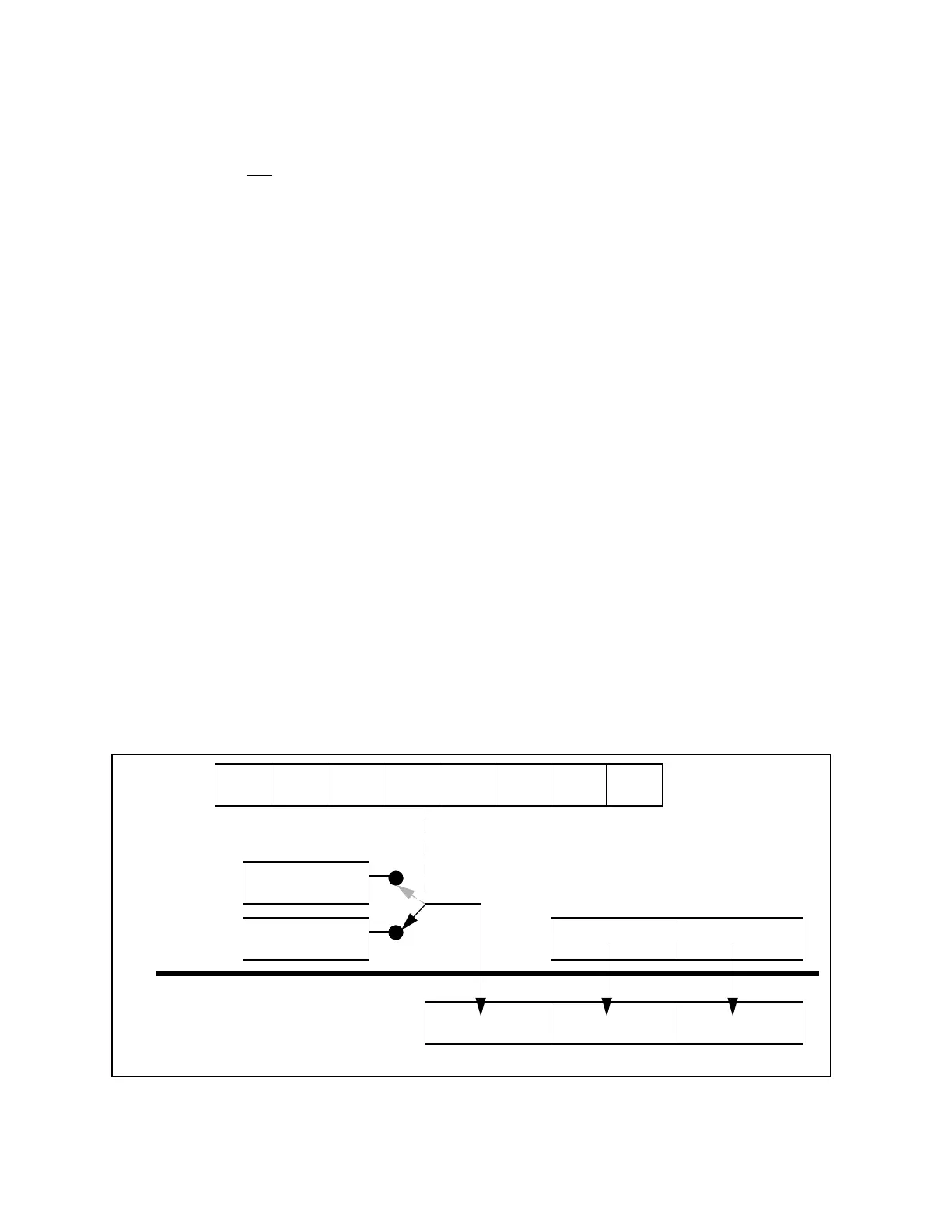
Code Segment register (CS) to form a 24-bit address, as shown in Figure 3.12. The source for the
upper 8 address bits is determined by the setting of the segment selection bit (0 = PC and 1= CS)
in the SSEL register that corresponds to the operand register.
Figure 3.12 MOVC addressing in code memory
SSEL
ESWEN
R6SEG R5SEG R4SEG R3SEG R2SEG R1SEG
PC
CS R4
complete
24-bit memory
address
segment
registers
8-bit segment
identifier
16-bit segment offset
0
1
R0SEG


 To Next Page