XA User Guide 9-2 3/24/97
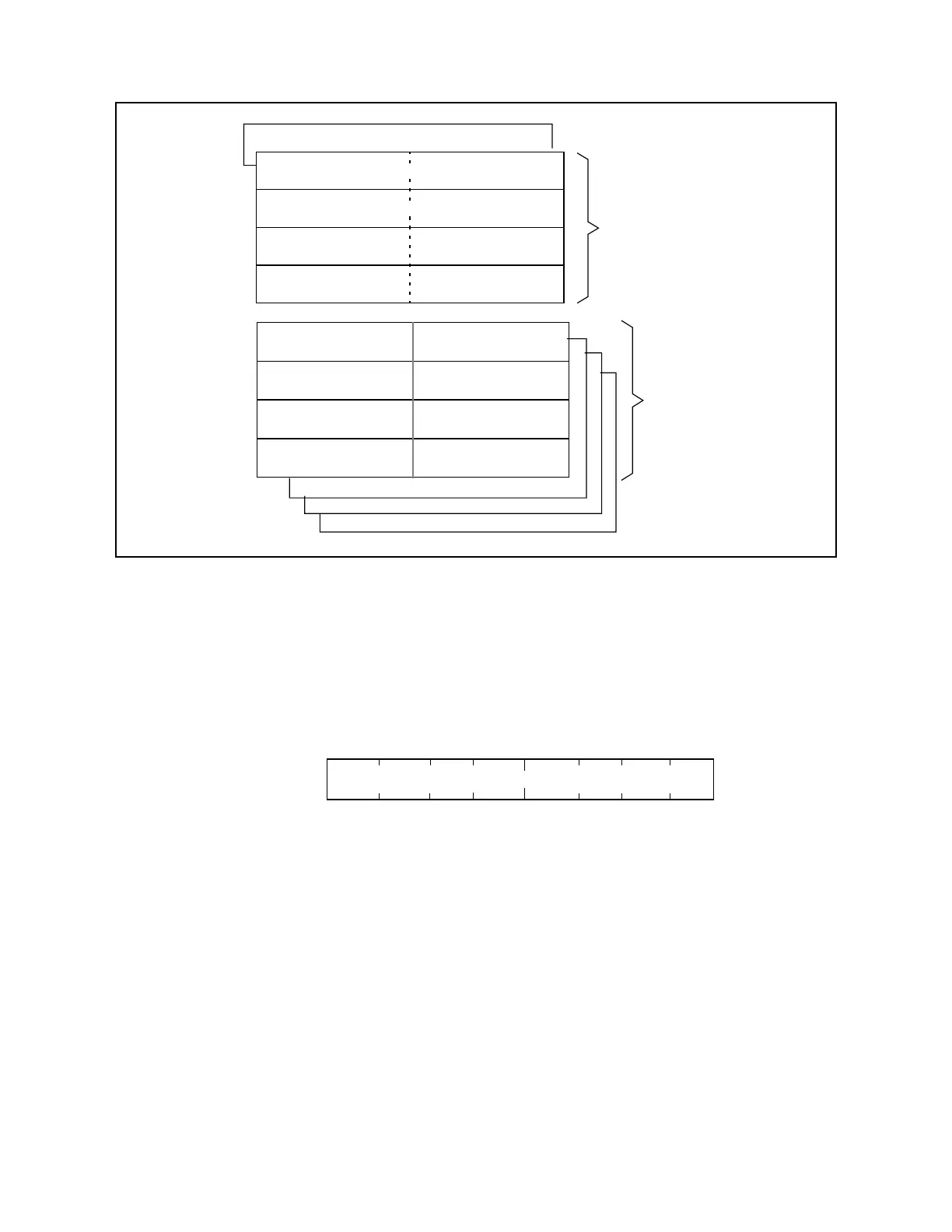
Figure 9.1. XA Register File
Other important registers of the 80C51 are provided in other ways. The program status word
(PSW) of the XA is slightly different than the 80C51 PSW, so a special SFR address is reserved
to provide an 80C51 compatible "view" of the PSW for use by translated code. This alternate
PSW, called PSW51, is shown in the figure 9.2. The F0 flag and the F1 flag are simply readable
and writable bits. The P flag provides an even parity bit for the 80C51 A register and always
reflects the current contents of that register. Note that the P flag, the F0 flag, and the F1 flag only
appear in the PSW51 register.
The 80C51 indirect data memory access mode, using R0 or R1 as pointers, requires special
support on the XA, where pointers are normally 16 bits in length. The 80C51 compatibility mode
also causes the XA to mimic the 80C51 indirect scheme, using the first two bytes of the register
file as indirect pointers, each zero extended to make a 16-bit address. Due to this and the
previously mentioned register overlap to memory feature, the compatibility mode must be turned
on in order to execute most translated 80C51 code on the XA. Other than the two
aforementioned effects, nothing else about XA functioning is affected by the compatibility mode.
Figure 9.2. PSW CPU status flags
R7
R6
R5
R4
R3
R2
R1
R0
R7H
R6H = DPH
R5H
R4H = B
R3L
R2L
R1L
R0L
R7L
R6L = DPL
R5L
R3H
R2H
R1H
R0H
R4L = A (ACC)
Global registers.
SSP
Banked Registers
USP
DPTR
PSW51
C
AC POV F1 F0
RS1 RS0


 To Next Page