Although a device can assert an interrupt at any time, the CPU usually only services (or
recognizes) interrupts between instructions. In other words, it does not stop in the middle of the
fetch/execute cycle to service an interrupt. This means there may be a delay between the time a
device generates an interrupt and the time the CPU processes it. We can expand the normal
fetch/execute cycle as follows:
Repeat
fetch instruction
decode instruction
fetch any memory operand necessary
execute instruction operation
write result to memory if necessary
check for hardware interrupt
Until Halt
Prioritizing Interrupts
The order in which the CPU checks devices with the polling scheme imposes a priority scheme
on the devices. Devices that the CPU checks first have a higher priority (they are more likely to
receive service). Imagine that two or more devices require service at the same time. The CPU
will service the device that it checks first before it services a device that it checks later. There is
also a priority scheme for interrupts, that is, the CPU considers some interrupt requests to be
more important than others.
Intel Interrupt Prioritization
The implementation of this prioritization is as follows. First, it is important to understand that
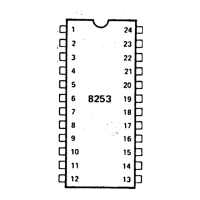
peripheral devices do not connect directly to the CPU. Instead, an interrupt controller (the
8259A chip) stands between the devices and the processor. This controller is a hardware device
that receives signals from up to eight different external devices. The chip has eight input lines,
each of which can connect to a peripheral device. The names of these input lines, IRQ0-IRQ7
(Interrupt ReQuest), correspond to the relative priorities of the devices attached to them, with the
device attached to line IRQ0 having the highest priority. The table below shows the standard
IRQ assignments. A device that requires the attention of the processor sends a signal on its line
to the interrupt controller. At any given moment, all, some, or none of the devices may require
the services of the CPU. If more than one device is sending a signal at the same time, the
controller selects the line with the highest priority (lowest numbered) of all the lines currently
active. Only the device connected to this line will actually be able to get the attention of the
CPU. The 8259A encodes the vector number corresponding to the selected signal and stores this
value in an internal register of the controller itself.
Priority IRQ Device
highest 0 System timer
1 Keyboard


 To Next Page