Need help?
Do you have a question about the Trilithic 180 DSP and is the answer not in the manual?
Provides an overview of the instrument, its basic features, and operational guidelines.
Contains helpful website links, manual organization, conventions, and precautions.
Details software like ViewPoint Express and Integrated Server for device configuration.
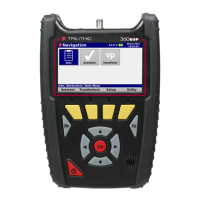
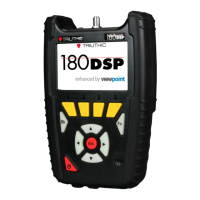
Introduces the 180 DSP, its features, and benefits for installers and technicians.
Lists the physical connection ports available on the 180 DSP unit.
Outlines the core measurement capabilities included as standard on the 180 DSP.
Details optional measurement and connectivity features available for the 180 DSP.
Provides an overview of the instrument, its components, and accessories.
Offers instructions on how to properly clean the touchscreen display.
Explains how to charge the instrument's battery and its status indicators.
Covers startup procedures and basic user interface interactions.
Details automatic and manual sleep modes for power conservation.
Explains automatic and manual shutdown procedures to conserve power.
Describes the components of the instrument's display interface.
Explains the primary area of the screen where measurements and data are shown.
Defines the functions of the softkeys and their dynamic labels.
Details the function of each button on the instrument's main keypad.
Guides users on how to operate the virtual keyboard for text input.
Details common functions accessible via the Function menu.
Explains how to enable or disable network connections like Ethernet and Bluetooth.
Describes how to remotely access the 180 DSP device using a network connection.
Introduces the Setup Menu and its available functions for instrument configuration.
Provides details on version, calibration, network, and option information.
Covers global, user, interface, measurement, and network settings.
Explains how to create, edit, and manage channel plans on the 180 DSP.
Details how to manage limit sets for measurement criteria and editing limits.
Covers configuration of network settings for Ethernet connectivity.
Provides operations for managing files, including backup, restore, import, and export.
Guides users on disabling and calibrating the touchscreen interface.
Details the process for updating the instrument's firmware from a website or USB drive.
Introduces the Autotest menu and its functions for managing jobs and autotests.
Explains how to connect the instrument to the ViewPoint WFM Module.
Covers creating, opening, closing, and deleting jobs on the 180 DSP.
Details how to execute autotests, interpret indicators, and manage test locations.
Introduces the Troubleshoot menu and its available functions for installation issues.
Covers performing level measurements on analog, digital, and DOCSIS channels.
Explains how to perform a scan of channels within a selected channel plan.
Details how to perform tilt measurements between selectable channels.
Covers return and forward spectrum analysis options and measurements.
Provides standard network tests including Ping, VoIP, Throughput, and Traceroute.
Explains the FDR measurement for determining distance to cable faults.
Details QAM EVS for tuning to channels and displaying error spectrum.
Covers traffic control measurements, including basic settings and signal density.
Introduces the Utility menu and its functions like Web Browser and Source Generator.
Guides users on how to use the built-in web browser for viewing websites.
Explains the Source Generator feature for creating CW or QAM signals.
Provides technical specifications for Level, Spectrum, Digital Channel, and HUM measurements.
Contains the terms and conditions of the Trilithic Broadband Instruments 1-Year Limited Warranty.
 General
| Input Impedance | 75 Ohm, VSWR < 1.25:1 |
|---|---|
| Weight | 2.5 lbs |
| Amplitude Accuracy | ±1.5 dB |
| Display | LCD |
| Dimensions | 9.5" |
| Frequency Range | 5 MHz to 1 GHz |

 To Next Page