Chapter 7. Node and Terminal Plug-ins
Vol. IV-7-22 Alcatel-Lucent
• Note that the RSSI (RSL) filter has a nominal 56 MHz bandwidth, which means
that depending on the channel bandwidth used, multiple adjacent channels can
be included within the filter passband
1
. Normally this will not cause a problem
as antenna discrimination (beamwidth) and good frequency planning should
exclude co and adjacent channel RSL interferers.
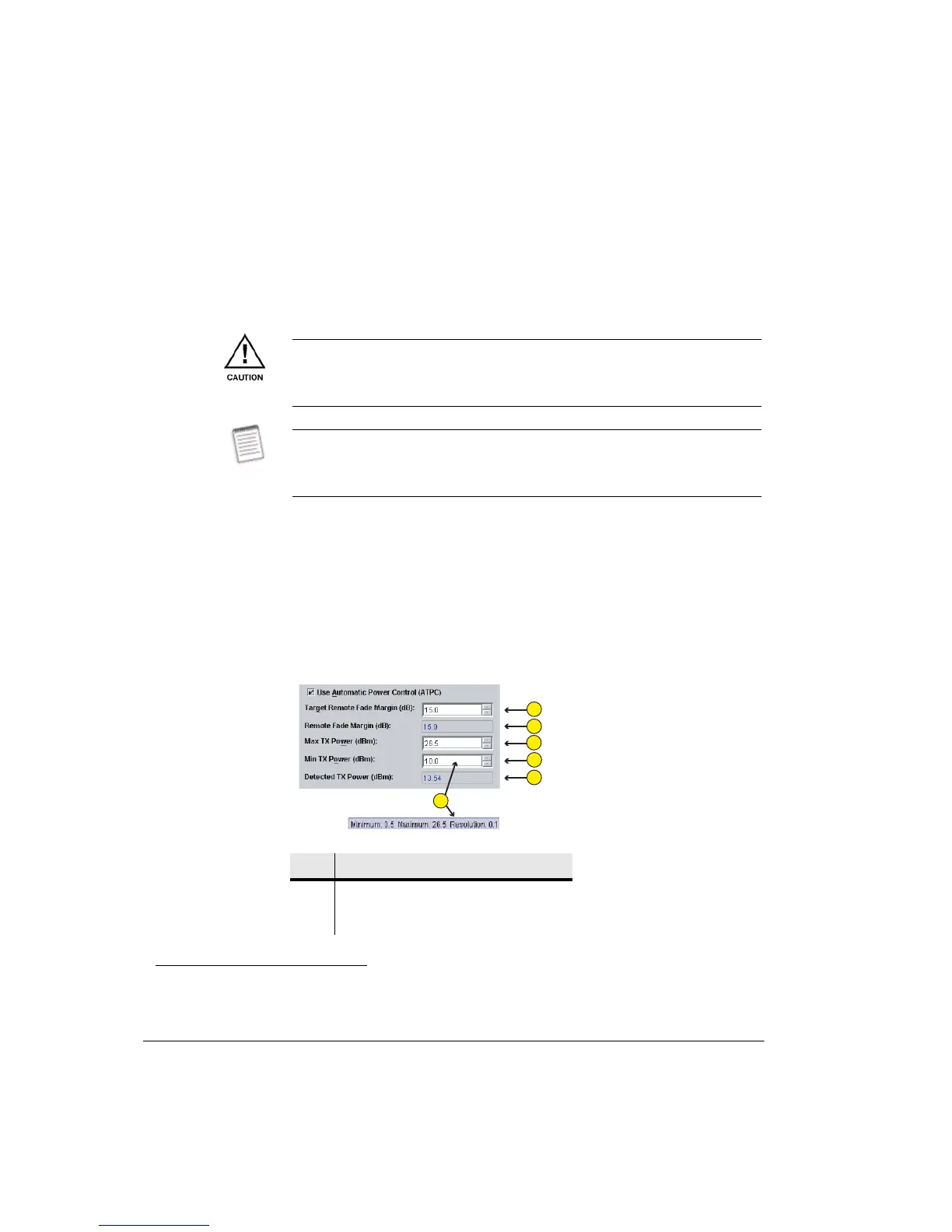
Setting ATPC
This procedure is based on the prevailing path conditions being typical during the
setup procedure, that is, not subject to rain fade or other fade conditions and
assumes the Target Fade Margin is the primary driver for establishing the
settings.
The objective is to check that Remote Fade Margin and the Detected Tx Power
are within +/- 3 dB of the planned figures for the link, and that there is
appropriate Tx Power headroom for correct ATPC operation.
1
RSSI filter bandwidth is not a function of, nor does it affect receiver adjacent channel C/I performance.
9500 MXC complies with relevant ETSI and FCC co and adjacent channel requirements.
For co-channel XPIC operation do not use ATPC.
For all other modes of operation, do not use ATPC where there is a measurable
RSL when the remote-end Tx is muted.
Where ATPC is configured, its operation should be monitored for a period after
installation to ensure it is providing the expected benefits under the prevailing
path conditions. Where indicated, ATPC settings should be optimized, or in
situations of frequent, fast and high fading it may be best to disable ATPC.
Item Description
1 Set the fade margin for the remote end
2 Calculated remote end fade margin
1
2
3
4
5
6



 To Next Page