9500 MXC User Manual
3DB 23063 ADAA - Rev 004 July 2007 Vol. II-2-15
Ethernet Module
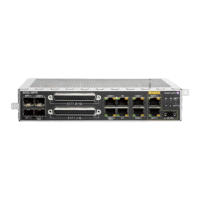
The Ethernet module incorporates an intelligent ISO layer 2+ switch, to provide
the switching, prioritization and queuing functions between ports and transport
channels, C1 and C2. It supports address learning for efficient management of
Ethernet traffic in multi-host situations, and advanced layer 3 and layer 2 settings
for traffic prioritization.
A gate array supports channel assignment and mux/demux to the digital
baseband.
The MAC address register supports 4096 entries.
The four 10/100Base-T Fast Ethernet ports may be connected to the transport
channels in transparent, VLAN or mixed operational modes. Channel capacity is
incremented in 2 Mbps (2.048 Mbps) or 1.5 Mbps (1.544 Mbps) steps.
Refer to:
• Ethernet Traffic Configuration on page 2-15
• Transport Channel Configuration on page 2-17
• Basic Port Settings on page 2-17
• Priority Mapping on page 2-17
• Flow Control on page 2-18
• Disable Address Learning on page 2-18
• Maximum Frame Size on page 2-19
• Latency on page 2-19
• Ethernet Diagnostics on page 2-20
Ethernet Traffic Configuration
IDU ES is configured using CT, the 9500 MXC craft terminal. User-friendly
screens prompt for channel size (Ethernet bandwidth), modes of operation, QoS
settings, and interface options.
Three modes of operation are supported, which define LAN connection options
between the ports and channels. These options are Transparent, VLAN or Mixed:
Transparent Mode
This is the default, broadcast mode; all ports and channels are interconnected. It
supports four customer connections (ports 1 to 4) with bridging to and between
the two transport channels (C1, C2).



 To Next Page