Chapter 7. Node and Terminal Plug-ins
Vol. IV-7-78 Alcatel-Lucent
• The default assignment of keys is balanced; the 16 keys are split evenly, or
near-even for an odd-number split. This assignment can be edited to support
instances where the links are not of equal capacity.
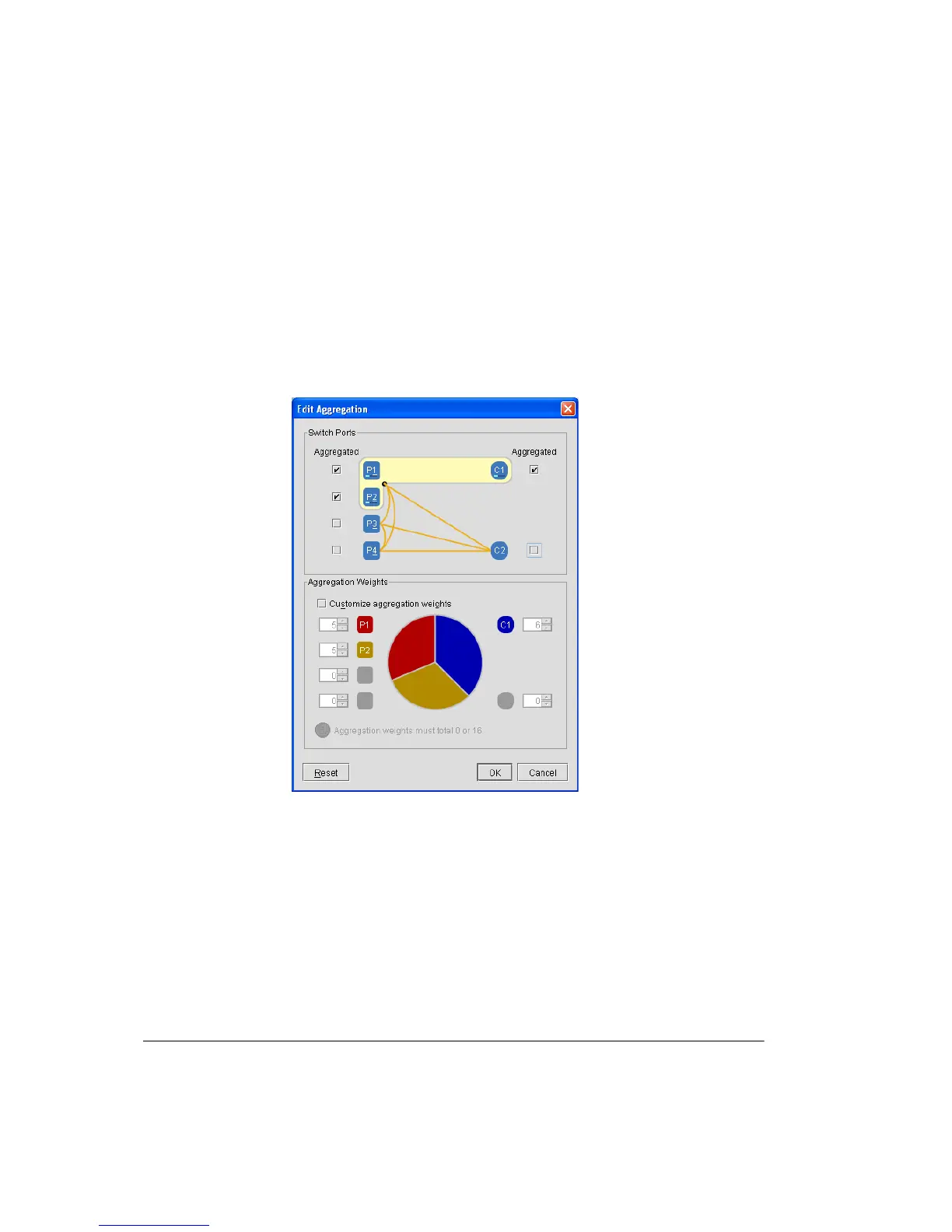
• Figure 7-29 shows the Edit Aggregation window for a C1, P1, P2 aggregated
grouping. Such a configuration would be used where three co-located INUs are
used to support separate physical links, for example three 300 Mbps links to
provide a single 900 Mbps virtual link at ports P3 and P4.
Figure 7-29. C1, P1, P2 Link Aggregation
Where there is only a single MAC addresses in play, such as a connection
between two routers, L2 link aggregation is not effective. All traffic goes via one
link - the other link or links in the aggregation group carry no traffic.
Where there are just a handful of MAC source and destination addresses in play
(less than 16) link load balancing may be less than optimum, particularly so
where just one or a few of the sessions have very high throughput demands.
With normal LAN traffic densities (20+ concurrent sessions), layer 2 aggregation
keying generally ensures equitable balancing of traffic between the links.
When a link fails, all traffic from the failed link is recovered over the remaining
link, or links. If it is to more than one link, aggregation keying applies an
equitable split between the links.



 To Next Page