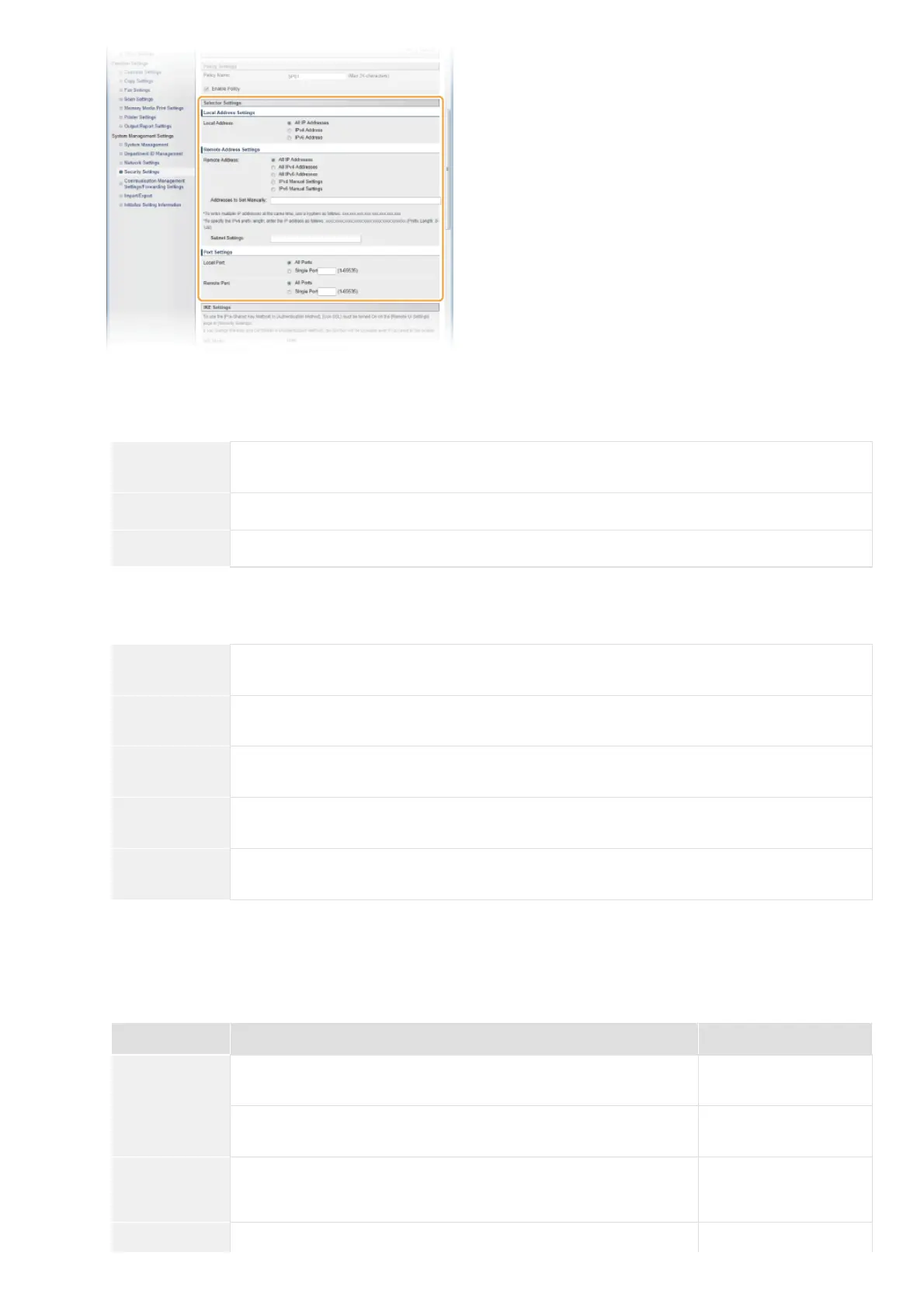
[Local Address]
Click the radio button for the type of IP address of the machine to apply the policy.
[All IP
Addresses]
Select to use IPSec for all IP packets.
[IPv4 Address] Select to use IPSec for all IP packets that are sent to or from the IPv4 address of the machine.
[IPv6 Address] Select to use IPSec for all IP packets that are sent to or from an IPv6 address of the machine.
[Remote Address]
Click the radio button for the type of IP address of the other devices to apply the policy.
[All IP
Addresses]
Select to use IPSec for all IP packets.
[All IPv4
Addresses]
Select to use IPSec for all IP packets that are sent to or from IPv4 addresses of the other devices.
[All IPv6
Addresses]
Select to use IPSec for all IP packets that are sent to or from IPv6 addresses of the other devices.
[IPv4 Manual
Settings]
Select to specify a single IPv4 address or a range of IPv4 addresses to apply IPSec. Enter the IPv4
address (or the range) in the [Addresses to Set Manually] text box.
[IPv6 Manual
Settings]
Select to specify a single IPv6 address or a range of IPv6 addresses to apply IPSec. Enter the IPv6
address (or the range) in the [Addresses to Set Manually] text box.
[Addresses to Set Manually]
If [IPv4 Manual Settings] or [IPv6 Manual Settings] is selected for [Remote Address], enter the IP address to apply the policy.
You can also enter a range of addresses by inserting a hyphen between the addresses.
NOTE:
Entering IP addresses
Description Example
Entering a
single address
IPv4:
Delimit numbers with periods.
192.168.0.10
IPv6:
Delimit alphanumeric characters with colons.
fe80::10
Specifying a
range of
addresses
Insert a hyphen between the addresses.
192.168.0.10-
192.168.0.20
Specifying a
㻠㻟㻣㻌㻛㻌㻢㻣㻢



 To Next Page