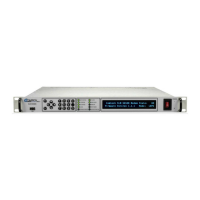
CDM-570A/570AL Satellite Modem with Optional Packet Processor
Revision 5
Introduction 1–22 MN-CDM570A
1.3.4 DoubleTalk® Carrier- in-Carrier® (CnC)
Requires the two links to share a common carrier frequency (Outbound and Inbound symbol rates do
not have to be equal)
Power Spectral Density Ratio
and CnC Ratio
BSPK/QPSK/8PSK/8-QAM: –7 dB to +11 dB (ratio of power spectral density, outbound interferer to
desired inbound)
16-QAM: –7 dB to +7 dB (ratio of power spectral density, outbound interferer to desired inbound)
Note: With asymmetric carriers, the absolute power ratio (or CnC ratio) would be different, depending
on the ratio of the symbol rates.
Example:
Outbound interferer = 1 Msymbols/sec
Desired Inbound = 500 ksymbols/sec
Ratio of power spectral density = +7 dB
Absolute power ratio (CnC Ratio) = +7dB + (10
log
Outbound/desired symbol rate) = +10 dB
Maximum Symbol Rate Ratio
Inbound/Outbound frequency
uncertainty
Within the normal acquisition range of the demod, as follows:
CDM-570AL or CDMR-570AL (L-Band):
Below 64 ksymbols/sec: ±1 to ±(Rs/2) kHz, where Rs = symbol rate in ksymbols/sec
Between 64 and 625 ksymbols/sec: ±1 up to a maximum of ±32kHz.
Above 625 ksymbols/sec: ±1 to ±(0.1Rs) kHz, up to a maximum of ±200 kHz
CDM-570A (70/140 MHz):
Below 64 ksymbols/sec: ±1 to ±(Rs/2) kHz, where Rs = symbol rate in ksymbols/sec
Equal to 64 ksymbols/sec and above: ±1 up to a maximum of ±32kHz.
(equal Inbound/Outbound power
spectral density)
BPSK = 0.3dB QPSK = 0.3dB OQPSK = 0.3dB
8PSK = 0.5dB 8-QAM = 0.4dB 16-QAM = 0.6dB
For +10 dB power spectral density ratio (outbound interferer 10 dB higher than desired inbound) add an
Frequency offset (between outbound interferer and desired inbound). 100 Hz resolution
CnC Power Ratio, in 0.1 dB (ratio of absolute power, outbound interferer to desired inbound)
Power Spectral Density Ratio, in 0.1 dB
±0.2 dB for symmetric symbol rate



 To Next Page