Automatic transmission-20
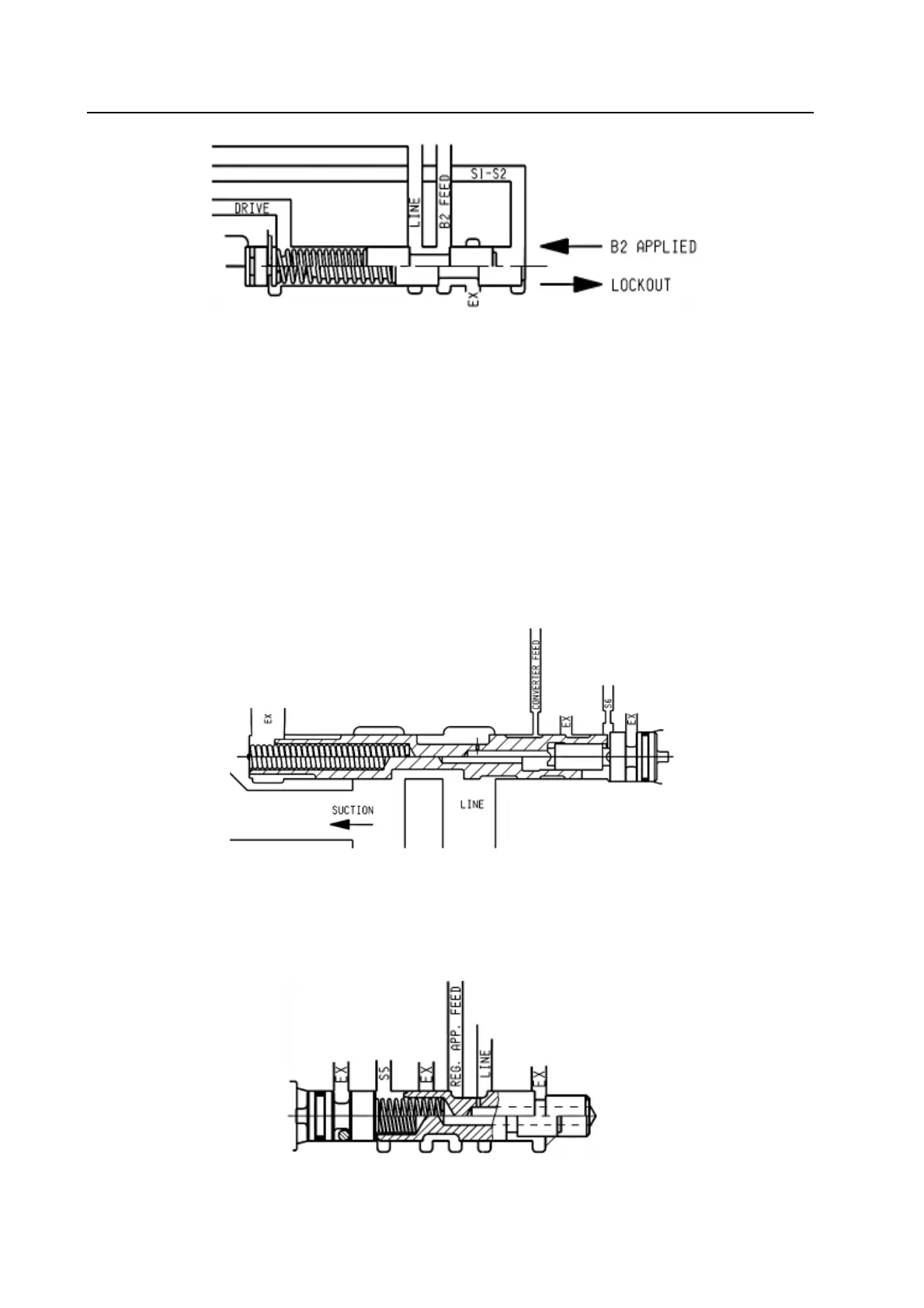
Figure 3.17 reverse lock valve
12. Primary regulating valve
Primary regulating valve (PRV) (refer to Figure 3.18) can regulate the line pressure of transmission (or pump output
pressure). The valve can give the high or low line pressure according to the on/off status of S6. When S6 is in on or off status,
the pressure S6 is applied on PRV, move it and has the action of spring force. Open the line pressure loop to turn on the inlet
of pump to reduce the line pressure. Generally, the line pressure is small when the throttle position is opened lightly and in
patrol status. It will cause the closing of S6 when the opening degree of throttle position is large and because the high line
pressure valve
For all shifting pressures are controlled by output of separation brake belt , clutch regulating valve and S5, so all step control
of line pressure has not affect on effect of shifting sensing.
By the oil inlet of torque converter, PRV also adjust the oil supply of hydraulic torque converter. The level effect of PRV
should ensure the priority of valve, i.e. it can keep the line pressure in low engine speed condition. When the speed of engine
is increased and the pump supplies excess oil, the PRV acts to open the torque converter oil inlet cover to increase the pressure
of torque converter. If the oil amount is beyond the requirement of transmission, PRV will act further to allow the oil return
to the suction inlet.
Figure 3.18 Primary regulating valve
Figure 3.19 Torque converter on/off regulating valve
The torque converter regulating valve (refer to Figure 3.19) adjusts the pressure applied on torque converter clutch oil.
According to the signal pressure form loop S5, adjust the oil flow status from line pressure loop in valve. With the change of
pressure signal of loop S5, the engagement and disengagement of torque converter clutch can be finished by electric control.
13. Torque converter on/off regulating valve



 To Next Page