160 b EDN S
EPTEMBER 24, 1998
Because of Intel’s patent on
the Slot 1 processor’s CPU
interface, the company is the
sole source of these proces-
sors, primarily characterized
by their dedicated backside
L2-cache bus. Separate buses
to main memory and L2
cache allow the CPU to access
the L2 cache at 200 MHz,
one-half the core-processor
speed. Slot 1 provides Intel’s
GTL+ bus protocol, which is
helpful in multiprocessor sys
-
tems.
Intel’s Slot 1-compatible
Pentium II barely resembles
the Pentium or any other x86
processor. With a decoupled
12-stage pipeline, the Pen-
tium II trades less work per
pipe stage for more stages.
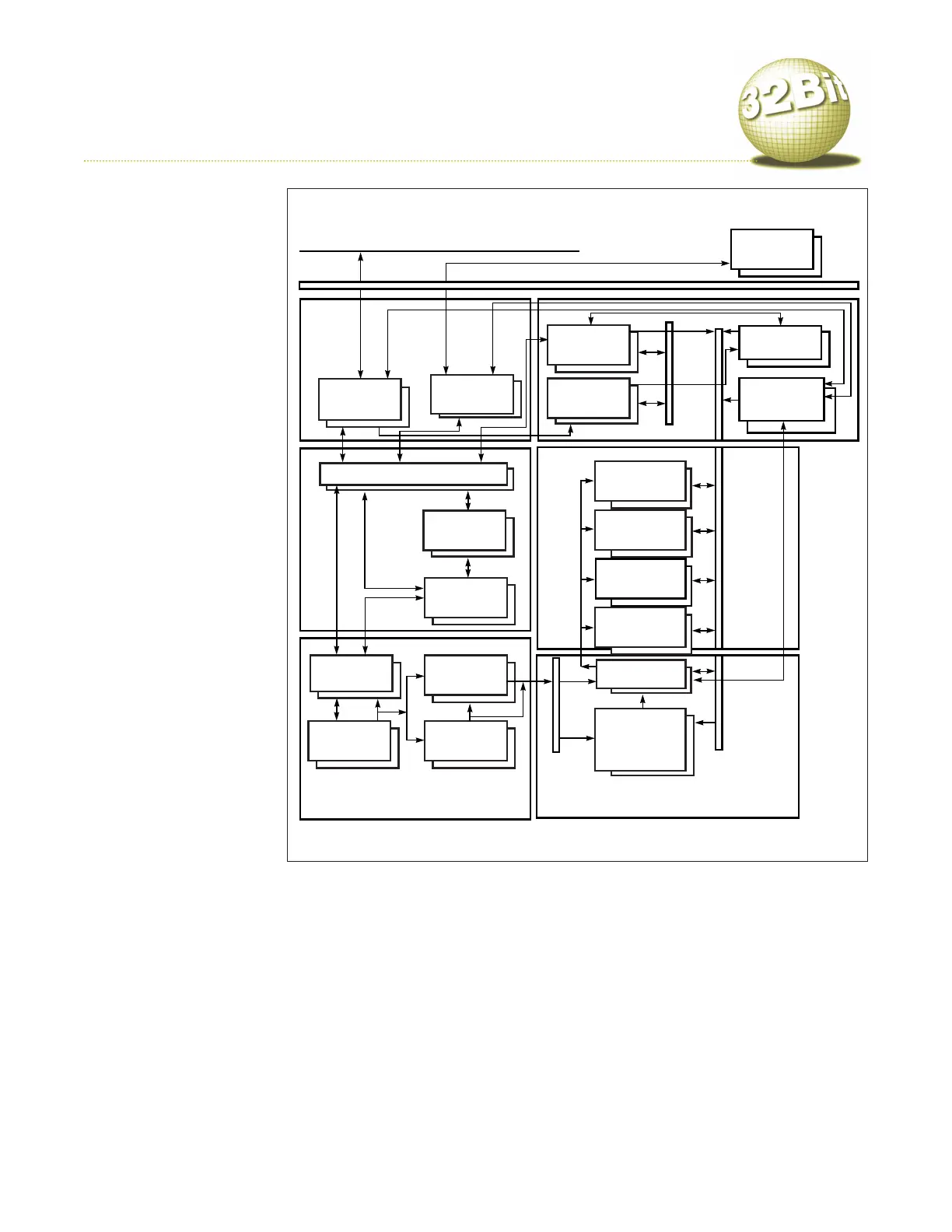
The Pentium II comprises
three independent engines:
fetch/decode, dispatch/exe-
cute, and retire. The fetch/
decode engine converts in-
structions into one or more
micro-operations (mops). The
mops improve performance
by representing fixed-length,
fixed-field, easy-to-execute
operations. You can individu-
ally schedule the mops, facili-
tating the Pentium II’s out-of-
order execution of in-
structions.
After the decoder creates
mops, it sends them to a 40-
mop-deep reorder buffer
(ROB). The mops then await
dispatch to the execution
portion of the pipeline. The
mops are then either ready for
execution or waiting for data from a memor
y access or a result
from a previous mop. T
o avoid register dependencies, the Pen-
tium II performs renaming: Extra registers represent the x86’s
programmer-visible registers. The dispatch/execute engine
queues ready-for-execution mops within a 20-entr
y, distrib
-
uted-reservation station. The Pentium II determines the data
flow by analyzing which mops depend on each other’
s results.
The processor dispatches mops from anywhere or in any order
within the reser
vation station.
The Pentium II speculatively executes and returns these
mops to the ROB, and the retire engine then evaluates them.
Although the Pentium II executes mops or instructions out of
order
, the device completes the instructions in the original
program order
. Furthermore, speculative execution implies
that the device executes some instructions that never retire.
This situation occurs if the device mispredicts a program
branch. When the Pentium II encounters a mispredicted
branch, it flushes its deep pipelines and removes mops from
the ROB. T
o minimize the possibility of a mispredicted
branch, Intel designers increased the branch target buffer to
512 entries and added histor
y bits to help the prediction algo-
rithm.
The Pentium II, with the same multimedia-extension
instructions as Pentium, comes in a single-edge-contact car
-
tridge with a 512-kbyte L2 cache. This year
, Intel introduced
its Celeron and Pentium II Xeon processors. Celeron, which
comes in a single-edge processor package, is basically a cache
-
less Pentium II and targets the less-than-$1000 PC market. At
the other extreme is Xeon, targeting the midrange to high-
end ser
ver and workstation market. Xeon is a Pentium II with
512 kbytes or 1 Mbyte of L2 cache. It comes in a Slot 2 mod
-
ule—approximately twice the weight and height of a Slot 1
module—and supports four- or eight-way multiprocessing.
Slot 1 processors


 To Next Page