PASSENGER AND CREW SEAT WEIGHT AND BALANCE
The KODIAK is equipped with removable passenger and crew seats. A
maintenance log book entry is not required when the seats are removed or
installed, but the aircraft weight and balance must be calculated to reect the
seat conguration for each ight.
Refer to the KODIAK 100 Installed Equipment List (AM905.0) for the current
aircraft conguration weight and balance record. For weight and balance
calculations regarding the removal or installation of seats, refer to the
following congurations.
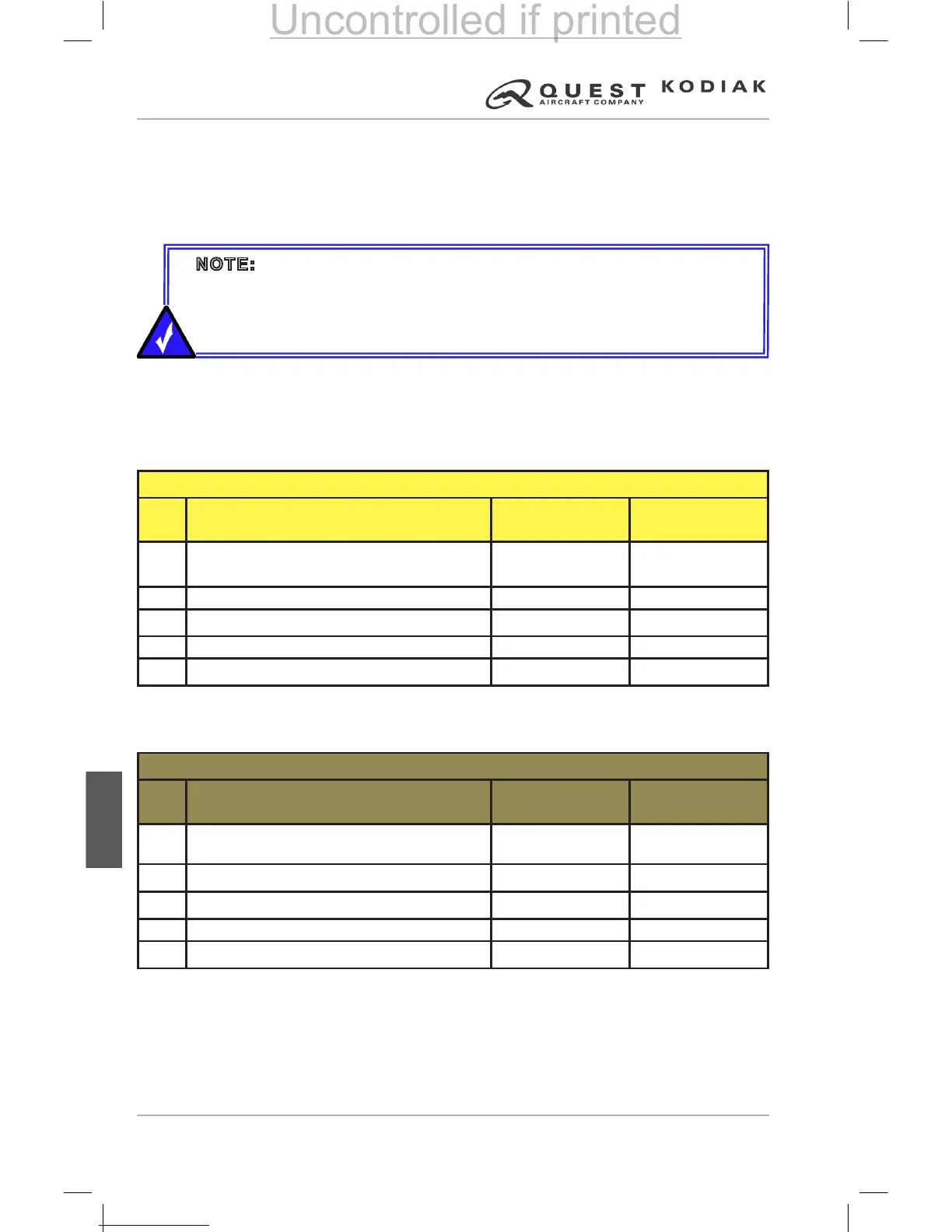
Standard Seating Positioning - (Conguration A)
Seat
Row
Ref. Point (FS), IN.
Empty Seat CG
(IN.)
Occupant CG
(IN.)
1
40.0
(Crew Seat Rear Stop located at FS 50.0)
41.0 35.0
2 84.0 79.3 73.2
3 115.0 110.3 104.2
4 146.0 141.3 135.2
5 177.0 172.3 166.2
Table 6-3 – Weight and Balance Calculations (Conguration A)
Standard Seating Positioning - (Conguration B)
Seat
Row
Ref. Point (FS), IN.
Empty Seat CG
(IN.)
Occupant CG
(IN.)
1
40.0
(Crew Seat Rear Stop located at FS 44.0)
41.0 35.0
2 78.0 73.3 67.2
3 109.0 104.3 98.2
4 140.0 135.3 129.2
5 171.0 166.3 160.2
Table 6-4 – Weight and Balance Calculations (Conguration B)
NOTE: Seats may only be installed within the limitations given in this
section. Crew seat rear stops must be installed in the location dened
by the congurations below. Failure to install the seat stop in the dened
location could result in seat positioning that does not meet the minimum
seat pitch requirements.


 To Next Page
 Loading...