15
15-50 d-Color MF552/452/362/282/222
[FTP] ([Public]/[Personal]/[Group]) ([Send])
To display: [Box] - Select a User Box - [Open] - Select the file - [Send] - [Direct Input] - [FTP]
Enter the host name or IP address of the destination FTP server to send files to the FTP server.
When specifying multiple destinations, tap [Next Dest.] to add destinations.
[Password] Enter the password of the user specified in [User Name].
[Reference] On the Touch Panel, search for a computer to send a file to, and select a
target shared folder.
When the authentication screen appears, enter the name and password of
a user who has privileges to access the selected folder. After authentica-
tion, [Host Name] or [File Path] is entered automatically.
The Reference function may fail in the following conditions.
• If 512 or more workgroups or computers are on the network (subnet)
connected to this machine, this function may fail.
• This function is not available in the IPv6 environment.
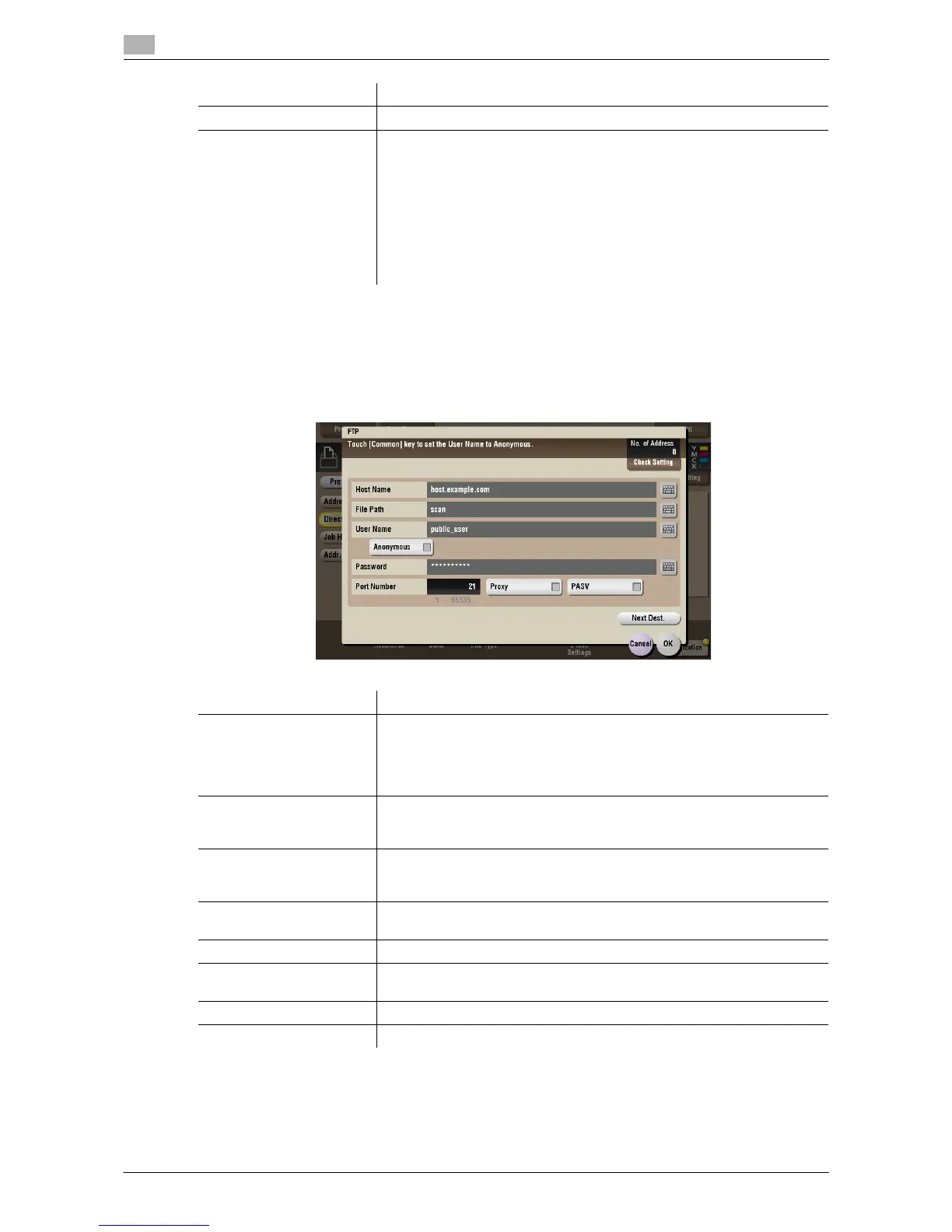
Settings Description
Settings Description
[Host Name] Enters the host name or IP address of the destination FTP server (up to 63
bytes long).
• Example of host name entry: "host.example.com"
• Example of IP address (IPv4) entry: "192.168.1.1"
• Example of IP address (IPv6) entry: "fe80::220:6bff:fe10:2f16"
[File Path] Enter the storage folder name of FTP server specified as the [Host Name]
(up to 127 bytes long).
• Entry example: "scan"
[User Name] Enter the login user name (using up to 64 characters) if the authentication
is required by the destination FTP server.
• Entry example: "public_user"
[Anonymous] When authentication is not required for the destination FTP server, select
this item.
[Password] Enter the password of the user specified in [User Name].
[Port Number] If necessary, change the port number.
Normally, you can use the original port number.
[Proxy] When a proxy server is used in your environment, select this item.
[PASV] When a PASV server is used in your environment, select this item.



 To Next Page
 Loading...