Vista 5 M3 Digital Mixing System
Desk Operation 2-3
2 VISTA 5 M3 DESK OPERATION
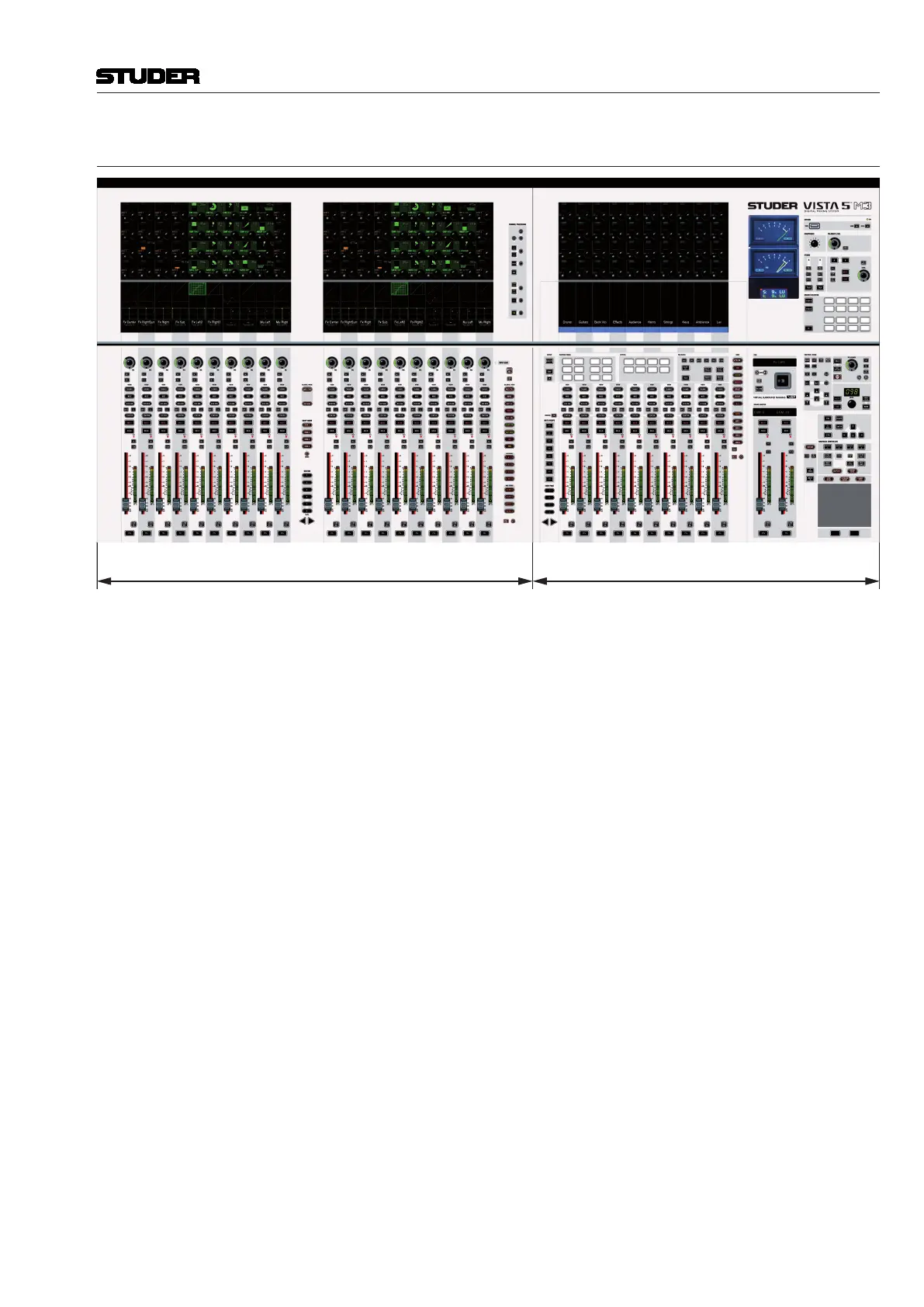
Fader Bays Control Bay
The desk consists of two types of bays: From one to three fader bays (ten
faders each), and one control bay (ten faders plus two ‘grand master’ faders).
For compactness, two fader bays are combined in a single fader bay module,
as shown above. This is the standard layout of a 32-fader console. The
42-fader version has one more 10-fader bay added at the righ of the control
bay, and the 22-fader version just has one 10-fader bay. Every bay features a
Vistonics screen with 40 rotary encoders in its upper part and a touch screen
surface below them.
The fader bays contain the console channel strips with rotary controls, faders,
keys, and meters. Ten strips are located next to each other in one bay. They
may be assigned to any DSP channel.
The control bay hosts the global desk operation controls, such as monitoring,
talkback, joystick and touchpad. It can also be used as fader bay in order to
control any DSP channel.
The desk contains the control system and their power supplies. A keyboard
is available in a drawer below the control bay.
An external TFT screen may be mounted on the rear of the desk in order to
display the Graphical Controller (GC) screen (refer to chapter 4). This screen
may be attached to the desk in one of two locations: Exactly above the control
bay or at the right of the console. If the TFT level meter option is installed,
this GC screen is already integrated into the meter bridge.
Each key marked with this symbol can be activated either momentarily or
latching. Pressing this key for a short time will make it latching. Holding it
down for a longer period of time will reverse its function automatically upon
key release.
Document generated: 28.08.13
SW V4.9


 To Next Page