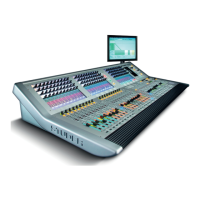
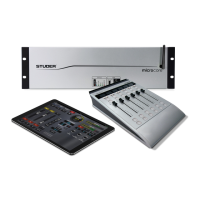
Vista 5 M3 Digital Mixing System
5-18 AutoTouchPlus
Document generated: 28.08.13
SW V4.9
5.3.3 Operational Philosophy
The automation system follows the paradigm that there is audio under each
control. It is as if this were a conventional analog moving fader system, in
which case the fader position always represents the audio level. This is re-
ferred to as WYSIWYH (‘What You See Is What You Hear’). However, in
order to enhance the operation of the system, this rule is broken from time to
time. Those cases will be noted and they are the exception. The general rule
is WYSIWYH.
Formula Based System In order to make a very powerful system that is also easy to understand, the
system is based on a set of consistent Rules that pertain to the behavior of
each mode or function. It is the consistency of these Rules, that allow the
system to be simple to understand, yet very deep and powerful.
To these Rules, Conditions and Options may be imposed that further define
the behavior of the basic modes or functions. It is these Conditions and Op-
tions that add extra facility and flexibility to the system.
Options essentially ‘fine-tune’ the functionality or operation of specific areas
of the system.
The combination of Rules, Conditions, and Options allows the user to start
using the system in a basic and easy to use manner. As familiarity increases
(and based on the needs of the production), more complex operations may
be carried out by applying the appropriate Conditions and/or Options. The
system also provides extreme flexibility so operation may be essentially
‘customized’ to the task at hand and/or the working style of the user. The net
result is a powerful and flexible automation system, that is easy to use, but
can address even the most complex needs of any production.
Rules Rules define the basic behavior of a control, a function or a feature. The basic
Rules are simple and straightforward. In the simplest form, these Rules will
dictate the basic functionality of the system. In this regard, Rules mostly ap-
ply to the basic modes of operation, but it should be noted that all aspects of
the system have their own set of rules.
In some cases the Rules will be broken or modified, and the exact function
will be determined by a given set of Conditions and Options.
Conditions Conditions further define the behavior(s) of a control, function, or feature.
They are imposed by the selection of combinations of modes/features and
in some cases by way in which controls are operated. Conditions may be
influenced by the selected set of Options.
Options Options apply operational or functional details to specific areas of the system.
Options further define the behavior of the associated mode, control, feature,
or function. In some cases, Options may influence the system independently
of the Rules and Conditions being applied. Options are set by selecting the
appropriate tab in the Mix Options page. They are indicated throughout this
document within brackets, i.e. <Option>.
Operational Formula The essential aspect to understanding the system is the following formula:
Rules + Conditions + Options = Exact Function


 To Next Page