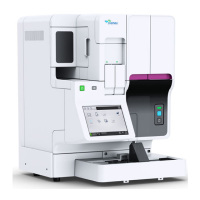
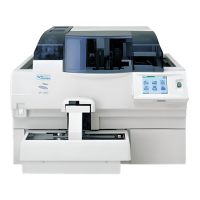
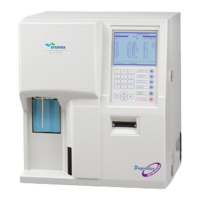
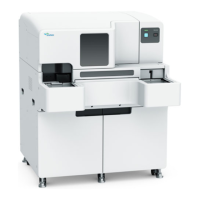
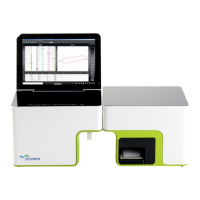
14-22 Sysmex XP-300
Technical Information
Revised October 2012
Non-cyanide hemoglobin analysis method
To analyze hemoglobin by automated methods, the Cyanmethemoglobin method or Oxyhemoglobin
method have so far been the main stream.
Cyanmethemoglobin method was recommended as the international standard method in 1966 by
ICSH (International Committee for Standardization in Hematology). This method, however, is so low
in hemoglobin conversion rate that it cannot be said an appropriate method in the automated process
in which multi-sample processing is the pre-condition. In addition, this method uses the reagent of
cyanide compound which is a poisonous substance and requires waste processing; thus, it can hardly
be called an environmentally favorable method.
At present, this method cannot be said suitable for a fully-automated instrument which is required to
handle a large amount of waste.
The Oxyhemoglobin method, on the other hand, is faster in hemoglobin conversion rate; in fact,
blood hemoglobin is converted instantaneously into oxyhemoglobin. Also, it does not contain
poisonous substance as cyanmethemoglobin method, making the method suitable for automation.
This method, however, is unable to convert methemoglobin into oxyhemoglobin. Consequently,
when a great amount of methemoglobin is contained as in control blood, lower-than-real values
result, although usual human blood poses no problems.
Non-cyanide hemoglobin analysis method utilizes the advantages of both of the above methods. Non-
cyanide hemoglobin analysis method rapidly converts blood hemoglobin as the Oxyhemoglobin
method and contains no poisonous substance, making it suitable for automated method.
Being capable of analyzing methemoglobin, this method can accurately analyze control blood, etc.
which contain methemoglobin.



 To Next Page