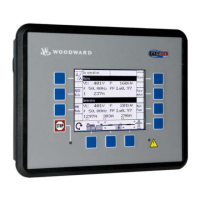
The easYgen(s) are started by a remote start signal or by AMF mode and operating their
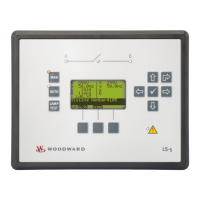
GCBs. The other breakers, handled from the LS-5, receive their breaker open and close
commands through orders coming from an external logic. The external logic could be a
discrete input, a remote control bit, a monitor function, an easYgen command, etc..
In this example the decision when to close or open the breaker is managed by a PLC
sending its orders over the CANopen protocol. Serial Modbus can also be used to send
orders or read information from all members.
For additional information refer to ╚═▷ “7 Interfaces And Protocols”.
Amongst others, the breaker feedbacks of the single LS-5 are sent via the CAN interface
and inform all other connected devices in the system, whether they are interconnected or
not. This determines the argument of the regulation for the easYgen (i.e. power control,
frequency control, load sharing).
Required application modes:
• easYgen-3400/3500 or easYgen-3400XT/3500XT:
A07
• LS-5:
A02
General notes
Please note that the measured power of all LS-5s in the same segment are accumulated
if there a several mains interchange points. The import/export control is based on this
accumulated power. It is not possible to individually control the power at the single mains
interchange points in the same segment.
All units must be
congured according to the requirements listed in ╚═▷ “6.3.1
Introduction”.
The following example does not contain any isolation switches, which could divide the
segments.
⚙
1. ▷
Draw a single line diagram that only contains essential equipment.
In this case the schematic should contain two incoming mains with MCBs, two or more
generators per generator segment, and all breakers (tie-breaker, GCB, GGB, MCB).
2. ▷
Number all easYgen control units from 1 to 32.
3. ▷
Number all system LS-5s from 33 to 48.
4. ▷
Number all CAN Node-IDs (usually the same as the device number).
5. ▷
Number all segments according to the denitions in ╚═▷ “Segment number”.
Unless special numbering conventions are required, count up continuously
from left to right or right to left.
279LS-5 v2 Series37650
6 Application
6.4 Setup easYgen & Independent LS-5x2 Applications (Mode A02)


 To Next Page
 Loading...