Chapter 7. Node and Terminal Plug-ins
Vol. IV-7-82 Alcatel-Lucent
Figure 7-33. Link Aggregation Example
Operational Characteristics
Within a DAC GE, port status propagation can only by executed without
ambiguity if there is a one-on-one (unique) relationship between related ports.
• Do not enable for many-to-many or one-to-many port/channel (non-unique)
relationships. Non-uniquely related ports do not execute status propagation
even if enabled in the configuration.
• When establishing port relationships, the DAC GE only considers user ports
and transport channels that are activated (enabled user ports, or
traffic-configured transport channels).
• Aggregated ports are considered as one virtual port, which means status
propagation can be enabled in this instance. If one of the aggregated ports is
down, the DAC-GE will automatically shutdown the uniquely related user port.
Similarly, if the uniquely related user port is down, it will automatically
shutdown the aggregated ports.
• Current implementation of link status propagation is not designed for double
failures. In order to avoid oscillation under such conditions, the DAC-GE
incorporates a delay of 20 seconds after port restoration.
• When a DAC-GE restores a port (port is forced up as a consequence of link
status propagation), a delay of 20 seconds occurs before port status is
re-verified.
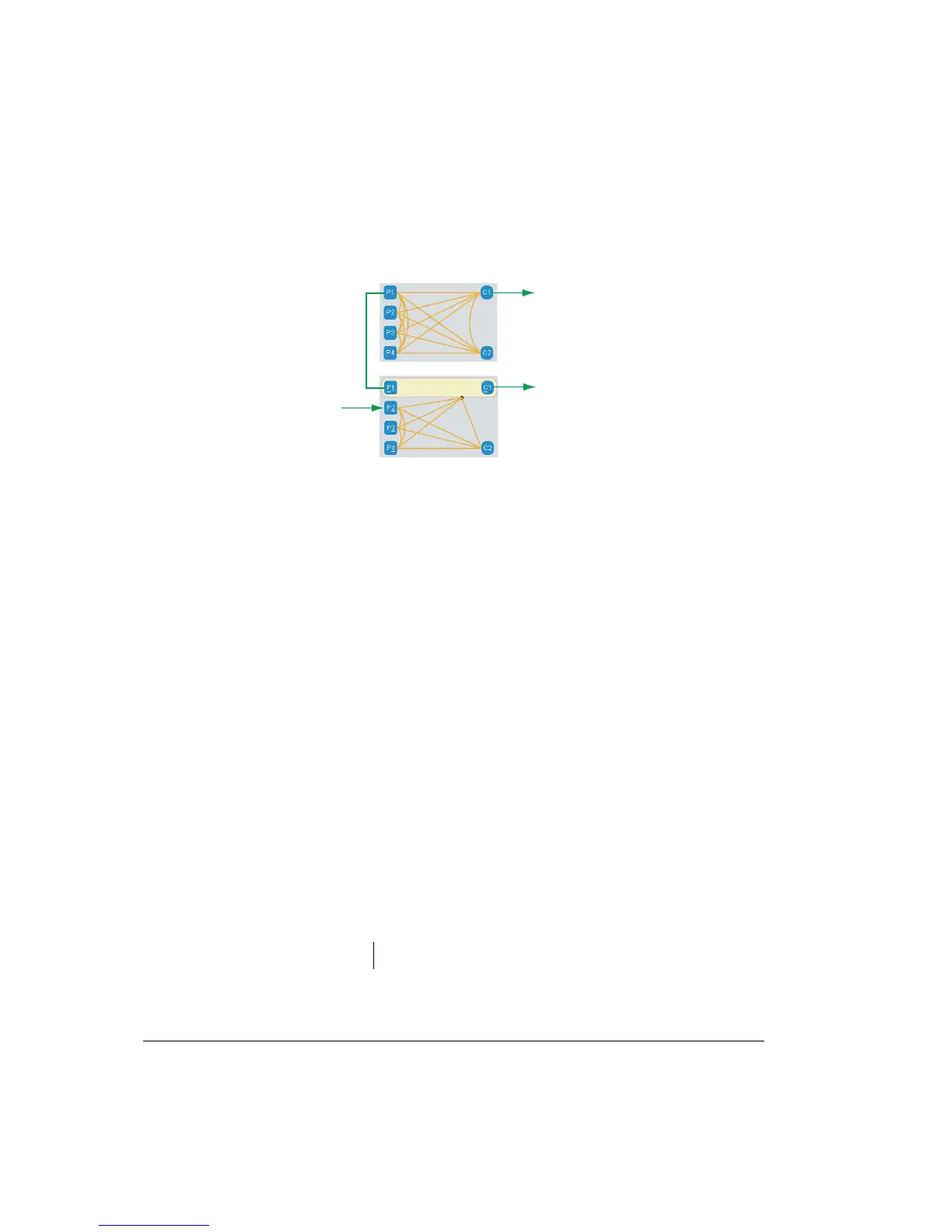
The following examples in Figure 7-34 illustrate these operational
characteristics. The green arrows indicate that a port/channel is activate,
otherwise it is inactive. Remember that Link Status Propagation should only be
enabled on the link or links that are to be aggregated - it should no be enabled on
the DAC GE that is hosting the aggregation function.
Example A: P1 & C1 are uniquely related, so link status propagation can be enabled.
300 Mbps
300 Mbps
600 Mbps
Link A
Link B



 To Next Page