82.3-0000010 OM
60
2.19.2 Seat «BELARUS» adjustments
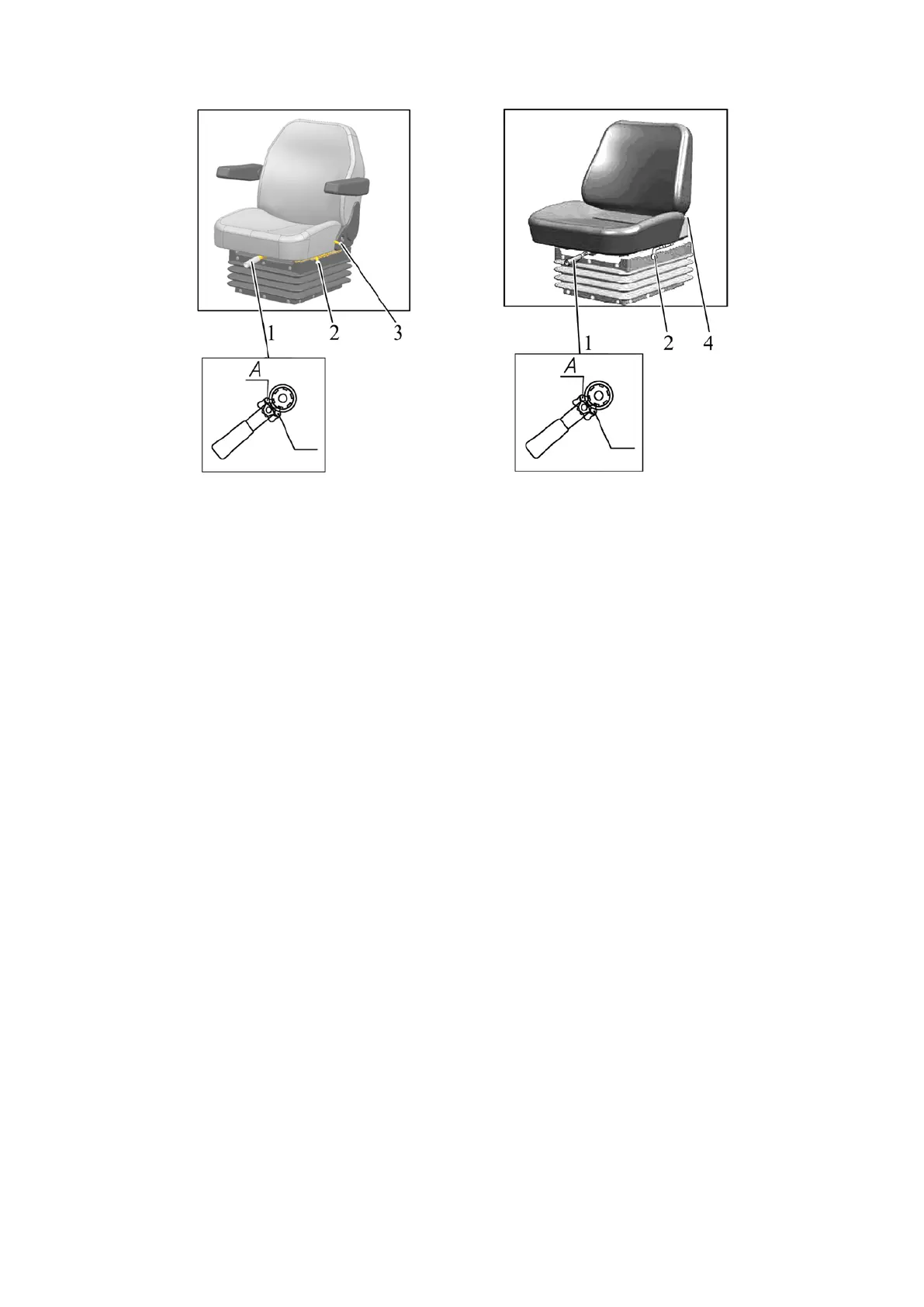
a) Seat BELARUS variant 1 b) Seat BELARUS variant 2
1 – handle for weight adjustment; 2 – handle for longitudinal adjustment;
3 – handle to adjust the backrest tilt; 4 – lever to adjust the backrest tilt.
Figure 2.19.1 – Seat BELARUS adjustments
The “BELARUS” seat has the following adjustments:
- adjustment according to the operator's weight. It is carried out by means of a han-
dle 1 (Figure 2.19.1) within the range from 50 to 120 kg. To adjust the seat for a bigger
weight it is required to turn the handle clockwise to the position "A" and to tighten the
springs by reciprocating movements. In order to adjust the seat to a lower weight it is nec-
essary to move the knob to position "B" and to release the springs with a reciprocating mo-
tion.
- longitudinal adjustment. It is carried out by means of handle 2 within the range of
± 80 mm from the middle position. To move the seat forward or backward, pull handle 2
up, move the seat and then release the handle. The seat will automatically get fixed in the
selected position.
- adjustment of the backrest tilt angle:
a) For the seat "BELARUS" variant 1 is carried out by the handle 3 within the
range from minus 15° to plus 20° with an interval of 5°. To change the backrest tilt angle,
pull lever 3 up, tilt the backrest to the necessary angle forward or backward and then release
the lever. The seat will automatically get locked in the selected position.
b) For the seat "BELARUS" variant 2 is carried out by the handle 4 within the
range from plus 5° to plus 25° with an interval of 5°. To change the backrest tilt angle, pull
lever 4 up against the stop, tilt the backrest to the necessary direction to achieve the re-
quired angle and then release the lever. The seat will get locked in the selected position.
- height adjustment. It is carried out within the range of ± 30 mm from the middle
position. The seat has three height positions: “lower”, “middle” and “upper”. To move the
seat from the “lower” position to the “middle” position or from the “middle” position to the
“upper” one it is required to lift the seat up smoothly till the ratchet goes off (a typical click is
heard). To move the seat from the “upper” position into the “lower” one it is necessary to lift
the seat up against the stop with an abrupt movement and then move it down. It is impossi-
ble to move the seat from the “middle” position to the “lower” one.



 To Next Page