82.3-0000010 OM
104
4.3.4 Attachment of implements to a tractor
During attachment of implements to a tractor, ensure that there are no people in the
area where the implement is being coupled. Using RLL controls, put down lower links to
the required level and connect the joints of the lower links to the implement and then con-
nect upper link joint by means of a pin. Use the right lifting rod to adjust the implement po-
sition in transverse plane. To make adjustments in fore-and-aft plane for alignment of
depth of front and rear working attachments of the implement, change upper link length by
turning link pipe to the necessary direction.
Final adjustment of the machine shall be made in the field.
Before starting operation, ensure that:
- tractor parts are not in dangerous proximity to implement components;
- upper link does not touch PTO guard with the implement in its lowest position;
- cardan drive from PTO is not abnormally long, with bigger joint angles and that
there is no thrust force;
- PTO guard does not touch machine cardan drive guard;
- lift the implement slowly and check availability of clearances between tractor and
implement in upper position;
- check availability of the required side oscillation of lower links and adjust by means
of buckles, when necessary.
WARNING: SOME TYPES OF MOUNTED OR SEMI-MOUNTED IMPLEMENTS
CAN TOUCH THE CAB AND DAMAGE IT. IT CAN RESULT IN DAMAGE TO THE CAB
WINDOWS AND CAUSE INJURY TO THE OPERATOR. CHECK AVAILABILITY OF
CLEARANCES (NOT LESS THAN 100 MM) BETWEEN FULLY RAISED IMPLEMENT
AND OPERATOR’S CAB!
Mount machines (implements) on a tractor by means of automatic coupler СА-1,
connected to the tractor lift linkage in three points (two rear hinge joints of lower links and
rear hinge joint of upper link).
4.3.5 Rules for switching the RLL from the working position to the transport position
Switch the RLL from the working position to the transport position as follows:
- raise the lower links to the uppermost position and lock the buckles as specified in
section 4.3.3.1 "Buckles";
- with the RLL locking mechanism lever, lock the rear lift linkage in upper (transport)
position as specified in section 2.14.4 "Control of RLL locking mechanism in transport posi-
tion on tractors with draft regulator", or in section 2.14.5 "Control of RLL locking mecha-
nism in transport position on tractors without draft regulator";
- if the RLL is set in transport position without attached implement, it is necessary to
raise the upper link and lock it in transport position, as indicated below in the text.
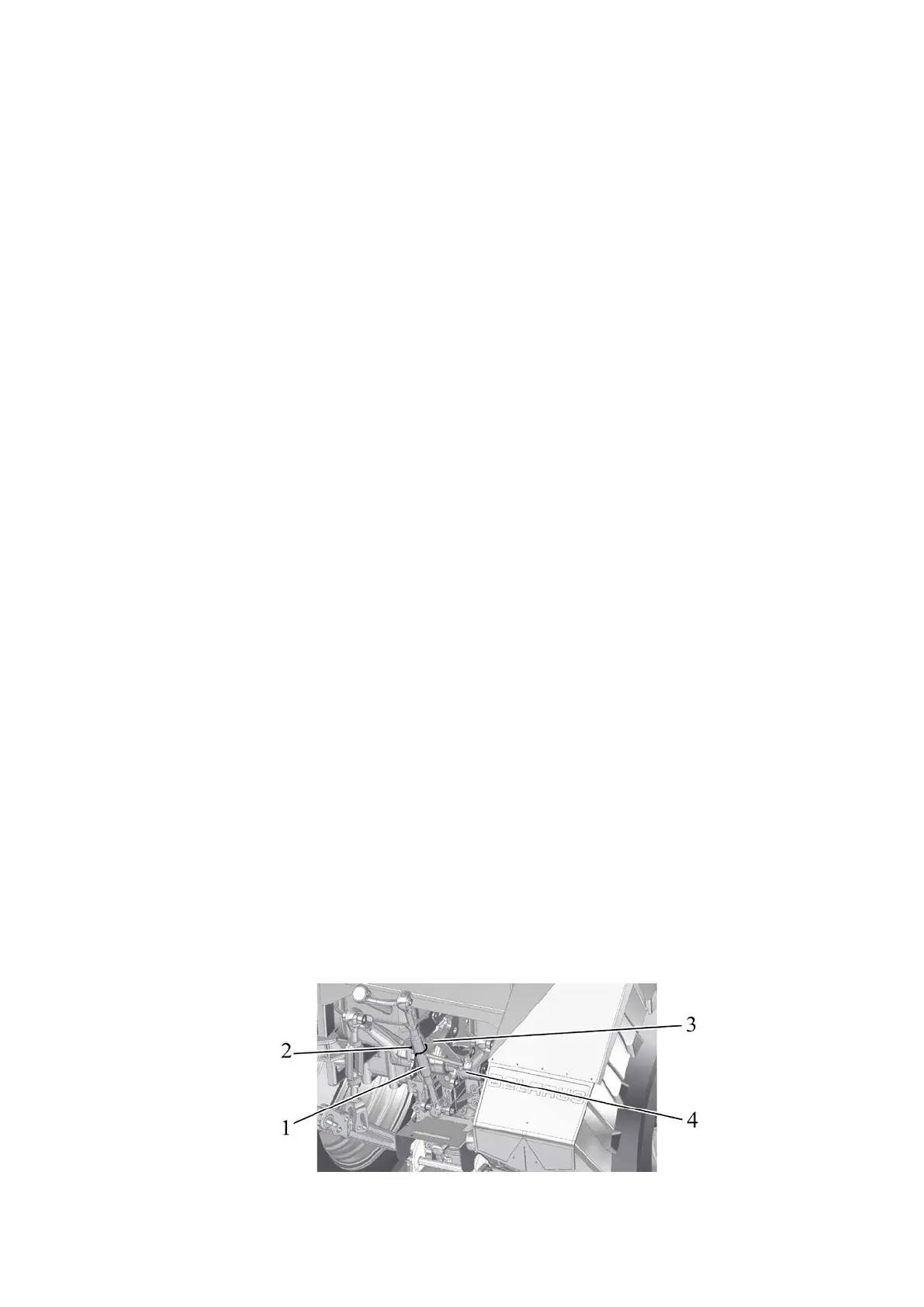
If your tractor design uses spring locking of the upper link in the transport position,
lift the upper link 1 (Figure 4.3.13) and lock it between the spring whiskers 2 in the bracket
3 by pressing in.
1 – upper link; 2 – spring; 3 – bracket; 4 – RLL.
Figure 4.3.13 – Setting RLL upper link in the transport position



 To Next Page