82.3-0000010 OM
39
2.7 Steering
2.7.1 General information
The BELARUS-82.3 tractors are equipped with hydrostatic steering control (HSC)
designed for steering of the guiding wheels and decreasing the necessary effort on the
steering wheel with the feed pump operating. If the feed pump is not operating or fails to
deliver oil into the system’s control circuit (in case the engine is stopped or there is a mal-
function in the HSC), the steering is performed in the manual mode, which requires appli-
cation of a greater effort on the steering wheel in order to turn the wheels.
2.7.2 Steering wheel adjustments
The steering wheel has the following adjustments:
- horizon tilt angle adjustment;
- height adjustment, along steering shaft axis.
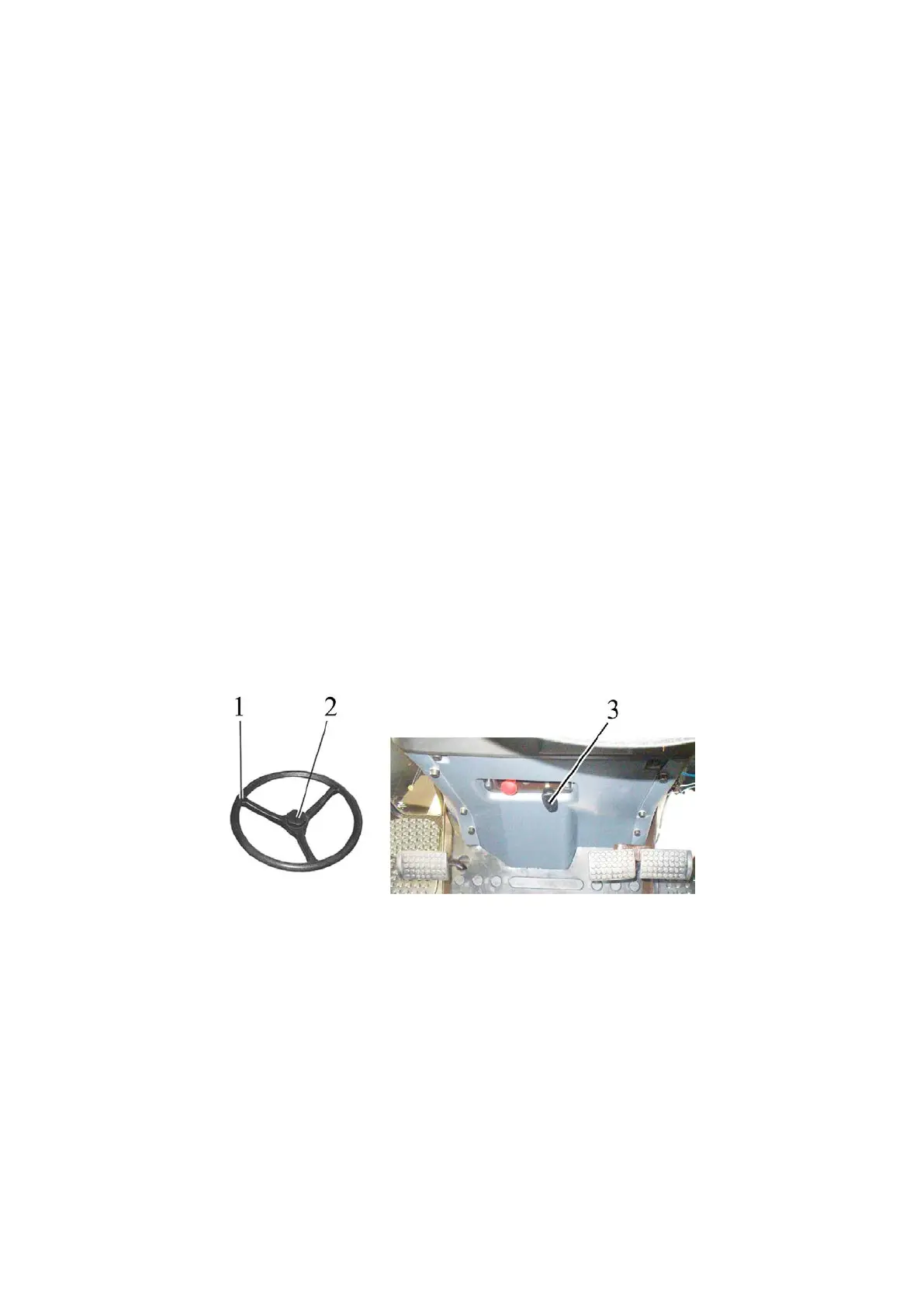
To change height positioning of the steering wheel proceed as follows:
- unscrew chuck 2 (figure 2.7.1) by 3-5 revolutions;
- set wheel 1 to a position comfortable for work;
- screw in chuck 2 with maximum possible force of fingers.
The range of the steering wheel height adjustment is 100 mm, gradual adjustment.
To change the steering column tilt angle do the following:
- pull handle 3;
- tilt the steering column to reach the position comfortable for work, and while re-
leasing handle 3, swing the steering column smoothly in longitudinal direction until fixed
firmly.
The steering column can be tilted and fixed in four positions from 25° to 40° with the
interval of 5°.
1 – steering wheel; 2 – chuck; 3 – handle to fix the tilt of the steering column.
Figure 2.7.1 Steering wheel adjustments
2.8 Parking brake control
Upper position of the lever 36 (Figure 2.1.1) stands for an engaged parking brake;
Lower position of the lever 36 stands for a parking brake turned off.
To disengage the parking brake, press the control lever button and let the lever 36
down until it stops.
2.9 Handle for fuel feed manual control
Moving handle 41 (figure 2.1.1) to the extreme front position increases fuel feed to
the maximum, and moving the handle to the extreme rear position decreases fuel feed to
the minimum, which corresponds to the minimum idle speed.



 To Next Page