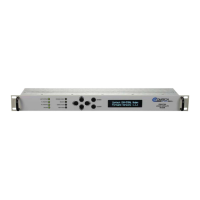
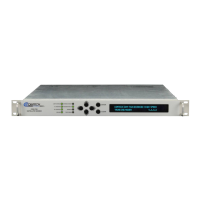
SLM-5650B Satellite Modem
Revision 2
Appendix D D–1 MN-SLM-5650B
Appendix D. MODEM OPTIONS
D.1 Forward Error Correction Options
As standard, the SLM-5650B Satellite Modem is equipped with three Forward Error Correction
(FEC) encoders/decoders: Viterbi, Trellis and TURBO (or Turbo Product Codes). The constraint
lengths and encoding polynomials are not only Open Network compatible, but are also Closed
Network compatible with the vast majority of existing modems from other manufacturers. The
modem also provides the capability to disable all FEC, allowing the modem to run uncoded.
D.2 Viterbi
The combination of convolutional coding and Viterbi decoding has become an almost universal
standard for satellite communications. The modem complies with the Intelsat IESS 308 and 309
standards for Viterbi decoding with a constraint length of seven. This is a de facto standard, which
means inter-operability with other manufacturer’s equipment. It provides very useful levels of
coding gain, and its short decoding delay and error-burst characteristics make it particularly
suitable for low data rate coded voice applications. It has a short constraint length, fixed at 7, for
all code rates. (The constraint length is defined as the number of output symbols from the
encoder that are affected by a single input bit.)
By choosing various coding rates (Rate 1/2, 3/4 or 7/8) the user can trade off coding gain for
bandwidth expansion. Rate 1/2 coding gives the best improvement in error rate, but doubles the
transmitted data rate, and hence doubles the occupied bandwidth of the signal. Rate 7/8 coding,
at the other extreme, provides the most modest improvement in performance, but only expands
the transmitted bandwidth by 14 %. A major advantage of the Viterbi decoding method is that the
performance is independent of data rate, and does not display a pronounced threshold effect (i.e.,
does not fail rapidly below a certain value of Eb/No). Note that in BPSK mode, the modem permits
code rates of 1/2, 3/4, and 7/8.
Because the method of convolutional coding used with Viterbi, the encoder does not preserve the
original data intact, and is called non-systematic.


 To Next Page