Nano Series GigE Vision Camera Additional Reference Information • 279
Light Sources
Keep these guidelines in mind when selecting and setting up light source:
• LED light sources are relatively inexpensive, provide a uniform field, and longer life span
compared to other light sources. However, they also require a camera with excellent
sensitivity.
• Halogen light sources generally provide very little blue relative to infrared light (IR).
• Fiber-optic light distribution systems generally transmit very little blue relative to IR.
• Some light sources age such that over their life span they produce less light. This aging may
not be uniform—a light source may produce progressively less light in some areas of the
spectrum but not others.
IR Cut-off Filters
Genie Nano cameras are responsive to near infrared (IR) wavelengths. To prevent infrared from
distorting the color balance of visible light acquisitions, use a “hot mirror” or IR cut-off filter that
transmits visible wavelengths but does not transmit near infrared wavelengths and above.
Genie Nano color cameras have a spectral response that extends into near IR wavelengths (as
defined for each sensor model in the sensor specification descriptions). Images captured will have
washed out color if the sensor response is not limited to the visible light band.
Nano Models with Built-in IR Cut-off Filters
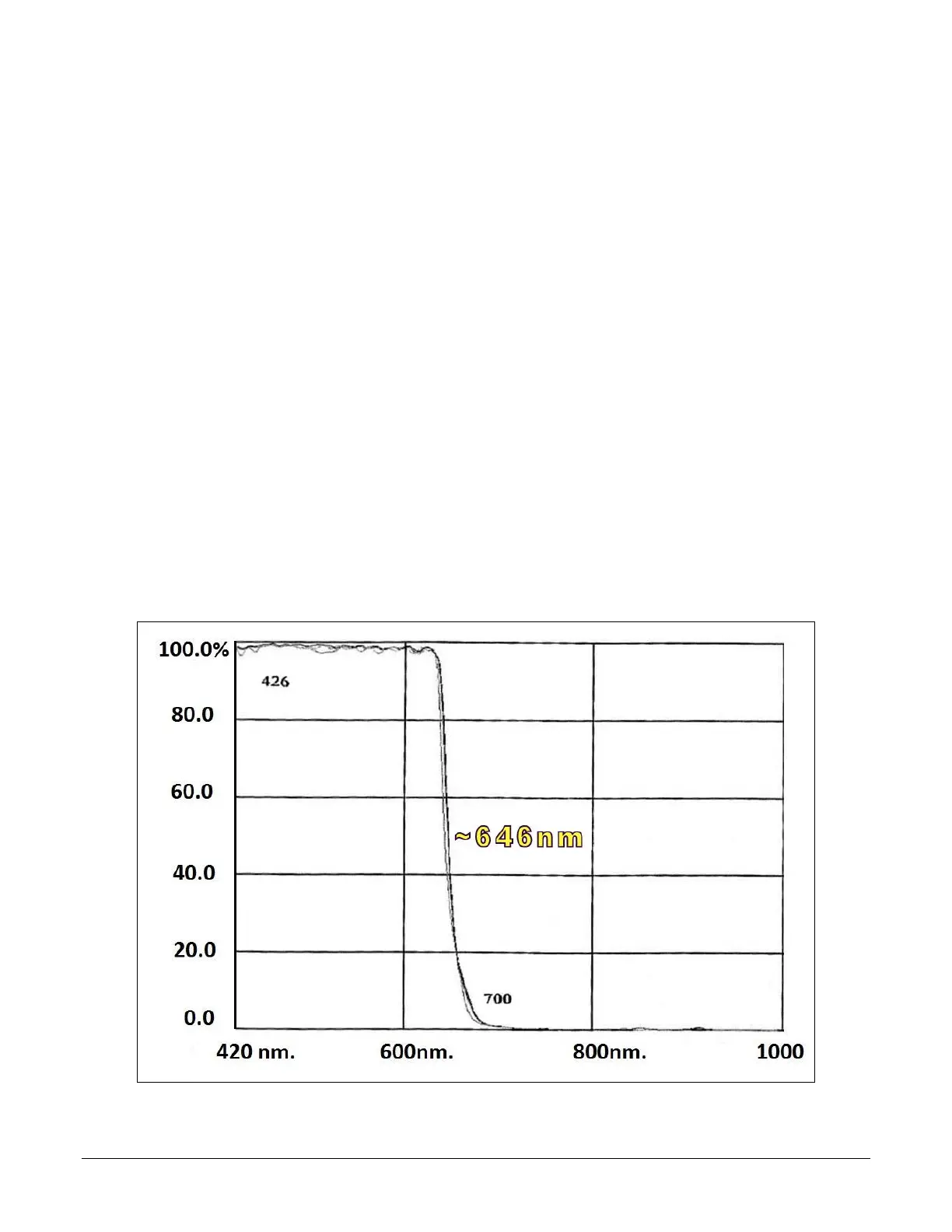
Choose Nano color cameras with built-in IR Cut-off Filters for an optimized solution. The following
graphic shows these models having an IR filter with a specified cut-off of about 646nm.


 To Next Page
 Loading...