GAMATRONIC ELECTRONIC INDUSTRIES LTD.
+
SA: 20, 30 and 40 kVA, Release 2.1
27
5. CIRCUIT BREAKER SELECTIVITY
When discussing power distribution, "discrimination" (also referred to as selectivity) is the
selection and arrangement of circuit breakers such that in the event of a short circuit or
overload in the line, the circuit breaker closest to the short will be tripped and the upstream
circuit breakers will remain unaffected.
In a UPS, the electrical circuit of the bypass ac input line includes the main circuit breaker
feeding the UPS and the circuit breaker distributing power to the load.
The UPS load is normally fed from the UPS's inverter. When a short circuit occurs, the UPS
detects the short circuit and switches the load to the bypass line. During the short circuit, the
current flows through the bypass line's main circuit breaker and continues through the other
circuit breakers in series to the load that is the source of the short circuit.
A problem that can arise in such a situation is how to prevent the main circuit breaker from
tripping before the downstream circuit breaker closest to the load is tripped.
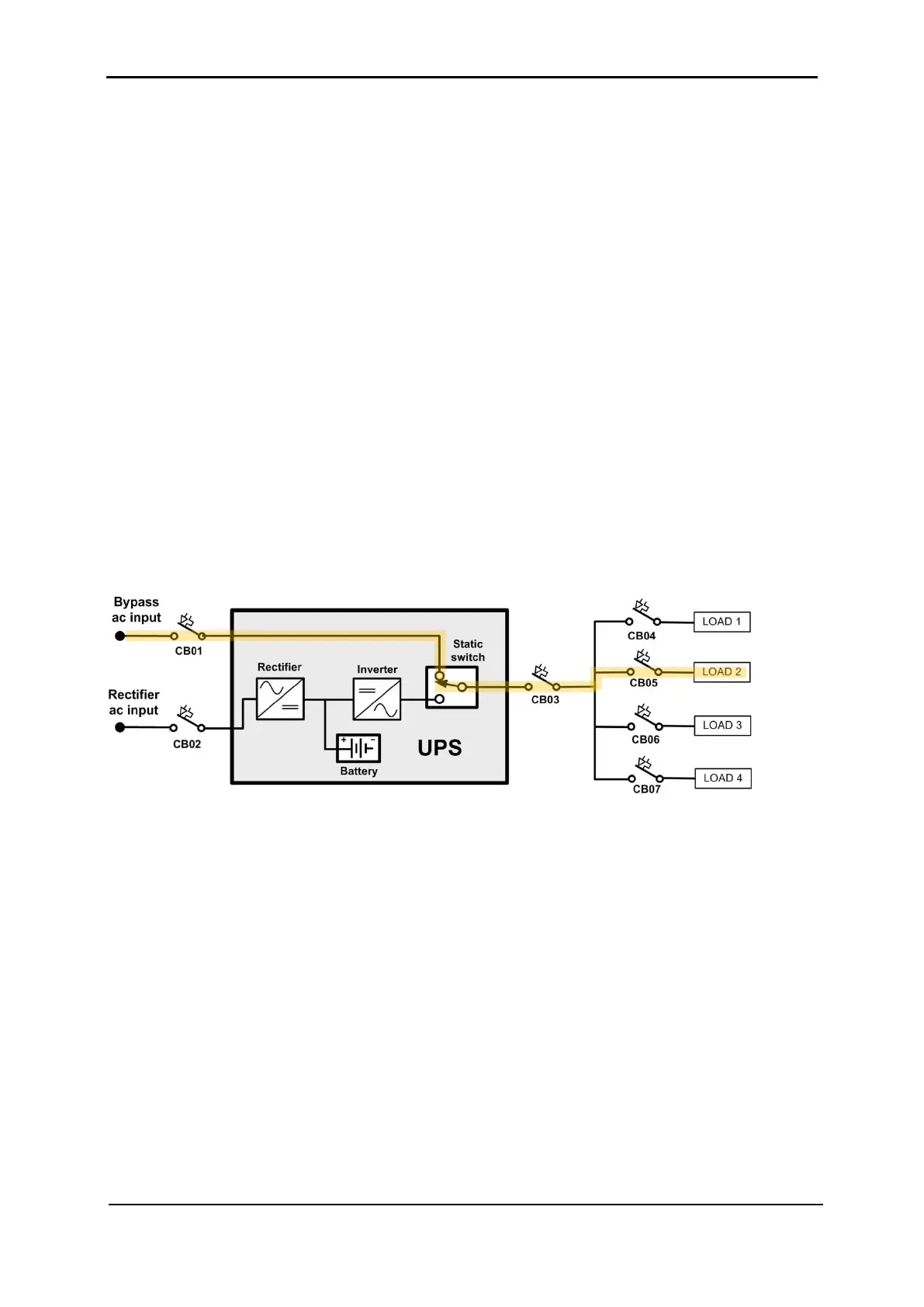
As an example, Figure 20 shows a typical UPS feeding a number of loads. When a short
circuit occurs in Load 2, the system switches the load to the bypass line. In the example, the
bypass line includes CB01, CB03, and CB05. The problem is how to prevent CB01 and
CB03 from tripping open before CB05 trips open.
Figure 20: A UPS's bypass circuit
Selection of circuit breakers to achieve discrimination involves the consideration of two factors:
thermal tripping and magnetic tripping. Circuit breakers can have one or both of these tripping
characteristics.
Magnetic tripping is activated immediately when the current though the circuit breaker exceeds a
specific limit. Magnetic tripping can include a deliberate delay, depending on the design of the specific
circuit breaker chosen.
Thermal tripping responds, with a delay, to lower-level, longer-term current excesses.
Thermal tripping can be useful on circuits that are subject to expected short-term current
overload, such as when a load with high-inrush current is turned on. In such a case you
would only want the circuit breaker to trip if the current overload continued for an abnormal
length of time.
Using Figure 20 as an example, optimal discrimination of circuit breakers in series can be
achieved by choosing them in such a way that when a short circuit occurs, the response of
circuit breaker feeding the bypass line (CB01) line will be based on thermal (slower-acting)
tripping, while the circuit breaker closest to the short circuit (CB05) will respond based on



 To Next Page