4.5
Date Code 20060320 Instruction Manual SEL-311C Relay
Loss-of-Potential, CCVT Transient Detection, Load-Encroachment, and Directional Element Logic
Load-Encroachment Logic
Load-Encroachment Logic
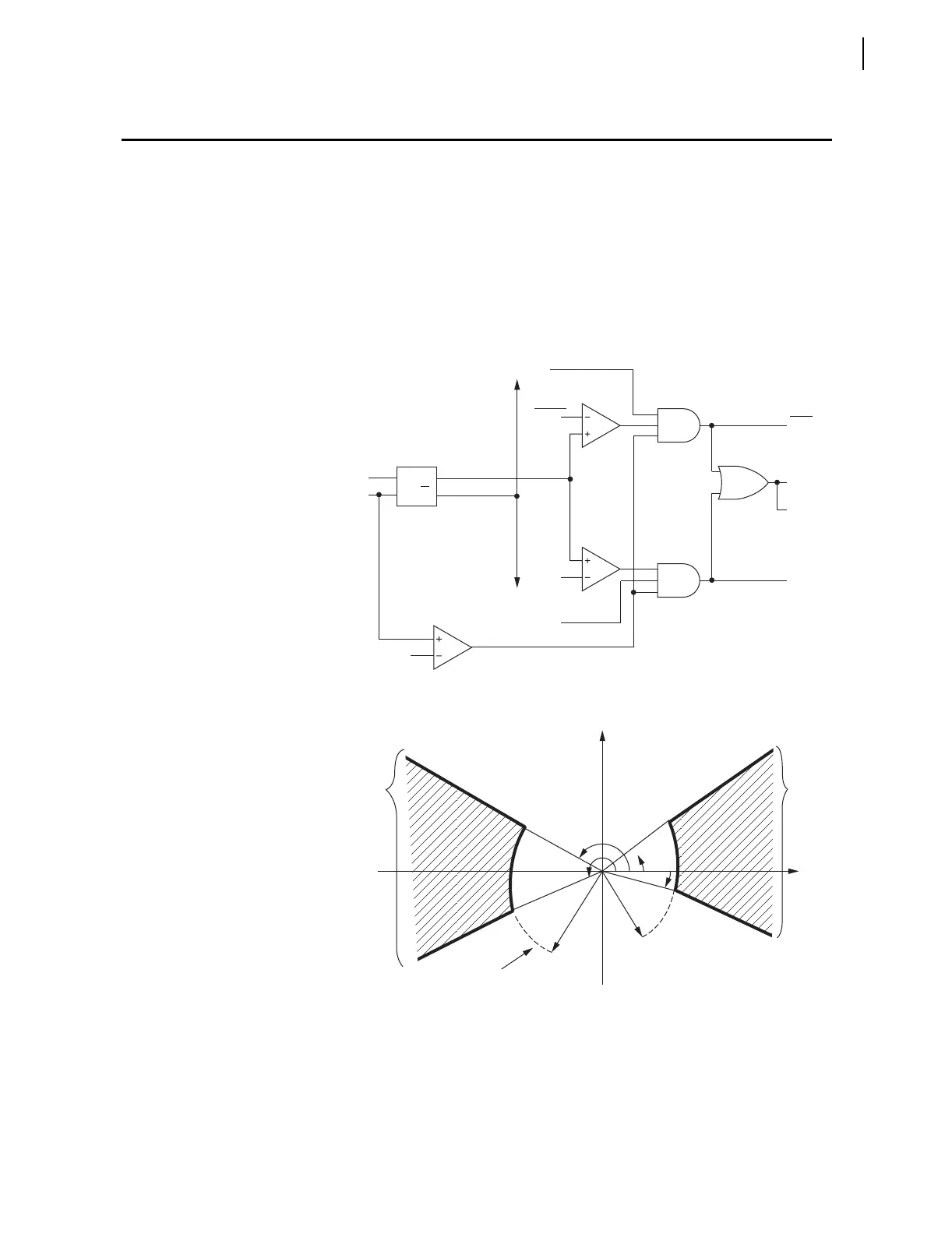
The load-encroachment logic (see Figure 4.3) and settings are enabled/
disabled with setting ELOAD (= Y or N).
The load-encroachment feature allows distance and phase overcurrent
elements to be set independent of load levels. Relay Word bit ZLOAD is used
to block the positive-sequence, voltage-polarized directional element (see
Figure 4.15), which may assert for three-phase load. The distance elements,
M1P–M4P, will not operate without directional control. Set !ZLOAD in the
phase overcurrent torque control equation to block phase overcurrent
operation.
q To Figure 4.15.
Figure 4.3 Load-Encroachment Logic With Example Settings
A positive-sequence impedance calculation (Z
1
) is made in the load-
encroachment logic in Figure 4.3. Load is largely a balanced condition, so
apparent positive-sequence impedance is a good load measure. The load-
(90˚)
(270˚) (—90˚)
(0˚)(180˚)
Example Settings
X
1
R
1
Positive-Sequence Threshold = (I
NOM
) • (0.1)
Load In
ZLOUT
ZLOAD
Load Out
ZLIN
PLAR
PLAF
>
∠
Z
1
>
NLAF
NLAR > ∠Z
1
> PLAR
Pos.-Seq.
Threshold
|Z
1
| (Magnitude)
∠Z
1
(Angle)
V
1
I
1
V
1
I
1
Z
1
=
q
Relay
Word
Bits
ZLF
ZLR
Settings
ZLIN
(Load In
Region)
ZLOUT
(Load Out
Region)
Z
LR = 19.00 Ω sec.
NLAR = 198˚
PLAR = 143˚
PLAF = 26˚
NLAF = —18˚
ZLF =
11.90 Ω sec.
(Setting)
(Setting)
(Setting)
(Setting)


 To Next Page