4.17
Date Code 20060320 Instruction Manual SEL-311C Relay
Loss-of-Potential, CCVT Transient Detection, Load-Encroachment, and Directional Element Logic
Directional Control for Phase Distance and Negative-Sequence Elements
Directional Control for Phase Distance
and Negative-Sequence Elements
The directional control for phase distance and negative-sequence overcurrent
elements is configured by making directional control setting E32. Setting E32
and other directional control settings are described in Directional Control
Settings on page 4.21.
Negative-sequence voltage-polarized and positive-sequence voltage-polarized
directional elements control the phase distance elements. The negative-
sequence voltage-polarized directional element operates for unbalanced faults,
while the positive-sequence voltage-polarized directional element operates for
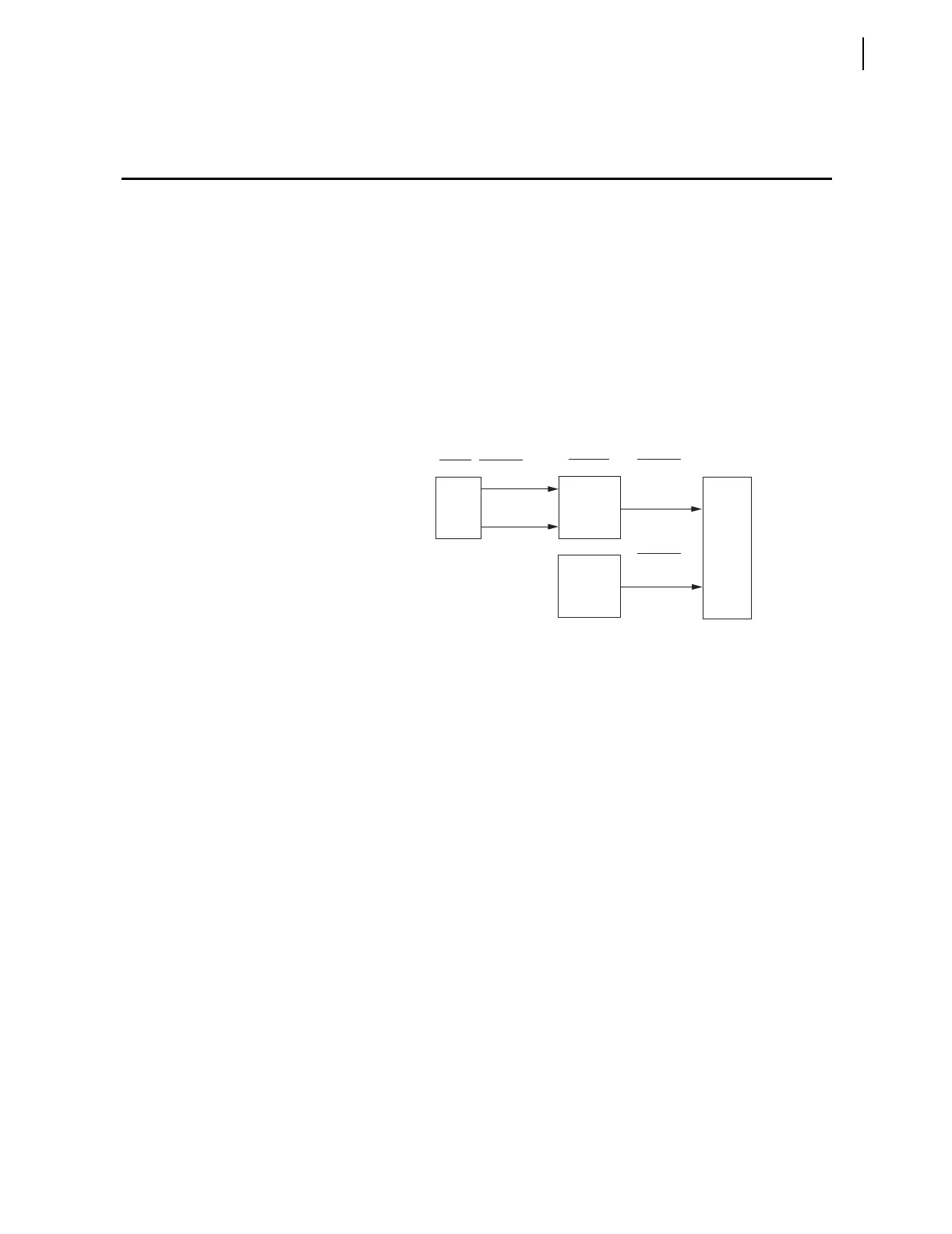
three-phase faults. Figure 4.13 gives an overview of how the negative-
sequence voltage-polarized and positive-sequence voltage-polarized
directional elements are enabled and routed.
q Figure 4.6; w Figure 4.14; e Figure 4.15; r Figure 3.4, Figure 3.5, Figure 3.6, and
Figure 3.23.
Figure 4.13 General Logic Flow of Directional Control for
Negative-Sequence Phase Overcurrent and Phase Distance Elements
Internal Enables
Refer to Figure 4.6 and Figure 4.13.
The Relay Word bit 32QE enables the negative-sequence voltage-polarized
directional element.
The settings involved with 32QE in Figure 4.6 (e.g., setting a2) are explained
in Directional Control Settings on page 4.21.
Directional Elements
Refer to Figure 4.13, Figure 4.14, and Figure 4.15.
If enable setting ELOP = Y or Y1 and a loss-of-potential condition occurs
(Relay Word bit LOP asserts), the negative-sequence voltage-polarized and
positive-sequence voltage-polarized directional elements and the phase
distance elements are disabled by ILOP (see Figure 4.14 and Figure 4.15).
Refer to Figure 4.1 and accompanying text for more information on loss-of-
potential.
The negative-sequence voltage-polarized directional element operates for
unbalanced faults while the positive-sequence voltage-polarized directional
element operates for three-phase faults.
Note in Figure 4.15 that the assertion of ZLOAD disables the positive-
sequence voltage-polarized directional element. ZLOAD asserts when the
relay is operating in a user-defined load region (see Figure 4.3).
Positive-
Sequence
Voltage-
Polarized
e
Negative-
Sequence
Voltage-
Polarized
w
32QE
50QF/
50QR
F32P/
R32P
32QF/
32QR
Internal
Enable
Relay Word
Bit Outputs
Directional
Elements
Relay Word
Bit Outputs
Internal
Elements
q
r


 To Next Page