13.10
SEL-311C Relay Instruction Manual Date Code 20060320
Testing and Troubleshooting
Relay Testing
The Amps specification indicates the nominal ac
current (1 A or 5 A) that the relay is designed to
measure. The relay measures other ac current
magnitudes accurately, as defined in Section 1:
Introduction & Specifications.
Purpose: Connect power supply voltage to the relay.
Method:
Step 1. Connect a frame ground to the terminal marked GND on the rear
panel and connect a voltage source to the terminals marked +
and –.
Polarity is unimportant. Relays equipped with 125 or 250 V
power supplies may be powered from a 115 Vac wall receptacle
for testing. In the final installation, we recommend that the
relay receive control power from the station dc battery. This
helps prevent loss of relay event reports stored in volatile
memory if station ac service is lost.
Purpose: Apply power supply voltage to the relay and access the relay via the
optional LCD front panel.
Method:
Step 1. Turn on the voltage source connected to the relay power supply
inputs.
Step 2. If you are using a battery simulator as the relay power supply
voltage source, be sure the simulator voltage level is stabilized.
a. The relay front-panel Enable target (EN) should
illuminate.
b.
EN should appear in the relay LCD screen.
c. The relay output labeled ALARM is typically configured
as a normally closed (form b) contact and closes to
indicate loss of dc power to the relay, failure of a relay
self-test, and several other functions. With power
applied to the relay and the relay turned on, the ALARM
contacts open.
d. If the Enable LED does not illuminate or
EN does not
appear on the relay LCD screen, turn off the power and
refer to Relay Troubleshooting on page 13.60.
Purpose: Perform a front-panel LED test and check LCD screen contrast.
Method:
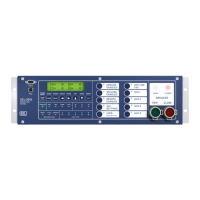
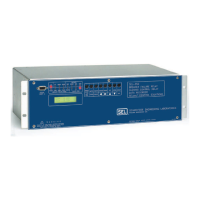
Step 1. Press the {TARGET RESET} pushbutton to perform an LED lamp
test.
a. During the lamp test, the relay illuminates all 16 front-
panel LEDs for about one second.
The relay also turns on the LCD back lighting. If the
LCD contrast is poor, refer to Relay Troubleshooting
for steps to adjust it.


 To Next Page