6.19
Date Code 20120126 Instruction Manual SEL-2032 Communications Processor
Database
Region Descriptions
Rows 20–27. CCIN1–CCIN64 are input bits, set by the card installed in the
slot.
Rows 28–35. CCOUT1–CCOUT64 are output bits, set by using SELOGIC
control equations specified with the SET O command.
You can use the CARD or TARGET command to view the status of the CCIN
and CCOUT bits.
Unsolicited
Message Buffer
The Unsolicited Message Buffer (BUF) contains all unsolicited messages
received from an IED. You must set AUTOBUF=Y with the SET A command
for unsolicited messages to be stored here. Use the CLEAR m:BUF or VIEW
m:BUF C commands periodically to clear the message queue so data are not
overwritten. Alternatively, a \DACn/ string can clear these buffers.
At the top of the Unsolicited Message Buffer region are two registers, Start
Index and End Index (see Ta ble 6.9), that contain register offsets. The Start
and End Indices reference the beginning address of the circular buffer (1002h)
to determine the address of the start and end of data. The first offset points to
the address of the beginning of unread data. The second offset points to the
address just beyond the last unread data. The SEL-2032 maintains the second
offset. If you reference these data by region with VIEW, CLEAR, or \DAC
string, the SEL-2032 maintains the first index for you. If you are directly
reading the data (using VIEW by address, or user-defined READ command)
you must maintain the first offset as data are read.
The remainder of the region acts as a circular character buffer beginning at
address 1002h. Each register in the circular buffer contains one character.
When the end of the buffer is reached, it wraps around to the beginning of the
circular buffer (address 1002h) and continues. If the buffer gets full (end index
catches up to start index), the oldest data will be overwritten.
When the SEL-2032 is connected to an SEL IED, the SEL-2032 removes all
passwords that are echoed from the SEL IED that would otherwise go into the
Unsolicited Message Buffer. This typically occurs in response to issuing the
STARTUP string to the SEL IED. This is to prevent unauthorized users from
gaining access to the SEL IED passwords by examining the unsolicited
message buffer.
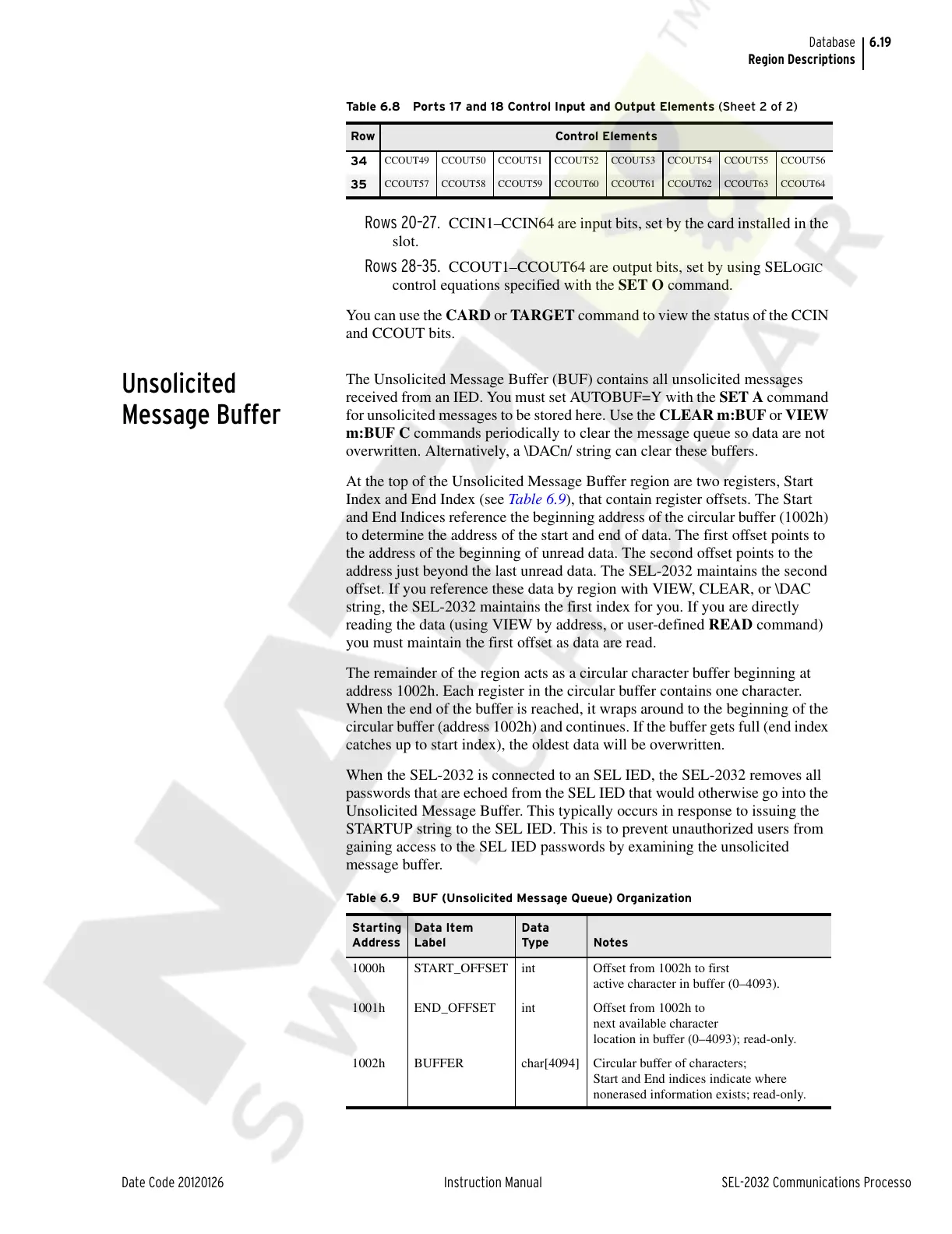
34
CCOUT49 CCOUT50 CCOUT51 CCOUT52 CCOUT53 CCOUT54 CCOUT55 CCOUT56
35
CCOUT57 CCOUT58 CCOUT59 CCOUT60 CCOUT61 CCOUT62 CCOUT63 CCOUT64
Table 6.8 Ports 17 and 18 Control Input and Output Elements (Sheet 2 of 2)
Row Control Elements
Table 6.9 BUF (Unsolicited Message Queue) Organization
Starting
Address
Data Item
Label
Data
Type
Notes
1000h START_OFFSET int Offset from 1002h to first
active character in buffer (0–4093).
1001h END_OFFSET int Offset from 1002h to
next available character
location in buffer (0–4093); read-only.
1002h BUFFER char[4094] Circular buffer of characters;
Start and End indices indicate where
nonerased information exists; read-only.
Courtesy of NationalSwitchgear.com


 To Next Page