1.4
SEL-2032 Communications Processor Instruction Manual Date Code 20120126
Introduction and Specifications
Substation Integration
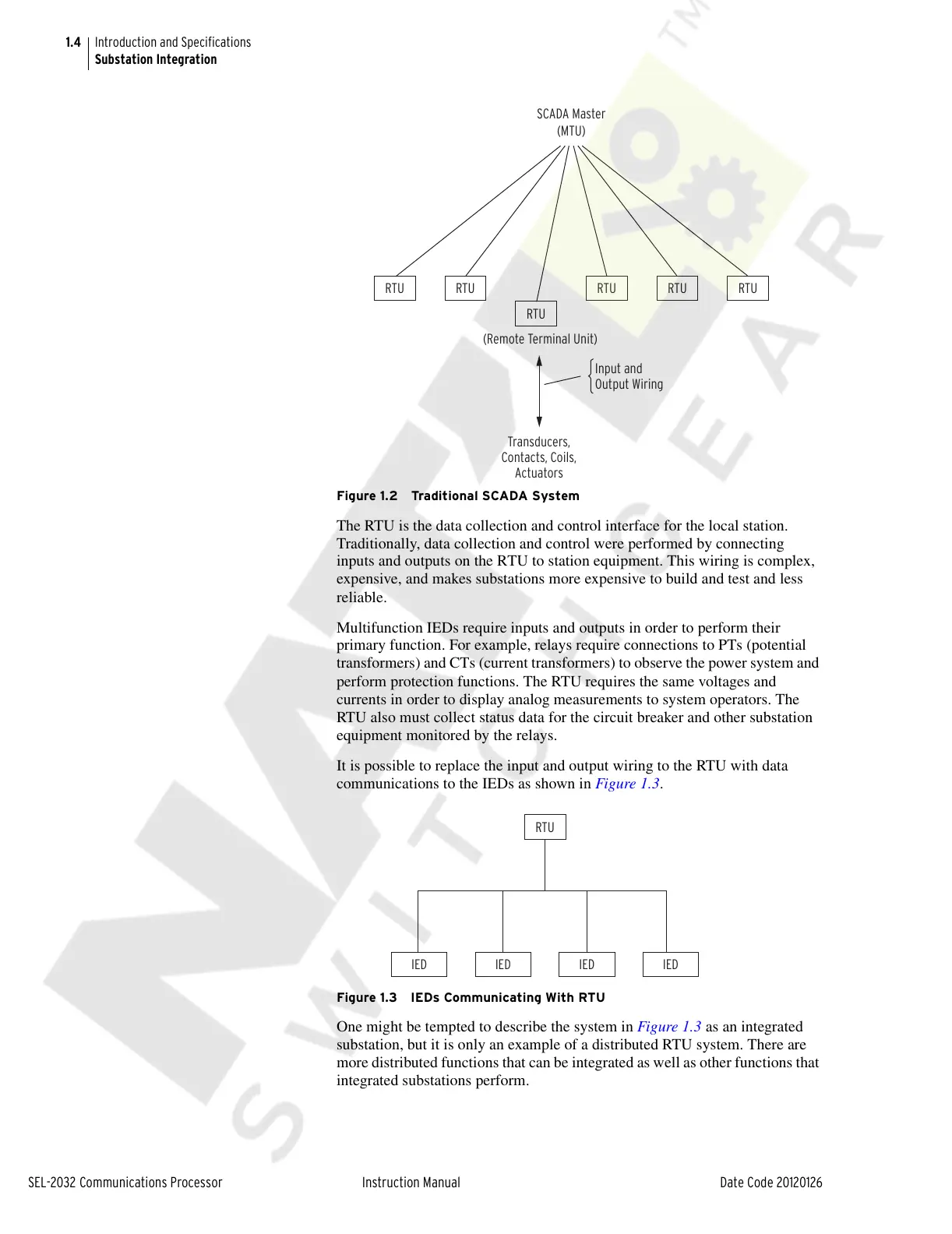
Figure 1.2 Traditional SCADA System
The RTU is the data collection and control interface for the local station.
Traditionally, data collection and control were performed by connecting
inputs and outputs on the RTU to station equipment. This wiring is complex,
expensive, and makes substations more expensive to build and test and less
reliable.
Multifunction IEDs require inputs and outputs in order to perform their
primary function. For example, relays require connections to PTs (potential
transformers) and CTs (current transformers) to observe the power system and
perform protection functions. The RTU requires the same voltages and
currents in order to display analog measurements to system operators. The
RTU also must collect status data for the circuit breaker and other substation
equipment monitored by the relays.
It is possible to replace the input and output wiring to the RTU with data
communications to the IEDs as shown in Figure 1.3.
Figure 1.3 IEDs Communicating With RTU
One might be tempted to describe the system in Figure 1.3 as an integrated
substation, but it is only an example of a distributed RTU system. There are
more distributed functions that can be integrated as well as other functions that
integrated substations perform.
SCADA Master
(MTU)
RTU
Transducers,
Contacts, Coils,
Actuators
Input and
Output Wiring
RTU RTU RTURTURTU
(Remote Terminal Unit)
Courtesy of NationalSwitchgear.com


 To Next Page