3.19
Date Code 20120126 Instruction Manual SEL-2032 Communications Processor
Job Done Examples
Example 4: Collect Unsolicited Write (Synchrophasor) Data
Example 4: Collect Unsolicited Write
(Synchrophasor) Data
The SEL-2032 is capable of collecting synchrophasor data from SEL IEDs
such as the SEL-311 series relays, most of the SEL-351 series relays, the
SEL-421 and SEL-451, and metering devices such as the SEL-734 at user-
defined discrete data rates. The SEL-2032 receives synchrophasor data as
Unsolicited Write (UW) Messages within the SEL Fast Message protocol.
This protocol is described in Section 9: Protocols.
Perform the following configuration steps to automatically collect
synchrophasor data as fast as 60 messages per minute from an SEL-311C and
make this data available to a DNP3 LAN/WAN master:
Step 1. Configure the SEL-311C Phasor Measurement Unit (PMU)
settings.
➢ Enter Access Level 2 on the SEL-311C and issue the
command SET G EPMU to edit Global settings.
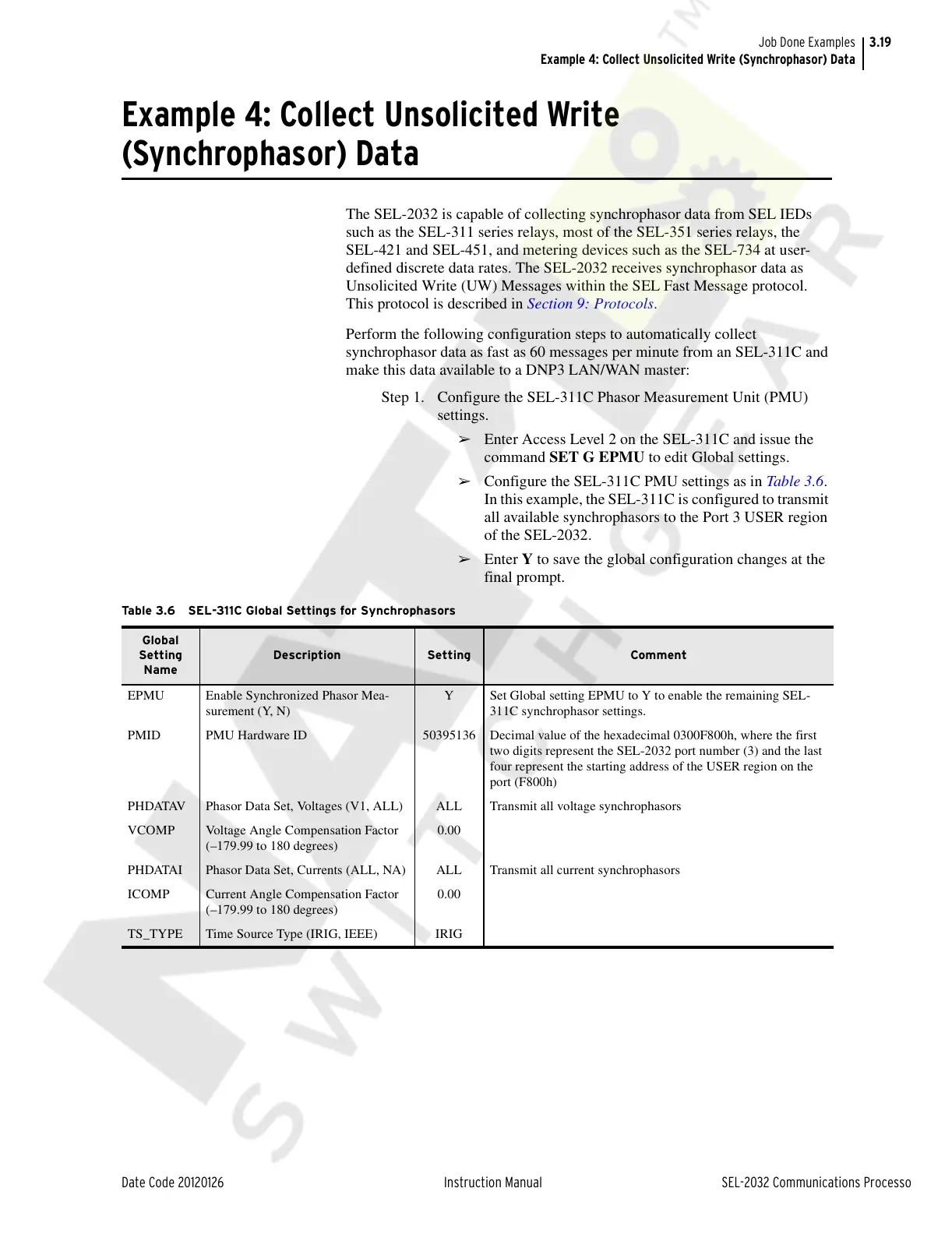
➢ Configure the SEL-311C PMU settings as in Table 3 .6.
In this example, the SEL-311C is configured to transmit
all available synchrophasors to the Port 3 USER region
of the SEL-2032.
➢ Enter Y to save the global configuration changes at the
final prompt.
Table 3.6 SEL-311C Global Settings for Synchrophasors
Global
Setting
Name
Description Setting Comment
EPMU Enable Synchronized Phasor Mea-
surement (Y, N)
Y Set Global setting EPMU to Y to enable the remaining SEL-
311C synchrophasor settings.
PMID PMU Hardware ID 50395136 Decimal value of the hexadecimal 0300F800h, where the first
two digits represent the SEL-2032 port number (3) and the last
four represent the starting address of the USER region on the
port (F800h)
PHDATAV Phasor Data Set, Voltages (V1, ALL) ALL Transmit all voltage synchrophasors
VCOMP Voltage Angle Compensation Factor
(–179.99 to 180 degrees)
0.00
PHDATAI Phasor Data Set, Currents (ALL, NA) ALL Transmit all current synchrophasors
ICOMP Current Angle Compensation Factor
(–179.99 to 180 degrees)
0.00
TS_TYPE Time Source Type (IRIG, IEEE) IRIG
Courtesy of NationalSwitchgear.com


 To Next Page