1.17
Date Code 20120126 Instruction Manual SEL-2032 Communications Processor
Introduction and Specifications
Functions
“20” Message Response
The SEL-2032 uses the auto-configuration information to parse “20” message
responses automatically. The SEL-2032 uses these messages with SEL relays
to collect relay data such as meter, target, event, and history. Meter and target
data are transferred from the SEL relay to the SEL-2032 in binary format.
Non-“20” Messages
Non-“20” responses can be ignored or parsed using any one of six parsing
options: ASCII Integer, ASCII Floating Point, Character String, Integer
String, Integer String with XON/XOFF encoding, and Flexible Parsing. Non-
“20” messages primarily are used with devices other than SEL relays (see
Section 5: Message Strings for more information).
You can use the SET A command to create SEL
OGIC control equations for
message triggering and the associated message strings. Also use SET A to set
the AUTOBUF switch that determines if unsolicited messages will be stored
or ignored.
Automatic
Database
Database Structure
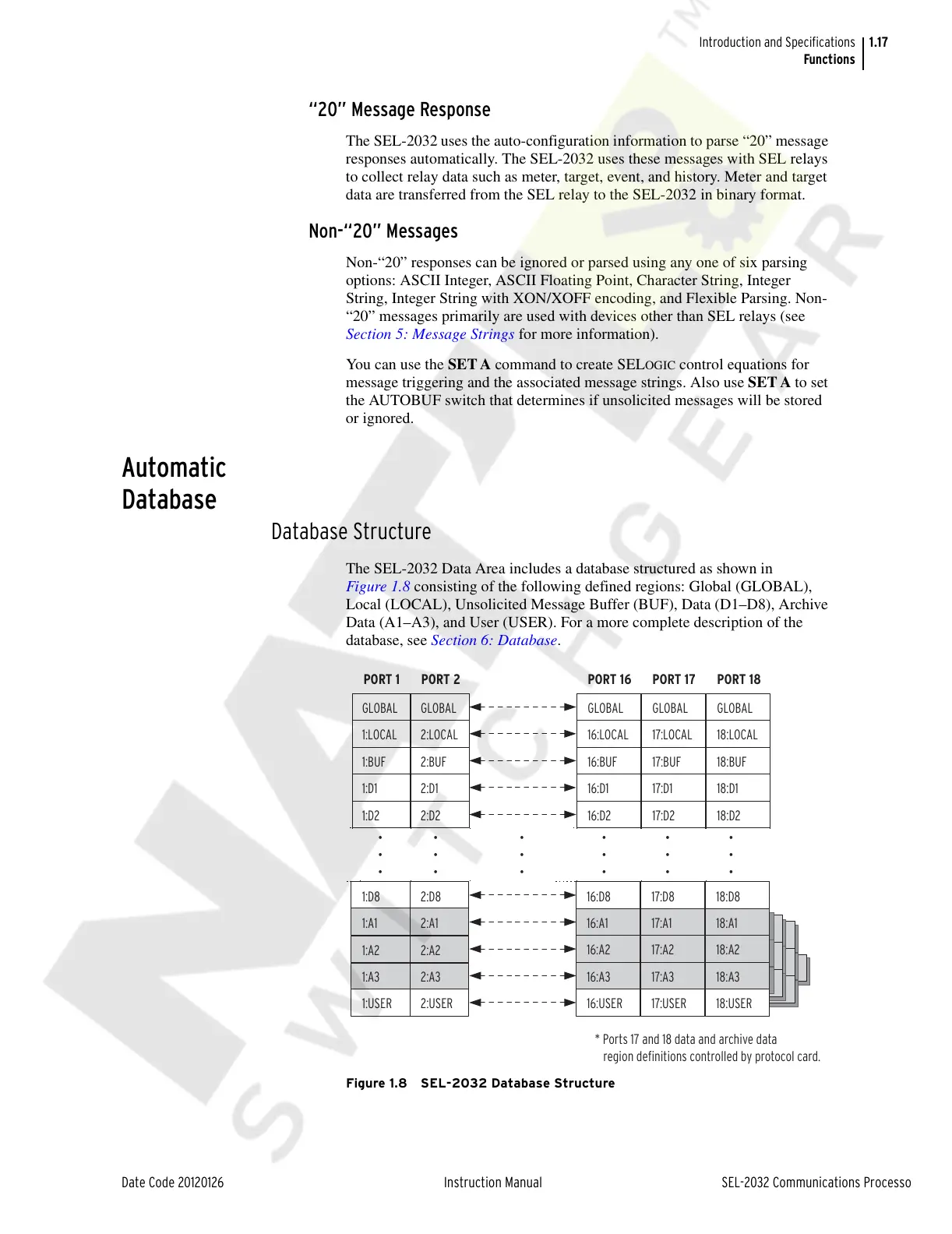
The SEL-2032 Data Area includes a database structured as shown in
Figure 1.8 consisting of the following defined regions: Global (GLOBAL),
Local (LOCAL), Unsolicited Message Buffer (BUF), Data (D1–D8), Archive
Data (A1–A3), and User (USER). For a more complete description of the
database, see Section 6: Database.
Figure 1.8 SEL-2032 Database Structure
2:D8
2:A1
2:A2
2:A3
2:USER
1:D8
1:A1
1:A2
1:A3
1:USER
GLOBAL
1:LOCAL
1:BUF
1:D1
1:D2
PORT 1
GLOBAL
2:LOCAL
2:BUF
2:D1
2:D2
PORT 2
GLOBAL
16:LOCAL
16:BUF
16:D1
16:D2
16:D8
16:A1
16:A2
16:A3
16:USER
PORT 16
GLOBAL
17:LOCAL
17:BUF
17:D1
17:D2
17:D8
17:A1
17:A2
17:A3
17:USER
PORT 17
GLOBAL
18:LOCAL
18:BUF
18:D1
18:D2
18:D8
18:A1
18:A2
18:A3
18:USER
PORT 18
* Ports 17 and 18 data and archive data
region definitions controlled by protocol card.
•
•
•
•
•
•
•
•
•
•
•
•
•
•
•
•
•
•
Courtesy of NationalSwitchgear.com


 To Next Page