7.18
SEL-2032 Communications Processor Instruction Manual Date Code 20120126
Settings
Automatic Message (SET A) Settings
Search Strings. A Search String in the Decode Expression instructs the
SEL-2032 to search the incoming message for an exact match or until the
message acquisition times out. Use any keyboard character in a string. A
Search String may be specified with either a preceding ampersand (&) or a
comma as shown below.
SExp = ‘str’
SExp = & ‘str’
SExp = , ‘str’
A preceding ampersand causes the SEL-2032 to search the incoming string for
an exact match to the Search String. If the Search String is found, the previous
Decode Expression is evaluated. If the Decode Expression is successfully
parsed before the Search String is found, the Search String is treated as a
Search String with a preceding comma. When using the ampersand, the
Search String has precedence over the preceding Decode Expressions.
A preceding comma causes the SEL-2032 to evaluate all expressions in the
specified order. If an expression before the search string fails, and then the
Search String is found, the parser continues parsing after finding the Search
String.
The Search String allows characters in hexadecimal format using \0xx (where
xx is a hexadecimal number represented by ASCII characters). Null characters
(\000) and single quotes are not allowed within Search Strings. The following
string is an example of a Search String. See Table 7.3 for reserved labels.
‘Text’, I, F& ‘str’
In this example, the parser searches for the ‘Text’ string, then it parses the next
integer and floating-point value. While evaluating the floating-point value, the
parser is also searching for the ‘str’ Search String. If ‘str’ is found before the
floating-point, the floating-point value is reset. See Tabl e 7.4 for the data type
reset values.
Database Storage and Parsing Rules
After successful setting creation, the database storage is reserved. After
receipt and parsing of the first response, the database region is valid regardless
of the success or failure of the data parsing. This allows you to view the
database region and aids in troubleshooting the Decode Equation.
An element is parsed successfully if the first character evaluated is within the
ranges specified in Table 7.4 for each data type. Once a valid character is
found, all valid characters are read and stored until the maximum number of
characters is read or an invalid character is found.
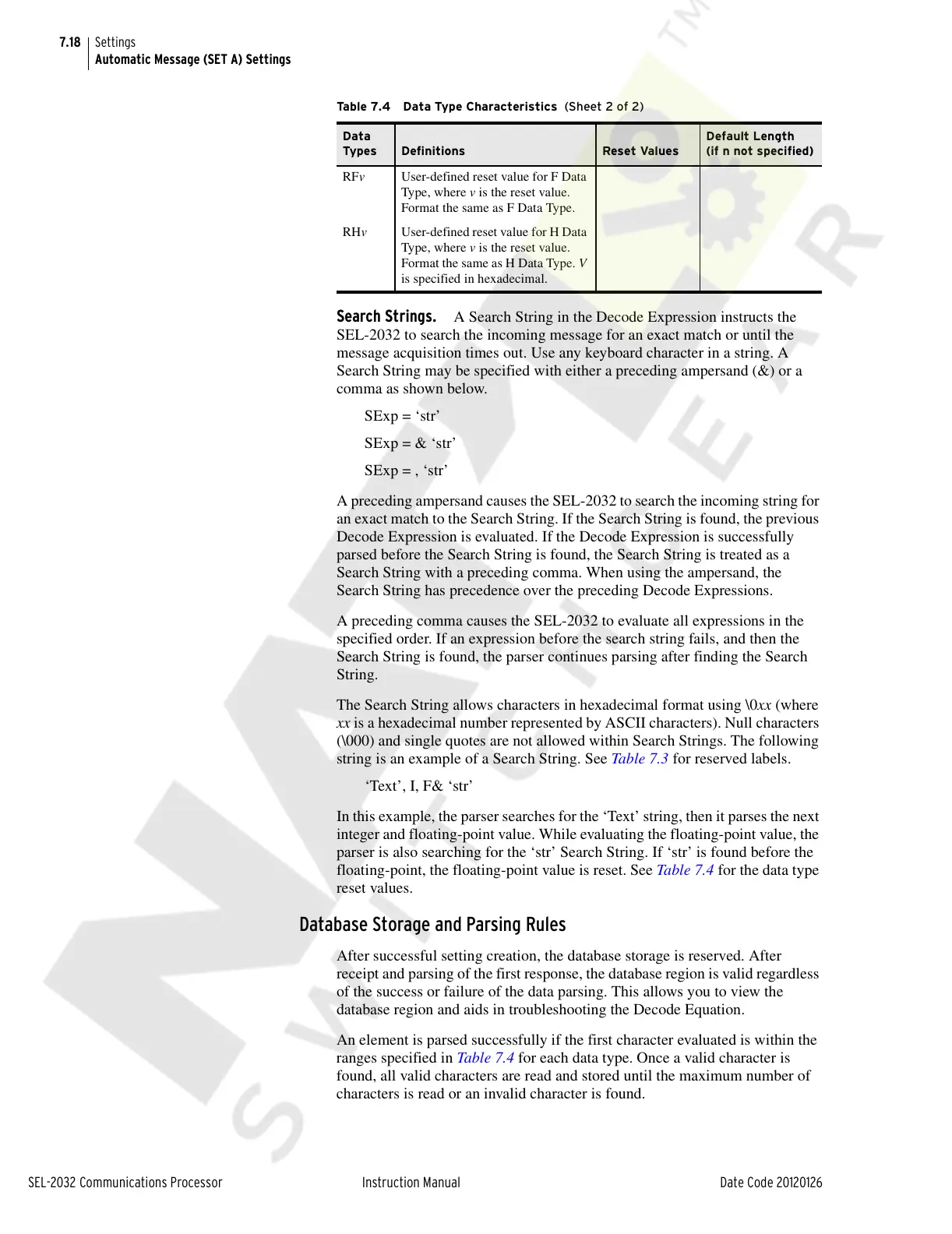
RFv User-defined reset value for F Data
Type, where v is the reset value.
Format the same as F Data Type.
RHv User-defined reset value for H Data
Type, where v is the reset value.
Format the same as H Data Type. V
is specified in hexadecimal.
Table 7.4 Data Type Characteristics (Sheet 2 of 2)
Data
Types
Definitions Reset Values
Default Length
(if n not specified)
Courtesy of NationalSwitchgear.com


 To Next Page