9.39
Date Code 20120126 Instruction Manual SEL-2032 Communications Processor
Protocols
Serial Distributed Network Protocol (Serial DNP3)
Internal Indication Object
Within the Internal Indications (IIN) object, the bits are used as specified
within the DNP3 standard. When TIME_SRC is equal to DNP3 within the
Global settings, the SEL-2032 requests time synchronization every 15
minutes. Bit 4 within the IIN object will be set and remain set until the
SEL-2032 receives a time synchronization. If the SEL-2032 receives a time
synchronization, it will clear the bit and then set it again 15 minutes later. The
SEL-2032 does not have local/remote states, so the local/remote bit indicates
whether or not SEL
OGIC control equations are running. If SELOGIC control
equations are not running, the status is indicated as local since the DNP3 data
will not be updated by SET M while SEL
OGIC control equations are not
running.
Timing
Maximum data-link response time (without confirmation): 150 ms.
Maximum class 0 request response time (without confirmation): 300 ms.
Maximum data-link confirm time: 150 ms.
Maximum application confirm time (without data-link confirmation): 50 ms.
Time
Synchronization
When TIME_SRC is equal to DNP3 within the Global settings, you can
perform Time Synchronization via DNP3 by executing a write to the Date/
Time object (object 50). The DNP3 protocol assumes that the time value sent
by the master device is the time at which the first bit of the first byte of the
write request is received by the slave (SEL-2032). It is the responsibility of the
master to account for transmission delay between sending the request and the
SEL-2032 receipt of the request. In many systems this transmission delay will
be 0. For example, in a simple point-to-point connection, the moment the first
bit is transmitted by the master, it is received by the slave device. In
configurations where the communication link may introduce delays, the
master may perform a delay measurement command and then calculate the
transmission delay based on the result of the delay measurement. The master
can then add this calculated transmission delay time to the time value that it
sends to the SEL-2032 when it writes the time. When time synchronization is
performed, the SEL-2032 will synchronize itself to within 5 ms (+3/–2) of the
given time. When the delay measurement command is performed, the value
reported by the SEL-2032 is accurate to 10 ms (+5/–5). So, disregarding errors
external to the SEL-2032, a time synchronization that uses a Delay
Measurement calculation is accurate to within 15 ms (+8/-7).
Event Data
The SEL-2032 generates DNP3 event data in one of two ways. For devices
that support the SEL Fast SER protocol, the SEL-2032 processes incoming
SER data to provide DNP3 events (Object 2 data) with time stamps generated
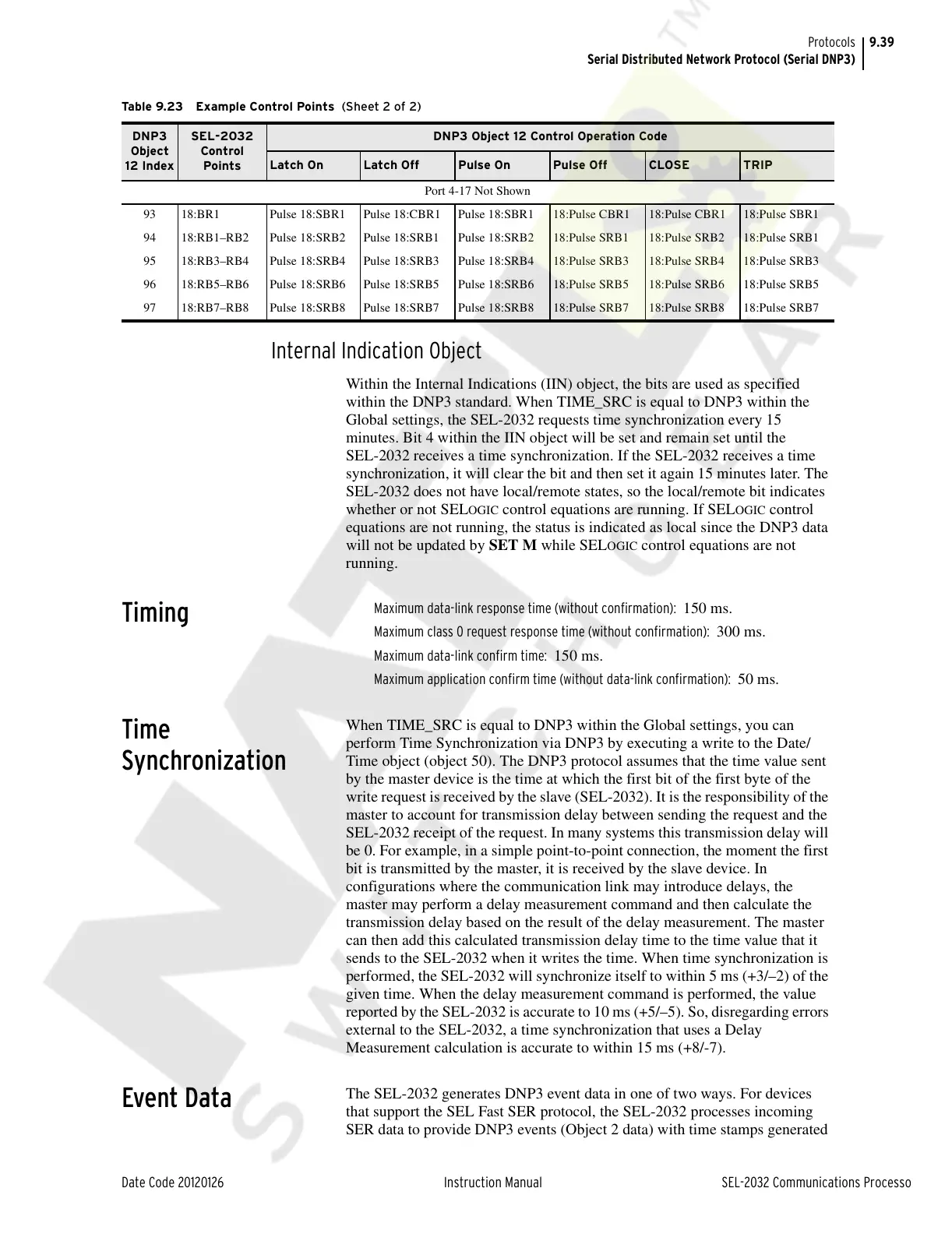
Port 4-17 Not Shown
93 18:BR1 Pulse 18:SBR1 Pulse 18:CBR1 Pulse 18:SBR1 18:Pulse CBR1 18:Pulse CBR1 18:Pulse SBR1
94 18:RB1–RB2 Pulse 18:SRB2 Pulse 18:SRB1 Pulse 18:SRB2 18:Pulse SRB1 18:Pulse SRB2 18:Pulse SRB1
95 18:RB3–RB4 Pulse 18:SRB4 Pulse 18:SRB3 Pulse 18:SRB4 18:Pulse SRB3 18:Pulse SRB4 18:Pulse SRB3
96 18:RB5–RB6 Pulse 18:SRB6 Pulse 18:SRB5 Pulse 18:SRB6 18:Pulse SRB5 18:Pulse SRB6 18:Pulse SRB5
97 18:RB7–RB8 Pulse 18:SRB8 Pulse 18:SRB7 Pulse 18:SRB8 18:Pulse SRB7 18:Pulse SRB8 18:Pulse SRB7
Table 9.23 Example Control Points (Sheet 2 of 2)
DNP3
Object
12 Index
SEL-2032
Control
Points
DNP3 Object 12 Control Operation Code
Latch On Latch Off Pulse On Pulse Off CLOSE TRIP
Courtesy of NationalSwitchgear.com


 To Next Page