38477BA2B
7 – 694 25.5.09
5 Functional Processes Volume 7
5.4 Damping
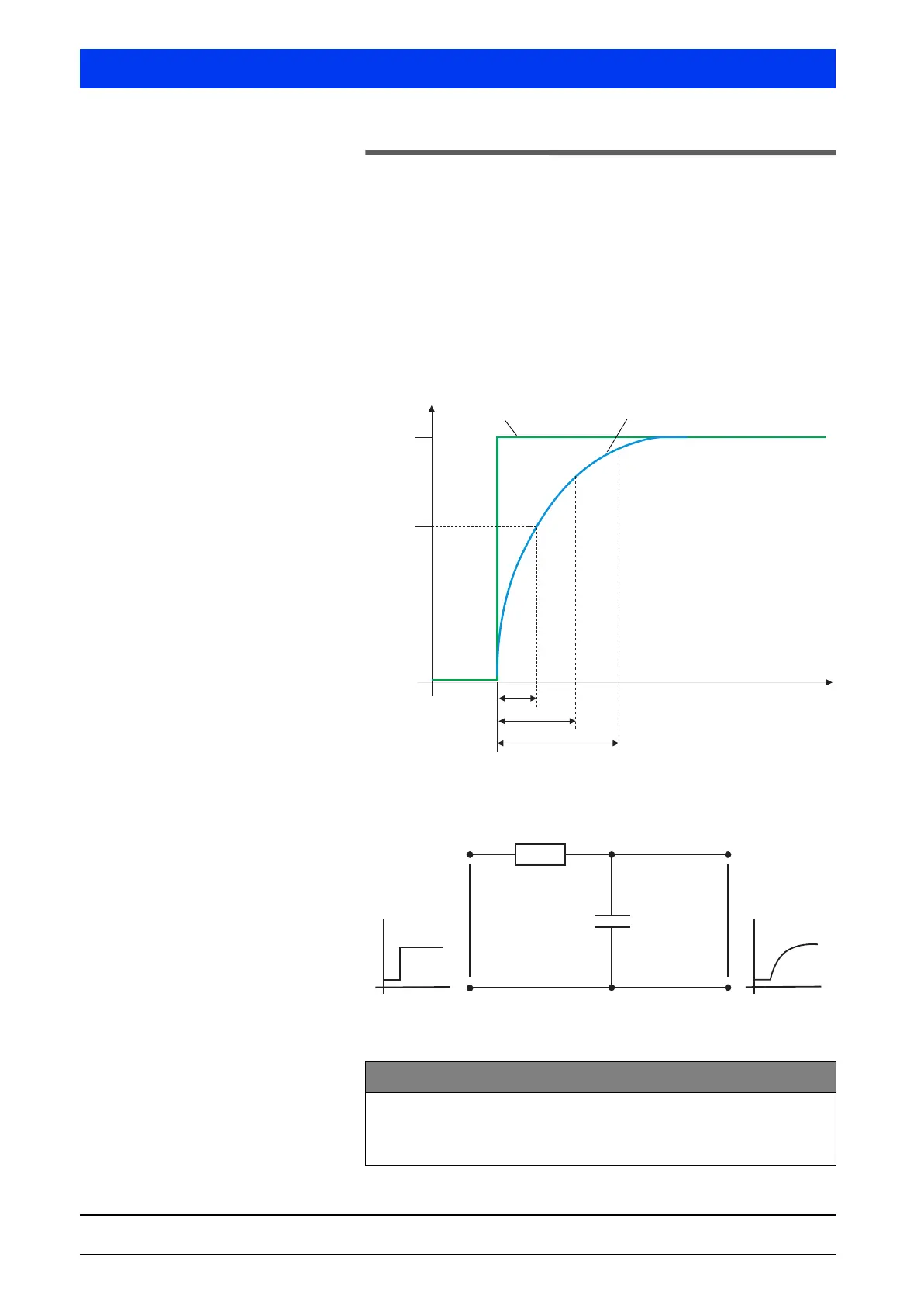
The illustration below shows the reaction of the output signal of the
Uni-Probe in case of erratic filling of the vessel (input change) and
a time constant of t: the output signal reaches the final output
value (100%) only after a time that is more than three times as
high as the time constant. Statistical fluctuations, as well as pro-
cess-immanent level fluctuations, e.g. caused by agitators, can be
smoothed.
A time constant of less than 20 seconds is required only in rare
cases, but it is dependent on the conditions on site (type and size
of disturbances).
1 x τ = single measurement time - standard: 20s
3 x
τ = virtually corresponds to the end value
The time constant corresponds in its function to an RC element.
Figure 5-1 Effect of the time constant on damping
Parameters used
LE_DAMPING
LE_DAMPING_TIME_CONSTANT
LE_DAMPING_FAST_SWITCH
LE_DAMPING_FAST_SWITCH_THRESHOLD
Input change
Output signal Uni-Probe
100%
64%
0%
Signal height
1τ
2τ
3τ
t


 To Next Page